
Ships and rigging, an explanatory article about different kind of rigs and ships, nautical terms like the "tween deck", and so on
Commercial lasts - Burden - Tonnage
Bark
Ship
Brig
Schooner
Between Deck - Steerage
Burden - Commercial lasts - Tonnage
"Kommerselester" or "Commercial lasts", is a measurement for the inside volume of the ship. It was recognized as the ships burthen or burden. 1 Norwegian Commercial last = 2,08 register ton = 165 Cu ft of cut board or I30 cu, ft of round timber.
There were restrictions on how many passengers a ship could carry. This is what the US Passenger Act of 1819 says about this.
SEC.1. Be it enacted by the Senate and House of Representatives of the United States of America, in Congress assembled. That if the master or other person on board of any ship or vessel, owned in the whole or in part by a citizens of the United States, or the territories thereof, or by a subject or subjects, citizen or citizens, of any foreign country, shall, after the first day of January next, take on board of such ship or vessel, at any foreign port or place, or shall bring or convey into the United States, or the territories thereof, from any foreign port or place; or shall carry, convey, or transport, from the United [States] or the territories thereof, to any foreign port or place, a greater number of passengers than two for every five tons of such ship or vessel, according to custom house measurement, every such master, or other person so offending, and the owner or owners of such ship or vessels, shall severally forfeit and pay to the United States, the sum of one hundred and fifty dollars, for each and every passenger so taken on board of such ship or vessel over and above the aforesaid number of two to every five tons of such ship or vessel; to be recovered by suit, in any circuit or district court of the United States, where the said vessel may arrive, or where the owner or owners aforesaid may reside: Provided, nevertheless, That nothing in this act shall be taken to apply to the complement of men usually and ordinarily employed in navigating such ship or vessel.
And from the British Passenger Act of 1828
...That no Ship shall sail from any Port or Place in the United Kingdom, or in the Islands of Guernsey, Jersey, Alderney, or Sark, or in the Isle of Man, on any Voyage to or for any Port or Place in His Majesty's Possession on the Continent or Islands of North America, with more Persons on board than the Proportion of Three Persons for every Four Tons of the Registered Burthen of such Ship....
And here from the Norwegian passenger act of May 23rd, 1863. - Transportation of passengers to foreign parts of the world:
§1
No vessel, that is intended to transport passengers from a Norwegian port, to countries outside Europe, must carry more than one adult passenger, hereunder master crew and cabin passengers included, for each Commercial last of burden,§2
The available space for each adult passenger must not be less than 12 ft² on the upper between deck, and on the lover between deck not less than 30 ft². If the ship is carrying other cargo in addition to the passengers...
Dimensions like length (L), beam (B) and depth (D) for ships are most often given in feet.
A ship’s recorded tonnage (burden) could vary between measurements, depending on its internal arrangements at the time or on alterations to the vessel.
Before the 1850s: Builder’s Old Measurement / Gammel Læst (old last)
Tonnage was calculated using a simple formula based on the ship’s length and maximum breadth: Length × Breadth × Breadth / 188. This system did not measure the actual internal volume of the hull. The second "Breadth" was used as a proxy for Depth.
Measuring a ship's actual depth inside the hold was difficult when loaded or afloat, so custom officials assumed a ship's depth was roughly half its breadth. Because breadth was squared, wider ships were heavily penalized with higher taxes. Shipbuilders responded by designing dangerously narrow, deep, and unstable ships to bypass the law until the system was replaced in 1854.
The Moorsom System, 1854
In 1854, Britain introduced the Moorsom system under the Merchant Shipping Act 1854. It soon became the international standard, and Norway adopted it in 1875–1876. The system introduced the register ton, equivalent to 100 cubic feet, or approximately 2.83 cubic meters. As new legislation and international agreements came into force during this period, existing vessels were remeasured. A ship built in 1840 could therefore receive a substantially different official tonnage after remeasurement in the 1850s or 1870s, even without any physical alterations.
From the mid-nineteenth century onward, steamships gradually replaced sailing vessels. To encourage steam navigation, authorities allowed deductions from measured tonnage for spaces devoted to propulsion, including engine rooms, boilers, and coal bunkers. This distinction gave rise to two important terms:
Gross register tonnage (GRT): The total internal volume of the ship’s enclosed spaces.
Net register tonnage (NRT): The volume available for earning revenue, including cargo holds and passenger accommodation, after deductions for machinery spaces, crew accommodation, and spaces used for navigation.
Ship types - rigging of sailing vessels:
This introduction does not include steamships (S/S). Note: the abbreviation S/S, S.S., or SS for steamship in English, is often used for sailing-ship (Seilskib or Seilskib) in Norway. The Norwegian abbreviation for steamship is D/S (Dampskib)
Bark - Barque (Norw: Bark) |
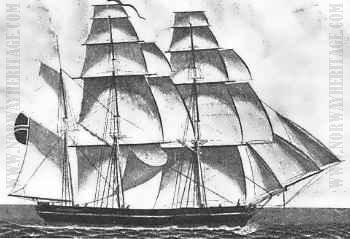
|
Ship (Norw: Skib, Skip, Fregattskib, or Fullrigger) |
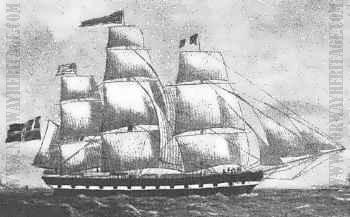
NOTE: in some cases when working with the different sources the term ship (or skib) can be used in the meaning "vessel", and not actually used to a specify the kind of rigging. This may cause some errors to be made when describing the rigging of ships |
Brig (Norw: Brigg) |
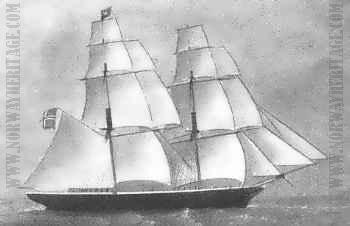
|
Schooner (Norw: Skonnert) |
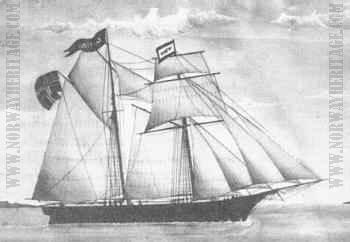
|
Between Deck - Steerage (Norw: Mellomdekk or Mellemdekk)
The "steerage," or between-deck (often shortened to "tween-deck"), was originally the deck located immediately below the main deck of a sailing ship. (In Norwegian: Mellomdekk or Mellemdekk.)
In the early days of emigration, the ships used to transport emigrants were originally built for carrying cargo. In practice, passengers were placed in the cargo hold. Temporary partitions were typically erected to create steerage accommodations. To access the between-deck, passengers often had to use ladders, and the passageways between the hatches were frequently narrow and steep.
On the great ocean steamships, the term "steerage" referred to any part of the ship designated for passengers traveling at the cheapest rate, typically located on the lower decks. In the United States Passenger act of 1882 the definition of "steerage passengers" is quite clearly defined as:
"The expression "steerage passenger" means all passengers except cabin passengers, and persons shall not be deemed cabin passengers unless the space allotted to their exclusive use is in the proportion of at least thirty-six clear superficial feet to each passenger."
Leave a Comment
Comments are reviewed before they appear publicly. Fields marked with * are required.