
The cooperation between the competing companies was not always smooth. In 1870 there was quite a newspaper campaign between the agent of the Anchor Line and the Allan Line
Competition Between the Allan Line and the Anchor Line
Competition for emigrant passengers in the early years of mass emigration was intense, and the advertisements placed by the various shipping lines and their agents sometimes led to public disputes. In 1869 and 1870, such a disagreement developed between the local representatives of the Allan Line and the Anchor Line in the Norwegian town of Trondheim. Trondheim was the port of departure for emigrants from all of Norway north of the Dovre Mountains and from parts of Sweden. Emigrants from Finland also traveled through Trondheim.
The following advertisements, published in Trondhjems Adressecontors Efterretninger, provide an unusual glimpse into this rivalry. They show how the two lines competed for passengers while, at the same time, depending on arrangements that allowed emigrants booked by one company to travel aboard ships operated by another.
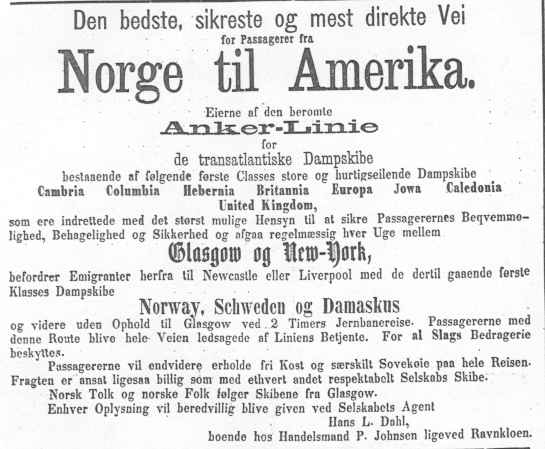
The best and safest route for passengers from Norway to America
The owners of the famous Anker-Linie (Anchor Line), whose transatlantic fleet consists of the following large, fast, first-class steamships: Cambria, Columbia, Hebernia, Britannia, Europa, Jowa [Iowa], Caledonia, and United Kingdom, all carefully equipped to provide for the comfort and safety of passengers, maintain regular weekly sailings between Glasgow and New York. Emigrants will be conveyed from here to Newcastle or Liverpool aboard the first-class steamships Norway, Sweden, and Damascus, and from there to Glasgow by train, a journey of two hours, without unnecessary delay.
Passengers traveling by this route will at all times be assisted by the Line's agents and protected against all kinds of fraud. Passengers will receive free meals and an individual berth throughout the entire journey. The fare is as inexpensive as that offered by any other reputable line. A Norwegian interpreter will accompany the ships from Glasgow. Further information may be obtained from the Line's agent, Hans L. Dahl, staying with merchant P. Johnsen at Ravnkloen.
The Anchor Line announcement was immediately followed by an announcement from the Allan Line agent, and in the same newspaper the Anchor Line responded again:
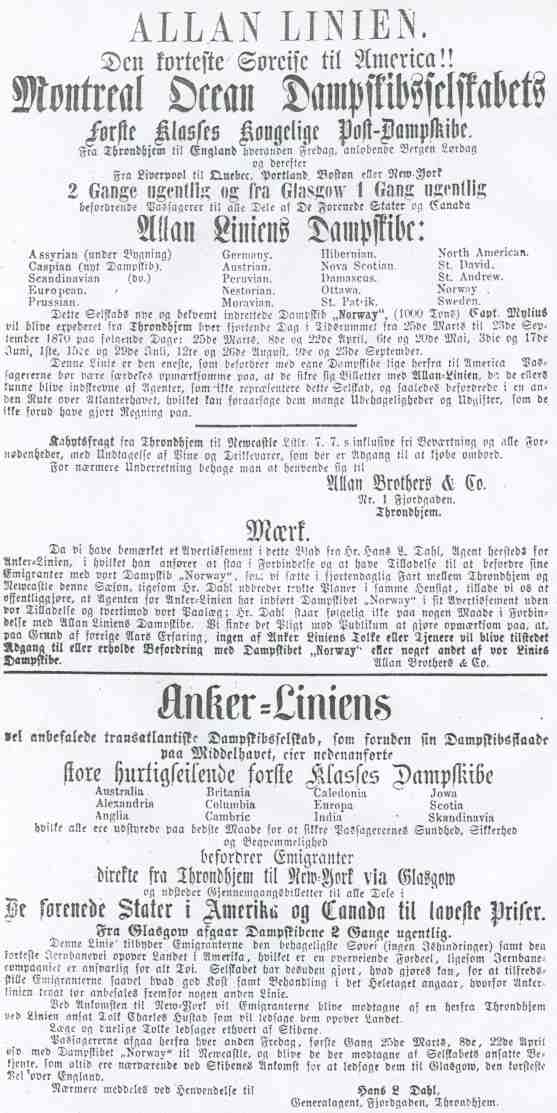
Allan Line and Anchor Line announcements published in the newspaper Trondhjems Adressecontors Efterretninger on March 1, 1870:
Allan Linien. The shortest sea voyage to America!!
Montreal Ocean Steamship Company's first-class Royal Mail steamers.
From Trondhjem to England every second Friday, calling at Bergen on Saturday, and from Liverpool to Quebec, Portland, Boston, or New York twice a week, as well as once a week from Glasgow. The company conveys passengers to all parts of the United States and Canada.
The Allan Line's steamships: Assyrian (under construction) - Caspian (new ship) - Scandinavian (new ship) - European - Prussian - Germany - Austrian - Peruvian - Nestorian - Moravian - Hibernian - Nova Scotian - Damascus - Ottawa - St. Patrick - North American - St. David - St. Andrew - Norway - Sweden.
The company's new and comfortably equipped steamship Norway (1,000 tons), Captain Mylius, will depart from Trondhjem every fourteen days between March 25 and September 23, 1870, on the following dates: March 25; April 8 and 22; May 6 and 20; June 3 and 17; July 1, 15, and 29; August 12 and 26; and September 23. This is the only line that conveys passengers aboard its own steamships from here all the way to America. Passengers should therefore make sure that they obtain tickets for the Allan Line. Otherwise, they may be booked by agents who do not represent this company and consequently be sent across the Atlantic by another route, causing considerable inconvenience and expenses that they had not anticipated. Cabin fare from Trondhjem to Newcastle: £7 7s., including full board and all necessities, except wine and other beverages, which may be purchased on board.
For further information, contact Allan Brothers & Co., No. 1 Fjordgaden, Trondhjem.
NOTE
It has come to our attention that Mr. Hans L. Dahl, the local agent for the Anchor Line, has published an announcement in this newspaper in which he claims to be associated with us and to have permission to convey his emigrants aboard our steamship Norway, which we intend to operate every second week between Trondhjem and Newcastle during the coming season. Mr. Dahl has made the same claim in printed advertisements.
We therefore take this opportunity to make it known that the Anchor Line agent has included the steamship Norway in his advertisements without our permission and despite our requests that he refrain from doing so. Mr. Dahl has no association whatsoever with the Allan Line steamships.
In view of our experiences last year, we consider it our duty to inform the public that no Anchor Line agents, interpreters, or clerks will be permitted to board or travel aboard the steamship Norway or any other Allan Line steamship.
Allan Brothers & Co.
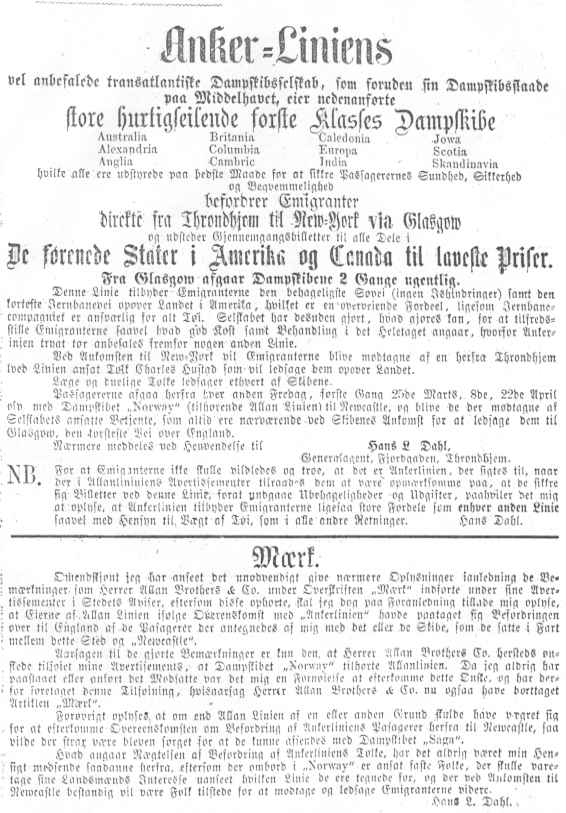
The Anchor Line Responds to the Allan Line
Anchor Linien. This well-recommended transatlantic steamship company, which in addition to its fleet of steamships in the Mediterranean owns the following large, fast, first-class steamships: Australia - Alexandria - Anglia - Britannia - Columbia - Cambric - Caledonia - Europa - India - Jowa [Iowa] - Scotia - Scandinavia, all carefully equipped to provide for the health, safety, and comfort of passengers, will convey emigrants directly from Trondhjem to New York via Glasgow and will issue tickets to all parts of the United States of America and Canada at the lowest prices.
There are departures from Glasgow twice a week. This line offers emigrants a particularly comfortable sea voyage, without problems caused by ice, as well as the shortest railway journey to destinations inland in America. This is a considerable advantage, and the railway company assumes responsibility for all luggage.
The company has furthermore done everything possible to meet the needs of emigrants with regard to food and treatment, and for this reason the Anchor Line is recommended in preference to any other line.
Upon arrival in New York, the emigrants will be met by Charles Hustad, an interpreter originally from Trondhjem, who will assist them on their journey inland. Physicians and competent interpreters sail aboard each ship.
Departures from Trondhjem will take place every second Friday, beginning March 25, followed by April 8 and 22, and so forth, aboard the steamship Norway (belonging to the Allan Line) to Newcastle. There they will be met by representatives of the Line, who will be present when the ship arrives and will escort the emigrants by the shortest route across England to Glasgow.
Further information may be obtained from the Line's agent, Hans L. Dahl, General Agent, Fjordgaden, Trondhjem.
NB: To prevent emigrants from being misled into believing, on the basis of the NOTE in the Allan Line advertisements, that they must purchase tickets from that company in order to avoid inconvenience and additional expense, I wish to point out that the Anchor Line offers emigrants advantages equal to those offered by any other line, both with regard to the allowance of luggage and in all other respects.
Hans Dahl
NOTE
Although I believe it should be unnecessary to provide any further explanation concerning the accusations made by Messrs. Allan Brothers & Co. under the heading "NOTE" in the newspapers, since these notices have now been discontinued, I nevertheless wish to take this opportunity to make the following facts known.
The owners of the Allan Line and the Anchor Line have entered into an agreement under which Anchor Line passengers are to be conveyed to England aboard the Allan Line steamships placed in service between this port and Newcastle.
The reason for the accusations was simply that Messrs. Allan Brothers & Co. here wished me to state in my advertisements that the steamship Norway belonged to the Allan Line. As I have never claimed or stated otherwise, I was pleased to comply with this request and have now added this information to my advertisements. Messrs. Allan Brothers & Co. have likewise removed the "NOTE" from their advertisements.
I would also point out that, had the Allan Line not fulfilled its agreement to convey Anchor Line passengers from this port to Newcastle, arrangements would immediately have been made to convey them aboard the steamship Saga.
As for the statement that Anchor Line interpreters would not be permitted aboard Allan Line steamships, I can only say that this was never intended, since interpreters are already employed aboard the Norway. Their duty is to look after the interests of their countrymen, regardless of which line the passengers have purchased their tickets from. Upon arrival at Newcastle, other representatives will also be present to assist the emigrants.
Competition and Cooperation in the Emigrant Trade
The exchange between the Allan Line and the Anchor Line provides an interesting insight into the competitive emigrant business in Trondheim around 1870. The advertisements gave the impression of competing, self-contained routes to America, but the actual transportation system was considerably more interconnected.
The Anchor Line did not operate its own feeder steamships from Trondheim and therefore depended on other carriers for the first stage of the journey. According to Hans L. Dahl, an agreement existed under which Anchor Line passengers could be conveyed to Newcastle aboard Allan Line steamships. This meant that emigrants who had purchased an Anchor Line ticket could begin their journey aboard the Norway, a vessel belonging to one of the Anchor Line's principal competitors.
The disagreement therefore appears to have concerned not only the transportation itself, but also how this arrangement was presented to prospective emigrants. Allan Brothers & Co. objected strongly to Dahl advertising the Norway without explicitly identifying it as an Allan Line vessel. Dahl subsequently added the words "belonging to the Allan Line" to his advertisement, while maintaining that the agreement entitled him to send Anchor Line passengers aboard the ship.
The dispute also illustrates the importance of controlling and assisting emigrants during their journey. Agents, interpreters, luggage arrangements, meals, railway connections, and protection against fraud all featured prominently in the advertisements. The companies were not simply selling an Atlantic crossing. They were selling a complete transportation service intended to take the emigrant from Trondheim through Britain and across the Atlantic, and in many cases onward to a final destination in the United States or Canada.
The advertisements consequently reveal an emigrant business characterized by both fierce competition and practical cooperation. Rival companies competed vigorously for the same passengers, yet they could also depend upon one another for individual stages of the journey. For the emigrant, the "line" named on the ticket did not necessarily correspond to a single shipping company operating the entire route. Behind the advertised journey to America was a network of shipping companies, local agents, feeder steamships, railways, interpreters, and connecting services that together made the transatlantic journey possible.
The organization and coordination of feeder services for emigrants between the Scandinavian ports and England was eventually resolved when the Wilson Line reached agreements with the transatlantic shipping companies to provide this part of the journey. This developed in strong competition with local steamship companies, which proved too small to meet the overall demand.
Leave a Comment
Comments are reviewed before they appear publicly. Fields marked with * are required.