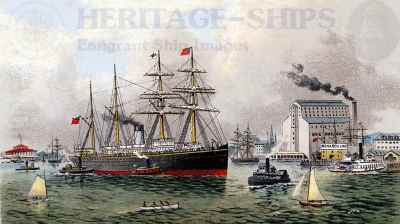
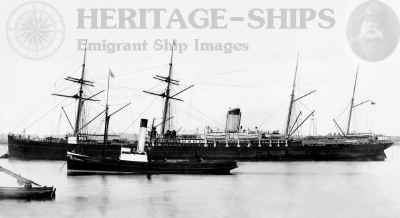
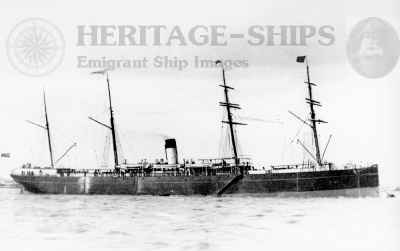
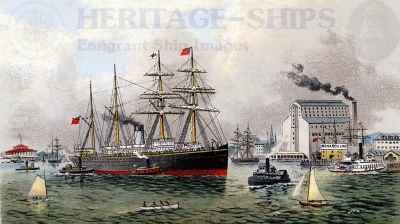
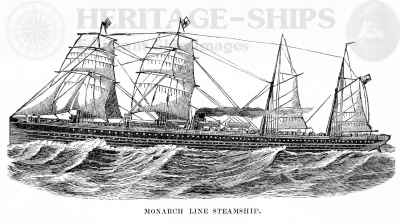
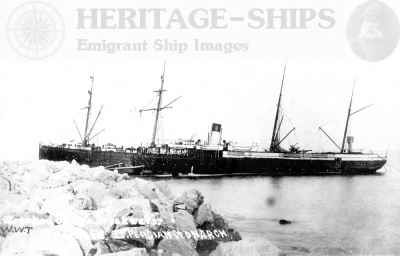
The Monarch Line, officially the Royal Exchange Shipping Company Limited, was a relatively short-lived British participant in the North Atlantic emigrant trade. The company began operations in the early 1870s with sailing ships employed mainly in the Mediterranean and Far Eastern trades. Its first steamships entered service in 1875–76, and the name Monarch Line came from the practice of giving its ships names ending in Monarch.
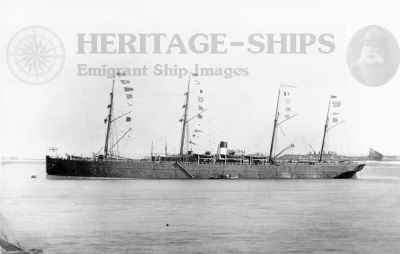
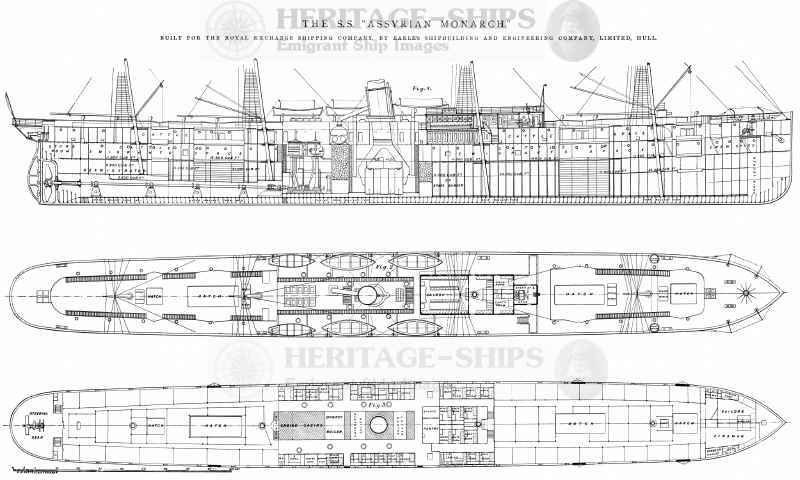
In 1879, the company decided to establish a passenger and cargo service between London and New York and ordered four large steamships for the new route. The first, the 3,300-ton Assyrian Monarch, was launched in August 1880. She was followed by the Persian Monarch, Egyptian Monarch and Lydian Monarch, while the larger Grecian Monarch entered service in 1882.
The new service was aimed strongly at the emigrant trade. In 1881, the four principal passenger steamships made 17 round voyages and landed 3,667 steerage passengers at New York, compared with only 255 first-class passengers. Traffic increased substantially in 1882, when the number of westbound passengers reached about 8,800, an average of approximately 440 passengers per voyage.
The Monarch Line in Norway
The Monarch Line also competed for Norwegian emigrant traffic. Norwegian advertisements show that passengers were offered regular departures to New York via London, with connecting transportation from Norway arranged as part of the journey.
One advertisement announced departures from Norway every Thursday and emphasized an important advantage of the route: passengers traveled via London and thereby avoided the railway journey across England that was required when traveling through Hull and Liverpool with many of the competing British lines. Until April, departures were to be approximately fortnightly, after which a regular weekly service was advertised.
The line competed strongly on price, advertising its fares as lower than those of any other British line.
Another Norwegian advertisement promoted the Monarch Line specifically to emigrants, describing its steamships as large, fast and particularly well equipped for emigrant passengers. The advertisement also emphasized that the transatlantic steamships sailed directly from England to New York without calling at an Irish port.
The company's Norwegian advertising further stated that the Monarch Line maintained agents at the principal destinations in America to whom newly arrived emigrants could turn for assistance. Tickets could also be purchased from America, indicating that the agency network handled prepaid passage as well as tickets purchased in Norway.
For Norwegian emigrants, the service therefore offered an alternative to the more established routes through Liverpool. The principal selling point was the connection through London, which eliminated the overland railway journey between Hull and Liverpool.
Ships and Accommodation
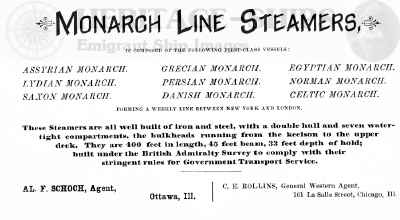
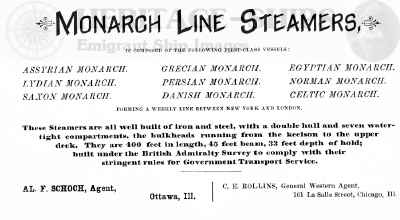
Advertisemant for the Monarch Line Steamers — Buy a copy
A contemporary Monarch Line advertising card listed nine steamships: the Assyrian Monarch, Lydian Monarch, Saxon Monarch, Grecian Monarch, Persian Monarch, Danish Monarch, Egyptian Monarch, Norman Monarch and Celtic Monarch. Not all of these vessels, however, formed part of the regular London–New York passenger service. Some were normally employed in the company's other trades, although the Saxon Monarch and Celtic Monarch also made a few voyages on the New York route.
The principal passenger steamships employed between London and New York were the Assyrian Monarch, Persian Monarch, Egyptian Monarch, Lydian Monarch and, from 1882, the Grecian Monarch. The first four had been ordered specifically for the new transatlantic service established by the company.
Company advertising placed considerable emphasis on the construction and safety of its steamships. They were described as iron or steel vessels with double hulls and seven watertight compartments and as having been built under British Admiralty supervision to meet the requirements for government transport service. These descriptions formed part of the company's promotional material and should therefore be understood as its own presentation of the vessels.
The passenger capacity of the principal transatlantic steamships demonstrates the importance of the emigrant trade to the company. The Assyrian Monarch, Persian Monarch, Egyptian Monarch and Lydian Monarch each accommodated about 40 first-class passengers and as many as 1,000 steerage passengers. The Grecian Monarch had accommodation for 40 first-class, 60 intermediate and 1,000 steerage passengers.
Norwegian advertising also claimed that the company had received a gold medal at a ship-model exhibition in London in 1882 for the model upon which the Grecian Monarch had been built. As this information comes from the company's own advertising, it is best understood as part of the way the line promoted the quality of its ships to prospective emigrants.
A Short-Lived Atlantic Service
Despite the rapid growth in passenger traffic during the first years, the Monarch Line's success proved short-lived. Business remained satisfactory in 1883, despite new competition, but a severe decline followed. By 1885, the average number of passengers had fallen to fewer than 50 per voyage. Traffic improved somewhat in 1886, partly because the National Line had ceased carrying passengers from London, but the recovery was insufficient to save the company.
The Royal Exchange Shipping Company went into liquidation, and its fleet was disposed of during the summer of 1887. Several of the ships subsequently continued carrying North Atlantic passengers under new owners. The Assyrian Monarch became the Allan Line's Assyrian, while the Grecian Monarch became the Allan Line's Pomeranian. The Persian Monarch, Egyptian Monarch and Lydian Monarch were acquired by the Wilson Line.
Thus, although the Monarch Line's New York passenger service lasted only a few years, it briefly became a significant competitor for the emigrant trade and established an agency network in Norway. Its route through London offered Norwegian emigrants an alternative to the familiar journey through Hull and Liverpool, while its ships were designed to carry very large numbers of steerage passengers relative to their first-class accommodation.