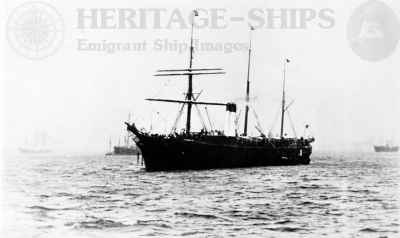
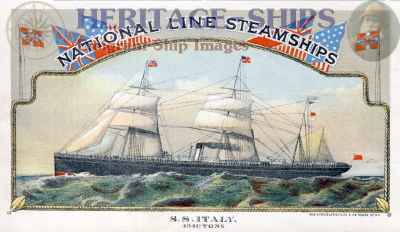
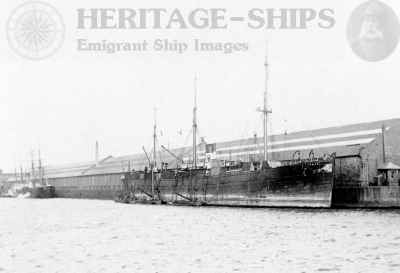
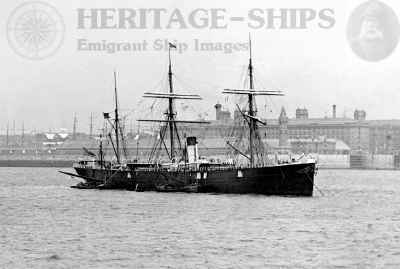
The National Steam Navigation Company Limited was founded in the autumn of 1863. Its immediate objective was to establish steamship services from Liverpool and London to New York, while services to the southern United States and Brazil were also contemplated. In 1867 the company was reorganized as the National Steamship Company Limited, although it was generally known simply as the National Line.
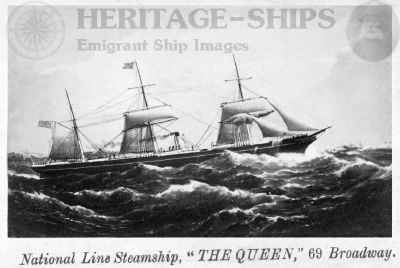
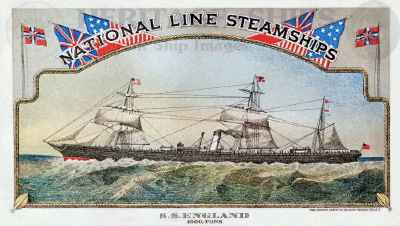
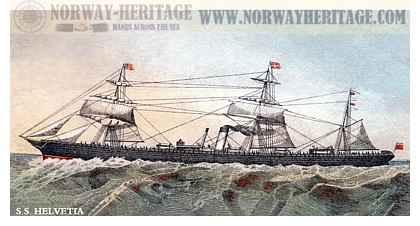
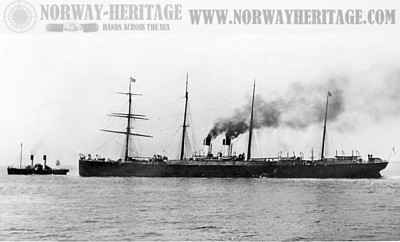
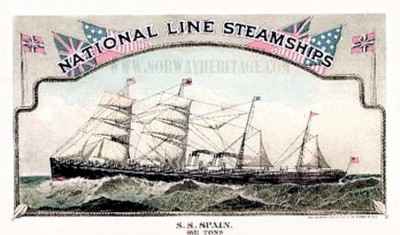
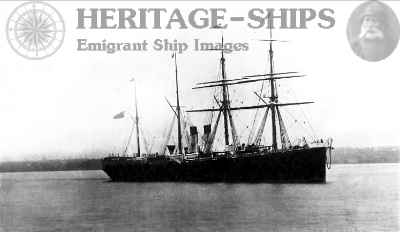
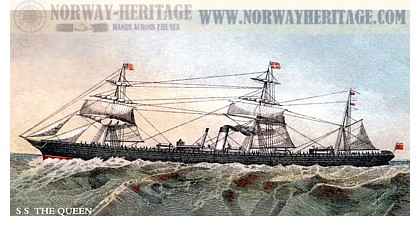
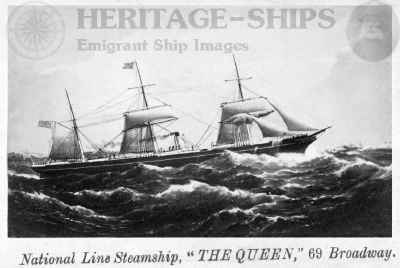
The company's first ships included the Louisiana, Virginia and Pennsylvania. They were soon joined by a series of large iron screw steamships for the Liverpool–Queenstown–New York service, including the Erin, Helvetia, Scotland, England and The Queen. When completed in 1865, The Queen was, apart from the Great Eastern, the largest screw steamer afloat.
Guion & Co., which already had extensive experience in the emigrant trade, initially handled the National Line's passenger business. This arrangement ended in 1866 when Guion established its own competing Liverpool–New York steamship service, after which the National Line organized its own passenger department.
The company expanded rapidly. By 1870 it operated ten steamships, with another two under construction. During that year its ships made 64 round voyages and landed 35,900 passengers at New York, of whom 33,500 traveled in steerage. The National Line's passenger total was second only to that of the Inman Line and higher than those of the Guion, Anchor and Cunard lines.
The National Line in Norway
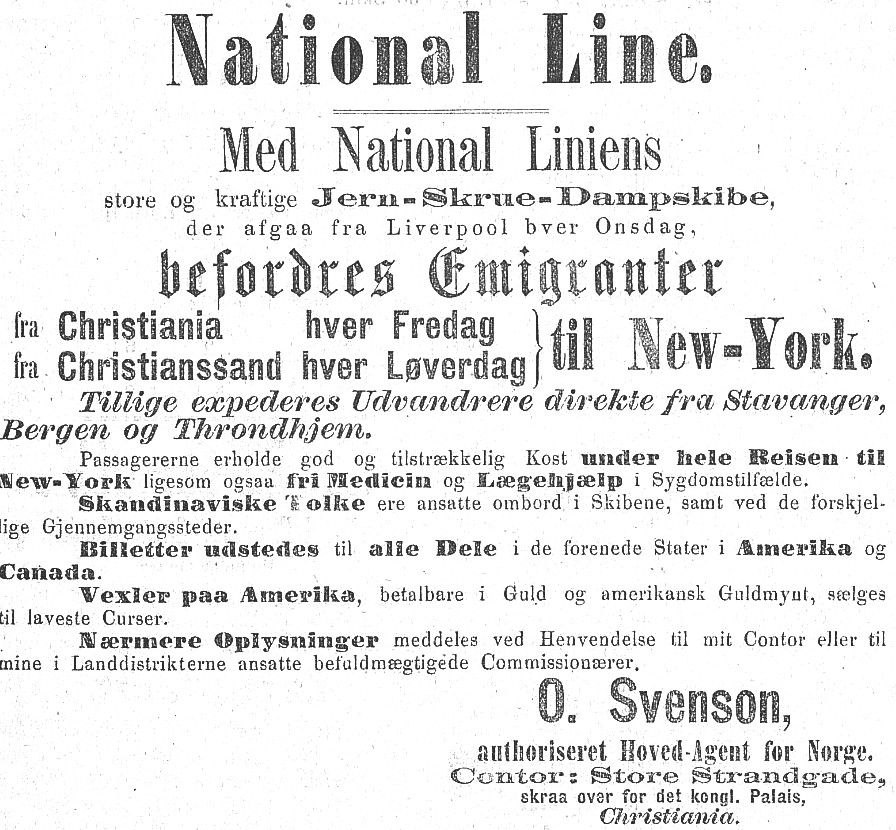
Announcemant in the Norwegian newspaper Dagbladet Feb. 4th, 1871
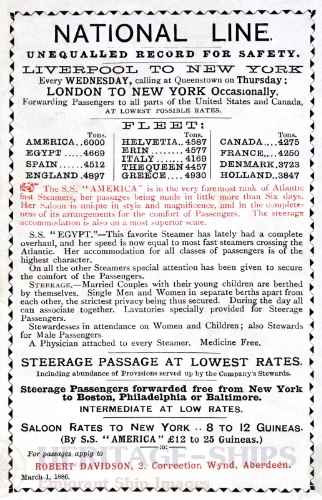
The National Line established itself in the Norwegian emigrant market during the late 1860s and developed a network of agents and representatives in different parts of the country. Norwegian advertisements from this period show that the company offered an organized journey from Norway to New York rather than merely selling passage on the transatlantic steamship.
By 1868, emigrants could begin their journey from Kristiania (Oslo) and Kristiansand, as well as from Stavanger, Bergen and Trondheim. The fare could include a berth and meals throughout the journey to New York, while through tickets were available to destinations throughout the United States and Canada.
As the National Line's transatlantic steamships sailed from Liverpool rather than Norway, the journey consisted of several connecting stages. Wilson Line steamships played an important role in carrying Norwegian emigrants across the North Sea to Hull. From Hull the passengers continued by train across England to Liverpool, where they joined the National Line steamship for New York. Depending on the connections and sailing dates, emigrants might also have to spend some time in lodging houses while waiting for the Atlantic departure.
This system was similar to that used by several other transatlantic companies operating from British ports. The emigrant did not necessarily have to arrange each stage separately. Through tickets and the network of agents made it possible to organize a connected journey from Norway, across Britain and the Atlantic, and onward toward the final destination in North America.
Language was another important consideration. Many Scandinavian emigrants spoke little or no English, while they were traveling aboard British ships and through British ports. The National Line advertised interpreters and stewards who spoke Scandinavian languages and could assist passengers during the journey. Scandinavian interpreters were also advertised at transfer points along the route. Medical assistance aboard the Atlantic steamships was another service emphasized in the company's Norwegian advertising.
The Scandinavian emigrant market was clearly important to the National Line. An advertisement published in 1870 claimed that about 20,000 Scandinavians would cross the Atlantic with the company that year. This was an advertising claim rather than an independently documented passenger figure, but the scale of the company's overall emigrant traffic was substantial. In 1870 the National Line landed 33,500 steerage passengers at New York.
Emigrant traffic formed a major part of the National Line's passenger business. Although its ships also carried saloon passengers and large quantities of freight, steerage passengers greatly outnumbered first-class passengers. In 1870 the company landed 33,500 steerage passengers at New York, compared with only 2,400 traveling in first class.
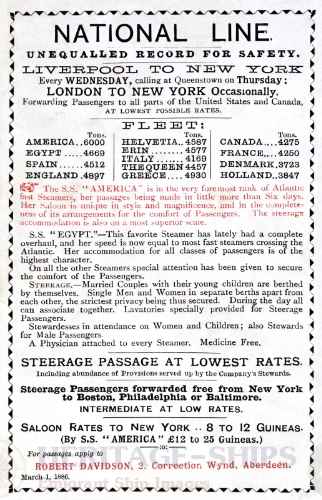
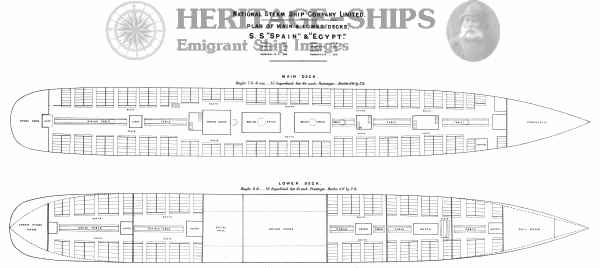
The company competed for emigrants not only through fares and its agent network, but also by emphasizing conditions aboard its ships. Later advertisements described the steerage accommodation as large, light and ventilated, and heated by steam during the winter. Married couples and families could be accommodated together, while single passengers were separated. Meals were served by the ship's stewards, and medical attention and medicine were provided without additional charge.
The continuing importance of Scandinavian traffic can also be seen in the company's fares. Around 1880, steerage passage was advertised at $30 from Scandinavian or German ports and $32 in the opposite direction. Such fares show that the company continued to market journeys extending beyond its own Atlantic steamship service and including connections with Scandinavian ports.
Passenger transportation was only one part of the business of these ocean steamships. The National Line also carried freight and livestock from America to Europe. One revealing example involved the America, one of the company's leading passenger steamships. While eastbound from New York to London with cargo and 250 head of cattle, she encountered the disabled Thingvalla Line steamship Hekla in the North Atlantic and attempted to assist her. The incident illustrates how the same steamships that carried passengers and emigrants across the Atlantic could be employed in quite different traffic on the return voyage.
In addition to its Liverpool service, the National Line began regular sailings between London and New York in 1871. The Erin, Helvetia and Denmark were initially employed on the route, and from 1872 four or five ships were regularly assigned to it.
During the 1870s the company also modernized several of its older ships with compound engines. The rebuilt Holland was among the earliest steamships with compound engines to cross the North Atlantic, and the success of the conversion led to similar work on other National Line ships.
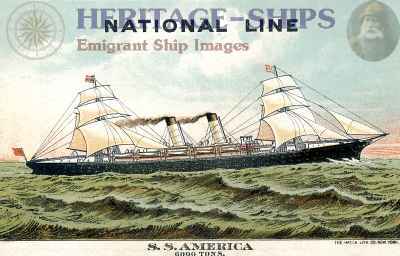
The company's most ambitious attempt to compete for speed came with the America in 1884. On her maiden voyage she crossed from Queenstown to New York in 6 days 15 hours 22 minutes, briefly establishing a record. The achievement was short-lived, as the record was broken within two months. With a coal consumption of about 190 tons a day, the America was also expensive to operate and was sold in 1887.
The National Line remained an important emigrant carrier during the 1880s. In 1886 its Liverpool steamships landed about 17,000 steerage and 2,500 saloon passengers at New York. By 1889 these figures had fallen to 8,100 steerage and 1,300 saloon passengers, and the company discontinued saloon accommodation on the Liverpool service the following year.
The company's financial position deteriorated further after the loss of the Erin, which disappeared without trace with 72 people aboard, followed about six months later by a fire aboard the Egypt. No lives were lost from the Egypt, but about 600 cattle were aboard the ship. These losses contributed to the company's decision to concentrate increasingly on freight and cattle traffic rather than passenger transportation.
The Liverpool–New York service was finally withdrawn in February 1894, with The Queen making the last sailing. Most of the company's older passenger steamships were subsequently sold or broken up.
The remaining business was eventually taken over by the Atlantic Transport Line, which continued the London–New York cargo service under the National Line name. By 1914 the last National Line ships had been absorbed into the Atlantic Transport fleet, bringing the history of the National Line as a separate shipping concern to an end.
Sources:
[Bonsor, N. R. P. North Atlantic Seaway: An Illustrated History of the Passenger Services Linking the Old World with the New. Prescot: T. Stephenson & Sons, 1955, pp. 201–205.] [Contemporary newspaper accounts, advertisements and other advertising material]