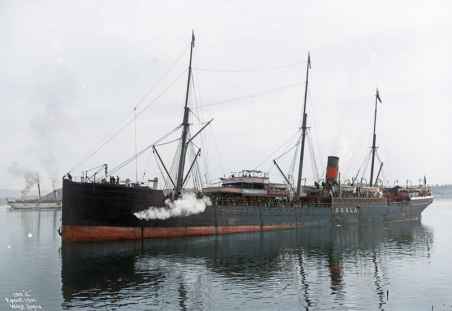
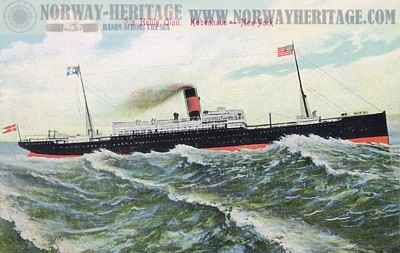
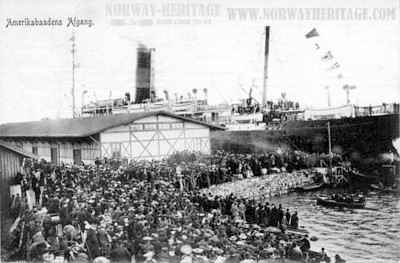
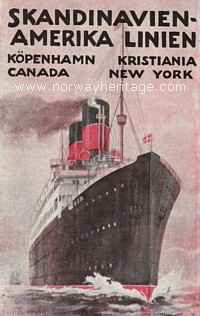
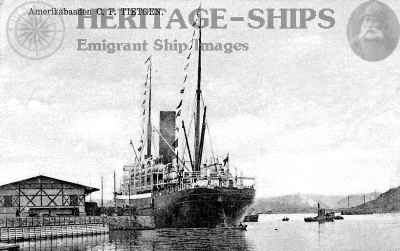
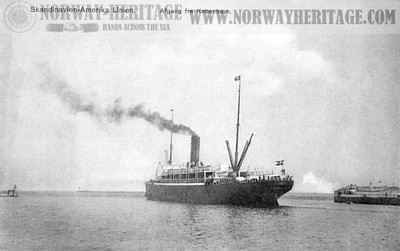
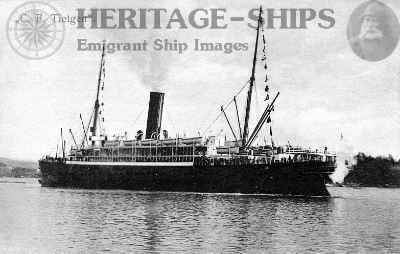
The old Hekla in Scandinavian America Line colors Photographer: Anders Beer Wilse · Copyright: CC BY-NC-ND 4.0
The Scandinavian America Line was established in 1898 when Det Forenede Dampskibs-Selskab (DFDS), the United Steamship Company of Copenhagen, acquired the Thingvalla Line. Rather than establishing an entirely new transatlantic service, DFDS continued the existing direct route between Scandinavia and New York under the new name Scandinavian America Line.
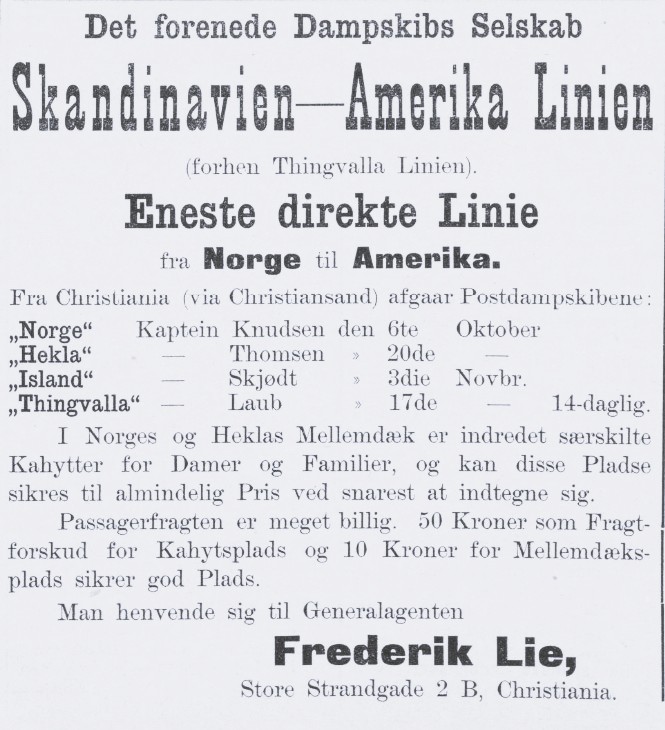
The continuity was made clear in contemporary advertising. In Norway the service was initially advertised as "Skandinavien-Amerika Linien (formerly Thingvalla Line)". The old Thingvalla Line steamships Norge, Hekla, Island and Thingvalla continued to maintain the service, with sailings every two weeks.
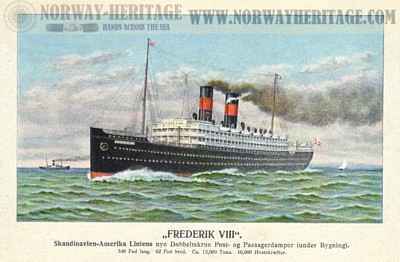
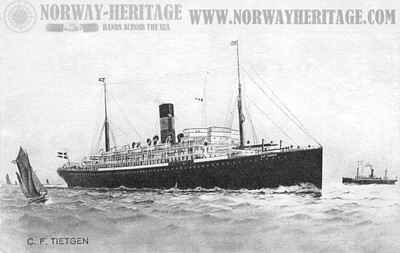
The fleet inherited from the Thingvalla Line consisted mainly of small and aging vessels. The line had also suffered a series of serious accidents, adding to the need for modernization. DFDS therefore began a substantial modernization of the transatlantic service. Between 1901 and 1903, three new twin-screw passenger steamships entered service: the Oscar II, Hellig Olav and United States. Each was around 10,000 gross tons, making them considerably larger than the old Thingvalla steamships, which were generally between 2,500 and 3,500 gross tons. The three new ships formed the core of the modernized Scandinavian America Line fleet.
The Direct Route between Norway to America
Advertisement for the newly established Scandinavian America Line, published in the Norwegian newspaper Politiken on October 1, 1898.The westward route
One of the Scandinavian America Line's greatest advantages in the Norwegian emigrant market was the simplicity of its route. Contemporary Norwegian advertising described it as the "only direct line from Norway to America." German companies had made attempts to establish competing direct services from Norway, including the Scandia Line, but these did not develop into a lasting regular service. The Scandinavian America Line therefore retained its distinctive position in the Norwegian market until the establishment of the Norwegian America Line in 1910, which introduced its own direct transatlantic service from Norway in 1913.
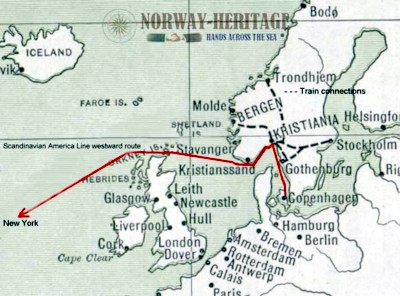
The westbound steamships of the Scandinavian America Line sailed from Copenhagen and called at Kristiania (Oslo) and Kristiansand before crossing the North Atlantic to New York. Norwegian passengers could therefore board the transatlantic steamer in Norway and remain aboard the same ship until reaching America.
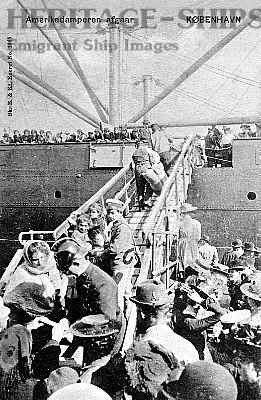
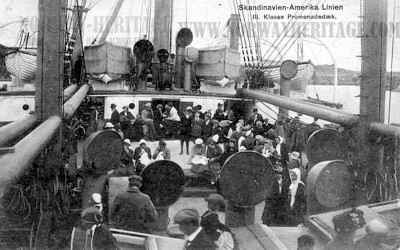
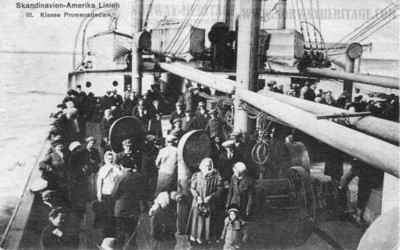
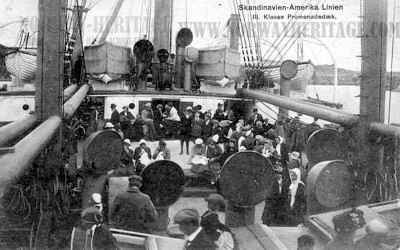
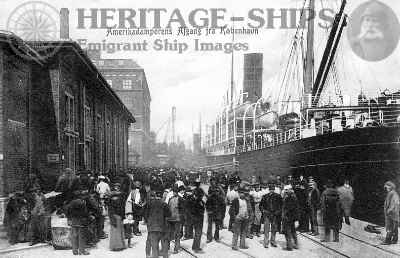
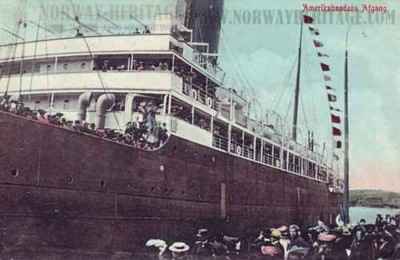
Emigrants embarking at Copenhagen — Buy a copy3rd class passengers on deck of a Scandinavian America Line steamship — Buy a copy
By 1898, Kristiania was connected by rail with Trondheim, which in turn had railway connections northward to Steinkjer and eastward across Jämtland to Sweden. Coastal steamship services connected Trondheim with ports farther north along the Norwegian coast. Passengers from these districts could therefore travel south through Trondheim and continue by rail to Kristiania. Kristiania also had railway connections with southern Sweden and was served by coastal steamship routes from other parts of Norway.
Kristiansand was well connected by coastal steamship services with Kristiania, southern Norway and the west coast. The Setesdal Railway, opened in 1896, also connected Kristiansand with its inland districts, although it remained an isolated railway system with no connection to the national railway network.
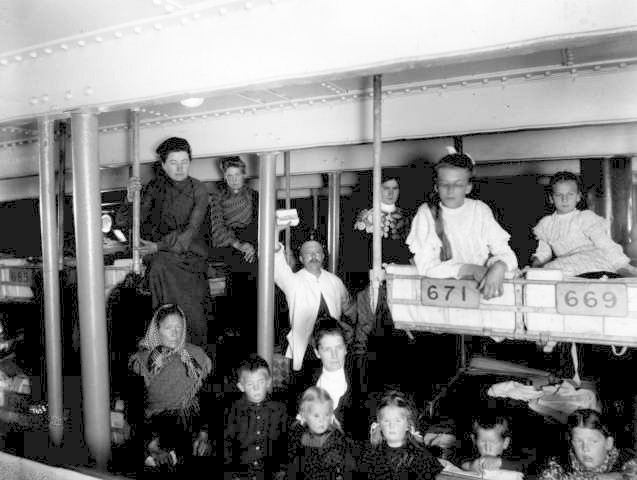
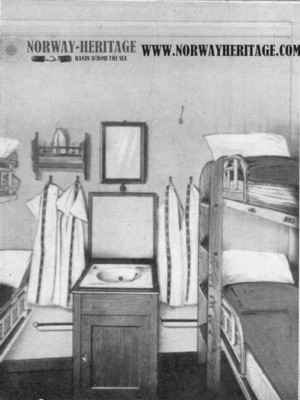
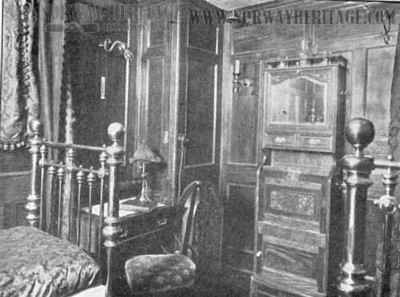
Passengers in their sleeping compartment
This distinguished the service from most of its British and continental competitors. Emigrants travelling with the major Liverpool lines first had to reach one of the Norwegian ports served by the feeder steamships, such as Trondheim, Bergen, Kristiania or Kristiansand. From there they crossed the North Sea to Hull, travelled by railway across England, and finally boarded another ship at Liverpool. By choosing the Scandinavian America Line, passengers could avoid the journey via Hull and Liverpool. Once they reached Kristiania or Kristiansand, they boarded the transatlantic steamer and remained on the same ship all the way to America.
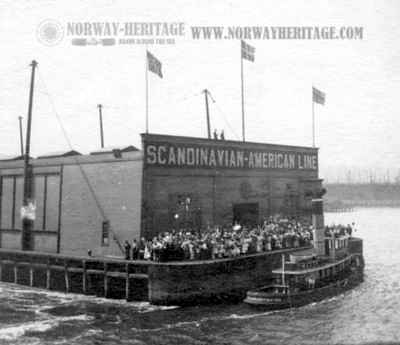
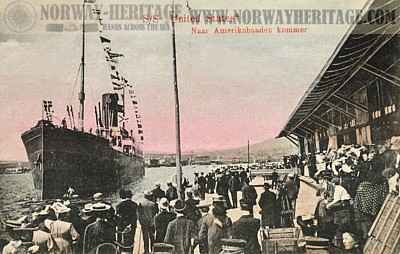
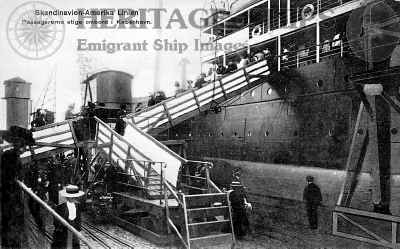
Scandinavian America Line pier at Hoboken — Buy a copy
The importance of the direct service was emphasized in advertisements for the new line, just as it had been under the former Thingvalla Line. The advertisement from October 1898 announced fortnightly departures from Kristiania by the Norge, Hekla, Island and Thingvalla. Passage was advertised at comparatively low fares, and accommodation could be secured by paying a deposit in advance.
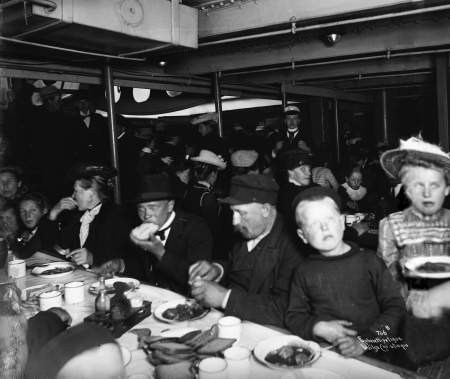
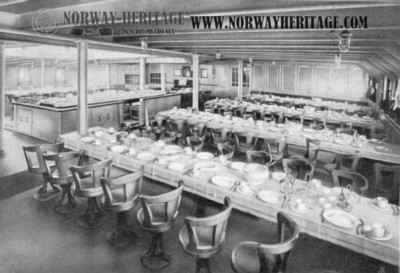
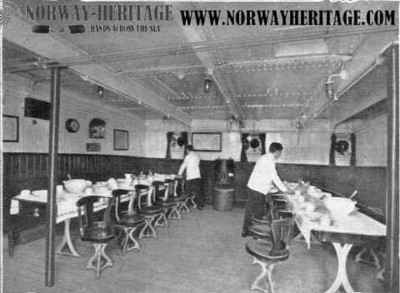
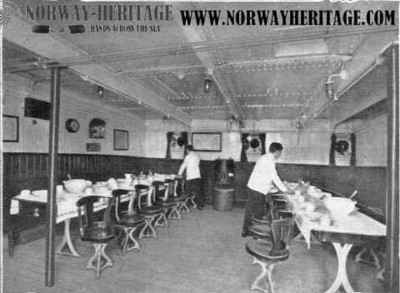
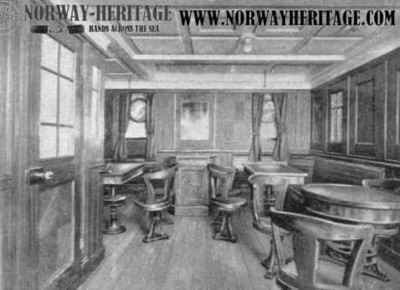
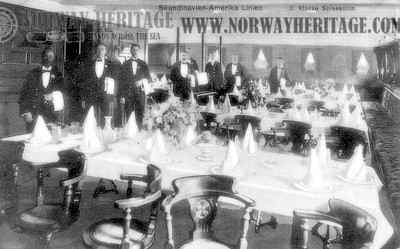
3rd class dining areaCredit: Anders Beer Wilse
Eastbound, the steamships departed from the company's pier at the foot of 17th Street in Hoboken, New Jersey. After crossing the Atlantic, the first Norwegian port of call was Kristiansand, where passengers, baggage and mail were landed. The ships then continued along the Norwegian coast and up the Kristiania Fjord (Oslofjord) to Kristiania before proceeding overnight to Copenhagen.
The Scandinavian America Line therefore provided a genuine two-way connection between Scandinavia and the large Scandinavian communities in North America. The direct route was not the only feature that distinguished the Scandinavian America Line from its British and German competitors. The ships themselves provided a distinctly Scandinavian environment.
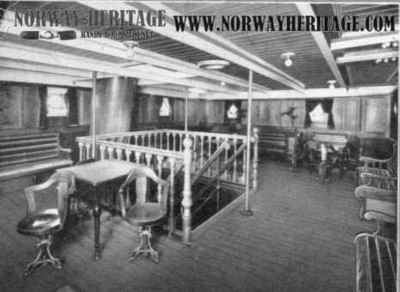
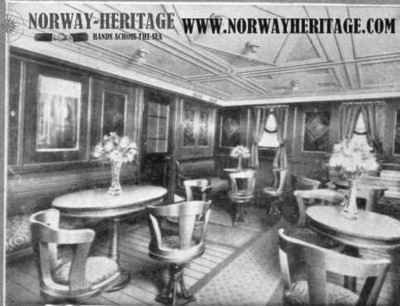
The 3rd class dining saloon on the Hellig Olav
The officers, stewards and much of the crew were Scandinavian, and Scandinavian languages were naturally spoken aboard. For passengers who knew little or no English, this could make the journey considerably easier than travelling aboard a British vessel where English was the working language.
Food and service were also promoted as Scandinavian. This was particularly relevant to emigrants who might be making their first journey outside their home country and who faced several weeks of unfamiliar travel before reaching their destination in America.
The line primarily served Denmark, Norway and Sweden, but it also attracted passengers from Finland and the Baltic countries. Copenhagen functioned as the home port, while the calls at Kristiania and Kristiansand gave Norwegian passengers direct access to the Atlantic service. From 1898 to 1900, calls at Stettin was also included in the service.
The new ships introduced by DFDS represented a considerable improvement over the older vessels inherited from the Thingvalla Line. The company promoted safety, comfort and passenger service as important features of the modernized Scandinavian America Line.
The ships were electrically lighted throughout, while staterooms and saloons could be heated by steam during the colder seasons. Wireless telegraphy was introduced, with operators maintaining the ship's communication with shore and other vessels. On later voyages, news received by wireless could be printed in a newspaper distributed aboard.
Libraries containing books in several languages were provided, with separate facilities for the different passenger classes. Passengers also had access to open deck space for exercise and recreation during the voyage.
Safety was naturally an important part of the company's advertising, particularly after the accidents associated with the earlier Thingvalla service. The Scandinavian America Line suffered its greatest disaster in 1904. On June 28, the Norge, one of the older steamships inherited from the Thingvalla Line, struck Rockall Reef in the North Atlantic while sailing from Copenhagen, via Kristiania and Kristiansand, to New York. The ship sank rapidly, with the loss of about 600 lives. Most of those aboard were emigrants from Scandinavia and other parts of Northern Europe.
The loss of the Norge became one of the worst disasters in the history of Scandinavian emigration and marked a tragic end to one of the older vessels inherited from the Thingvalla service. The newer ships were promoted as being equipped with modern safety appliances, life preservers and sufficient lifeboat capacity for those aboard.
These descriptions largely originated in company promotional material and naturally presented the service in the most favorable terms. They nevertheless illustrate the improvements in passenger accommodation and shipboard services that accompanied the modernization of the Scandinavian transatlantic service around the turn of the century.
From Steerage to Third Class
Departure from Vippetangen in Kristiania (Oslo) — Buy a copyPhotographer: unknown
The accommodation provided for emigrants also changed considerably during the history of the line.
Immediately after the takeover of the Thingvalla service, contemporary Norwegian advertising still referred to mellemdæk, or between-deck accommodation (steerage). On the Norge and Hekla, however, separate cabins were already being provided in this area for women and families.
On the newer Scandinavian America Line ships, the company increasingly promoted third class rather than the traditional open steerage accommodation associated with nineteenth-century emigrant ships. Third-class passengers were accommodated in cabins, generally arranged for two, four or six persons. This allowed families to remain together during the crossing.
According to the company's promotional descriptions, the cabins were ventilated and furnished with iron beds, mattresses, sheets, pillows and blankets, together with washstands, mirrors, towels and other basic necessities. Stewards and stewardesses attended to the accommodation and supplied fresh drinking water.
Meals were served by waiters in third-class dining rooms rather than passengers being expected to eat in their sleeping quarters. Tables were laid with linen and porcelain tableware, and the company particularly emphasized that meals were plentiful and prepared in a Scandinavian style familiar to many of its passengers.
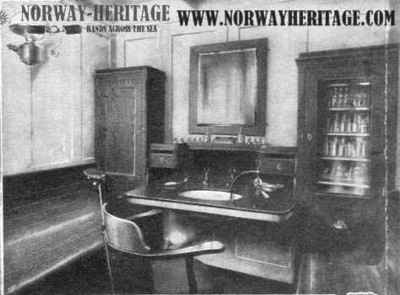
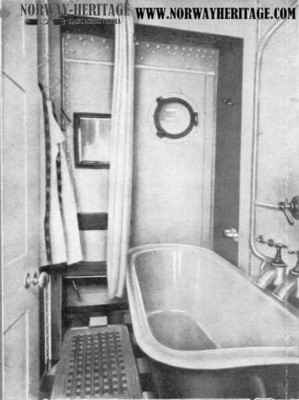
Third-class passengers also had their own deck space and public rooms, including a ladies' saloon and smoking rooms. Baths and barber facilities were available, while medical care was provided by the ship's physician and nurse, with hospital and dispensary facilities aboard.
Special attention was given to women and children travelling without male companions, who were placed under the care of a matron and stewardesses.
The distinction between the older steerage arrangements and the later third-class accommodation is significant. Emigrants still travelled much more simply than first- and second-class passengers, but the gradual replacement of large communal steerage spaces by smaller cabins, dining rooms and dedicated public facilities represented an important change in the experience of crossing the Atlantic.
From Emigrant Traffic to a Changing Passenger Market
Although emigrant traffic remained important, the character of the Scandinavian America Line's passenger business gradually changed. The large Scandinavian communities established in the United States created a substantial market for eastbound travel. Immigrants who had settled in America returned to Scandinavia to visit relatives and their former home communities, while others returned permanently after years abroad. The same ships that carried emigrants westward therefore became an important connection in the opposite direction.
Tourism also became an increasingly important part of the passenger business. The eastbound service provided convenient access to Scandinavia for American tourists, with Kristiania serving as a gateway for journeys to the Norwegian fjords and the North Cape. The line was thus increasingly serving a mixture of emigrants, returning Scandinavian Americans, visitors and tourists travelling in both directions across the Atlantic.
At the same time, competition for Scandinavian passenger traffic increased. For many years, the Scandinavian America Line's principal advantage had been its direct service from Scandinavian ports, but this position was increasingly challenged during the early twentieth century. The Norwegian America Line began direct passenger service between Norway and America in 1913, while the Swedish American Line was established in 1914 and began its transatlantic service the following year.
The First World War caused serious disruption to transatlantic passenger traffic, and the market changed still further after the war. The United States introduced restrictive immigration quotas in 1921, followed by still tighter restrictions in 1924. The era of mass Scandinavian emigration was drawing to a close, reducing the westbound emigrant traffic that had formed an important part of the line's business.
The route itself changed somewhat during the line's years of operation. From 1925, Halifax was added to the westbound route, with the ships calling there before continuing to New York.
These changes made tourists, returning immigrants and other passengers increasingly important. The Scandinavian America Line continued its transatlantic service through the 1920s and into the 1930s, but changing migration patterns, increased competition and difficult economic conditions eventually undermined its profitability.
In 1935, DFDS discontinued the Scandinavian America Line, ending more than three decades of service under that name and bringing to a close the direct transatlantic tradition it had inherited from the Thingvalla Line.
More about the line: Survivors of the S/S Norge - This article was transcribed and submitted by Debbie Dahl-Cole. Source: The Alexandria Post - Alexandria, Minnesota Date: Thursday 21 July 1904
The Sinking of the Norge - This article was first printed in the Budstikken, May 2005. The Budstikken is a publication of the Valdres Samband. The article was transcribed for this site by Jo Anne Saddler, and is reprinted here with kind permission of Valdres Samband and Dan Hovland
The S/S Norge disaster - newspaper reports - The New York Times July 4 - 6. Transcribed by Jo Anne Sadler 2006. This is the story of the sinking of the Norge as reported day by day in the press. The ship went down on June 28th 1904, and by July 4th the news were all over the front pages of the mayor newspapers. Jo Anne Sadler has transcribed the reports from The New York Times spanning from July 4th to July 6th. The same stories were also printed in the Norwegian newspapers.
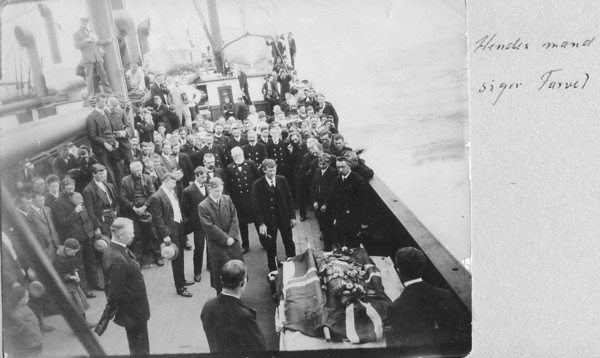
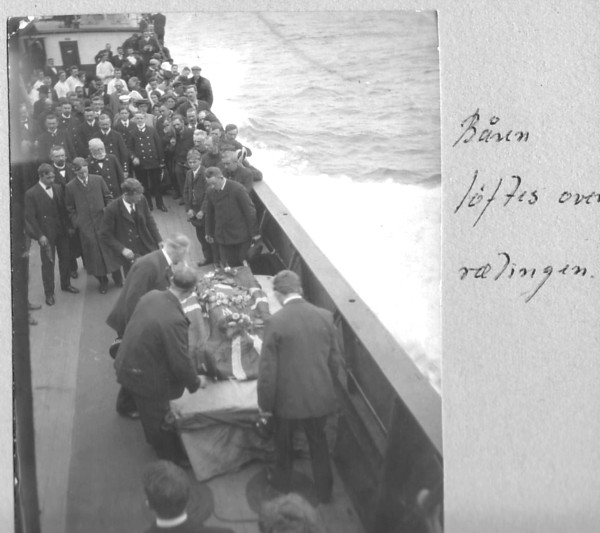
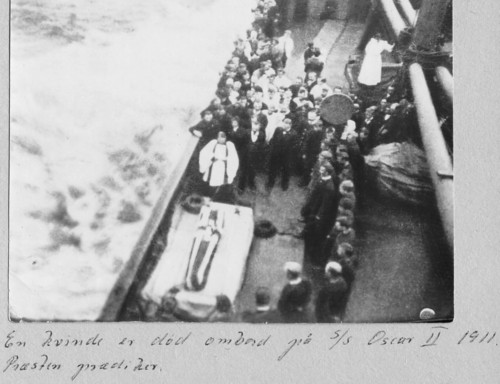
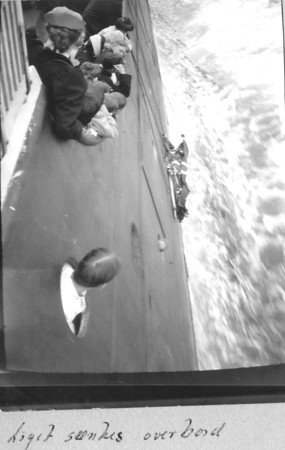
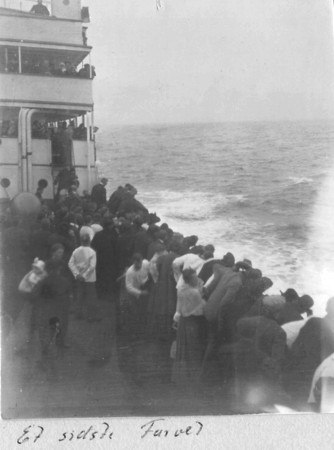
A burial at sea on board the S/S Oscar II in 1911 - snapshots taken by Peder Georg Christian Pedersen in 1911, when he sailed as an officer on the S/S Oscar II. Pedersen served on the Scandinavian America Line steamships from 1902 till 1920, and became the master of the S/S C. F. Tietgen. The pictures were provided by Karsten Egeblad, one of Pedersen's descendants. The text to the pictures are in Pedersen's own words.
Junior Marine Engineer on Frederik VIII, 1923-25 - This is part of William Elmgreen's (1902-1990) autobiography. He was born in Denmark, and grew up in Lemvig, Jutland. In 1923 he became a Junior Marine Engineer on the Scandinavian America Line steamship "Frederick VIII", and sailed on her till 1925. This otherwise unpublished autobiography was submitted by John Elmgreen, Sydney, Australia, 2008