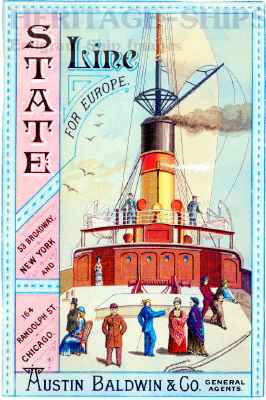
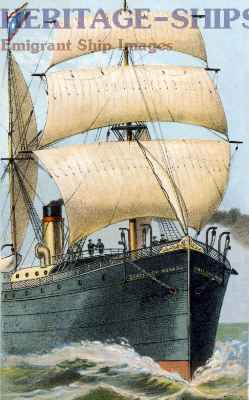
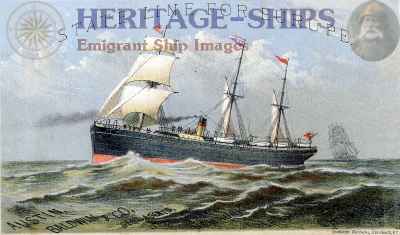
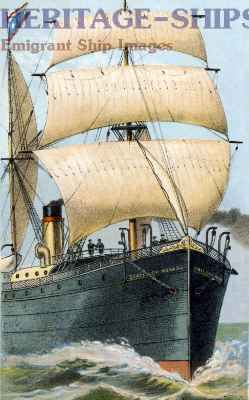
The State Steamship Company, generally known as the State Line, began transatlantic operations in 1872. The company initially planned services from Glasgow and Liverpool to New Orleans and from Glasgow to New York.
The first sailing took place in August 1872, when the Louisiana sailed from Glasgow and Liverpool for New Orleans. The New York service followed in April 1873, when the Pennsylvania sailed from Glasgow to New York.
The company was British and based its North Atlantic operations principally on Glasgow. Its early fleet consisted of relatively new iron screw steamships, with several additional vessels introduced during the following years. In December 1873, "State of" was added to the names of the company's ships to distinguish them from similarly named vessels operated by other North Atlantic lines.
Although never one of the largest transatlantic companies, the State Line became a significant competitor in the Glasgow passenger trade and entered the Norwegian emigrant market soon after beginning its New York service.
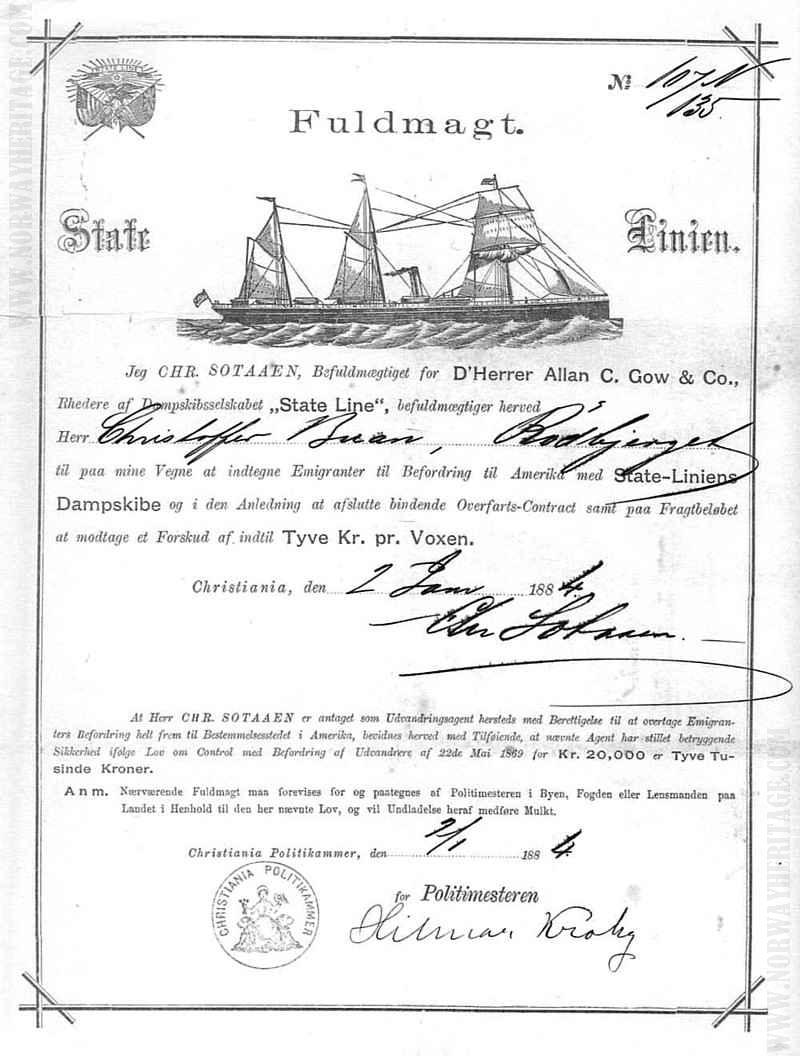
The State Line in Norway
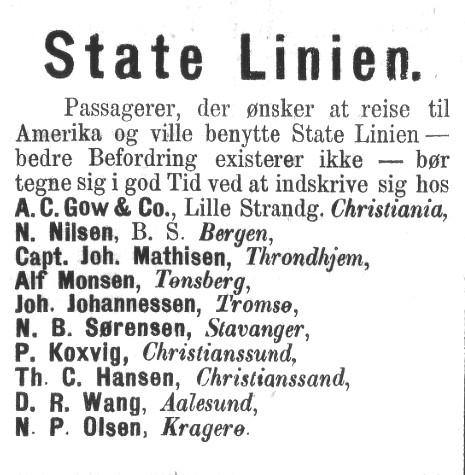
State Line annoncement from Norsk Handels og Søfartstidende, March 17. 1881
The State Line was represented in Norway from 1873. The Norwegian organization was expanded the following year, when a company office was established in Christiania and agents represented the line in other parts of the country.
The authorization of 1874 specifically covered the conveyance of emigrants via Hull and Glasgow to New York and New Orleans and onward to their final destinations in America. The State Line steamships did not sail from Norway, and the first stage of the journey was therefore made aboard feeder steamships to Hull. An important part of this traffic was provided by the Wilson Line, whose steamships connected Norwegian ports with Hull and carried large numbers of Scandinavian emigrants across the North Sea.
From Hull, the passengers continued by railway across Britain to Glasgow, where they boarded the State Line steamship for the Atlantic crossing. After arrival in America, many continued by rail toward destinations in the interior. Although several shipping and railway companies were involved, through tickets allowed much of this journey to be arranged before the emigrant left Norway.
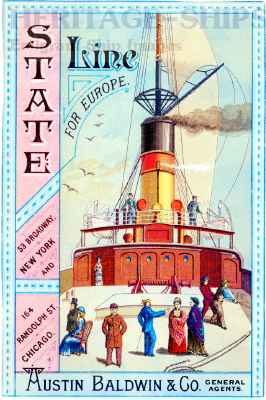
Contemporary advertising offered through transportation to destinations throughout the United States and Canada. An American State Line advertising card listed through steerage fares to and from Scandinavian ports including Christiania, Bergen, Christiansand, Stavanger and Drontheim, as well as Gothenburg, Malmö and Copenhagen. The Norwegian traffic was therefore part of a wider Scandinavian transportation network organized around the company's Glasgow service.
The State Line originally intended to maintain weekly sailings between Glasgow and New York, while New Orleans was also served during the company's early years. The economic downturn of the mid-1870s forced the New York service to be reduced to fortnightly departures, while the New Orleans service was, apart from occasional sailings, discontinued in 1875. Conditions later improved, and a weekly New York service was resumed in 1878.
The Atlantic Crossing and Life on Board
The State Line competed actively for emigrant passengers and placed particular emphasis on the accommodation provided in the between-decks. Norwegian advertisements in 1874 promoted the ships as modern vessels incorporating recent improvements intended to make the Atlantic crossing more comfortable.
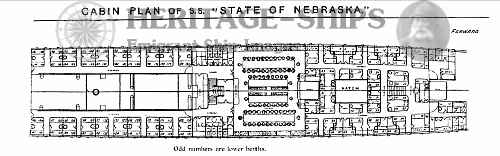
The between-decks were advertised as higher than was usual aboard emigrant steamships, providing more light, air and space. Tables and benches were provided, together with washbasins supplied with fresh water. Sleeping accommodation was arranged so that families could remain together, and each adult passenger was provided with a berth.
Food was also an important part of the company's Norwegian advertising. Fresh bread was said to be baked aboard every day, while meals were plentiful and prepared in a Scandinavian manner. A Norwegian-speaking interpreter accompanied the passengers, and a doctor was carried aboard, with medicine provided without additional charge.
Safety formed part of the same marketing. Particular attention was drawn to what the advertisements called the "lane route," with different tracks used for eastbound and westbound passages across the Atlantic. The company promoted this arrangement as a means of reducing the risk of collision with other vessels.
These descriptions originated in the company's own advertising and naturally presented the service in favorable terms. They nevertheless show what the State Line considered important when competing for Scandinavian emigrant traffic: modern ships, improved between-deck accommodation, familiar food, assistance in the passengers' own language, medical care and safety during the Atlantic crossing.
An Emigrant's Journey, 1883–1884
A particularly interesting account of the journey was provided by Waldemar Wilberg, a decorative painter who emigrated from Trondheim to Chicago in December 1883. His journey can be partly reconstructed from the emigrant records and from a letter he later wrote to the State Line agent in Trondheim.
Wilberg left Trondheim at 8 a.m. on Thursday, December 13, aboard the Wilson Line steamship Tasso. The ship sailed south along the Norwegian coast, calling at Kristiansund and Ålesund before crossing the North Sea to Hull, where it arrived on Monday, December 17.
From Hull, Wilberg continued across Britain to Glasgow. In his later account, he particularly remembered the assistance provided to the emigrants during the transfer and praised the emigrant hotel where they stayed in Glasgow before the Atlantic departure.
He then boarded the State Line steamship State of Nevada, commanded by Captain Stuart. Wilberg praised the accommodation and food aboard, but placed particular emphasis on the assistance provided by the ship's interpreter, Mr. Widemann, who helped the emigrants during the crossing.
The voyage took place over Christmas and New Year. Wilberg recalled that the steerage passengers celebrated Christmas Eve together, while on New Year's Eve the captain arranged a celebration in which, according to his account, saloon and steerage passengers participated.
After crossing the Atlantic, Wilberg continued to Chicago. His account is particularly valuable because it illustrates what a State Line passage from Norway actually involved.
Wilberg's letter was published in a Norwegian newspaper in June 1884 and clearly also served a promotional purpose for the State Line and its Norwegian agency network. Its enthusiastic assessment of the company should therefore be read in that context. At the same time, when combined with the emigrant records, it provides unusually detailed contemporary evidence of the different stages of a Norwegian emigrant's journey to the American interior.
Despite its relatively small fleet, the State Line developed into a significant competitor in the Glasgow-New York passenger trade. In 1885 the company landed 10,066 passengers at New York, compared with 14,120 carried on the Anchor Line's Glasgow service.
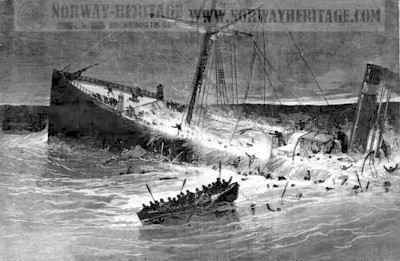
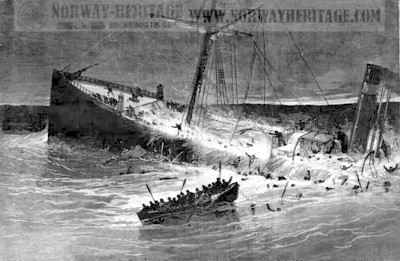
The company's record was not without serious accidents. The State of Louisiana was wrecked in Lough Larne in December 1878, followed by the loss of the State of Virginia at Sable Island in July 1879. In April 1884, the State of Florida sank following a collision at sea, with the loss of more than 100 lives.
Competition was intense, however, and passenger fares declined considerably. The minimum cabin fare, for example, fell from thirteen guineas in 1873 to six guineas in 1885. While the financially stronger Anchor Line was better able to withstand such conditions, the State Line struggled throughout much of its existence to make its operations profitable.
By the end of the 1880s these financial difficulties had become increasingly serious, and the company went into liquidation in 1890.
The Allan-State Line
In March 1891, the State Line's fleet and goodwill were purchased by the Allan Line. Most of the surviving State Line ships remained with the Allan Line only briefly, although the newer State of Nebraska was retained for a longer period. The State of California, which was still under construction when the acquisition took place, was completed for the Allan Line.
The Glasgow-New York service itself continued. Rather than immediately abandoning the established State Line identity, the Allan Line operated the route under the name Allan-State Line, a designation that remained in use until 1905.