The Thingvalla Line was established in Copenhagen in 1880 to maintain a regular passenger and freight service between Scandinavia and New York. The enterprise developed from earlier transatlantic voyages by the steamship Thingvalla, which had been built by Burmeister & Wain in Copenhagen in 1874. Her first voyage carrying emigrants from Copenhagen took place in October 1879, and the experience encouraged the establishment of a regular Scandinavian passenger service.
The new company, A/S Dampskibsselskabet Thingvalla, was formally established in March 1880. Its intention was to operate between Copenhagen and New York at fortnightly intervals, carrying both passengers and freight. Since the Thingvalla was unavailable because of machinery problems, the chartered steamship Harald made the first voyage for the new service, leaving Copenhagen on March 11, 1880, and arriving at New York on April 6. The Harald had been fitted with accommodation for more than 200 steerage passengers.
The Direct Route from Scandinavia
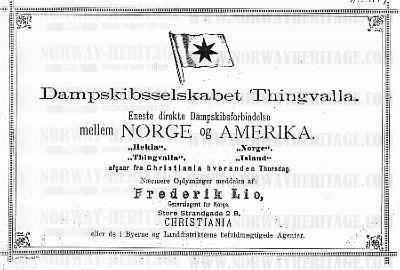
Newspaper announcemant for the new line printed in the norwegian newspaper Dagbladet Oct. 20, 1880
The Thingvalla Line was established to provide Scandinavia with its own regular transatlantic connection. Before its establishment, large numbers of Scandinavian emigrants travelled through British or German ports, and German companies in particular had carried much of the Danish emigrant traffic.
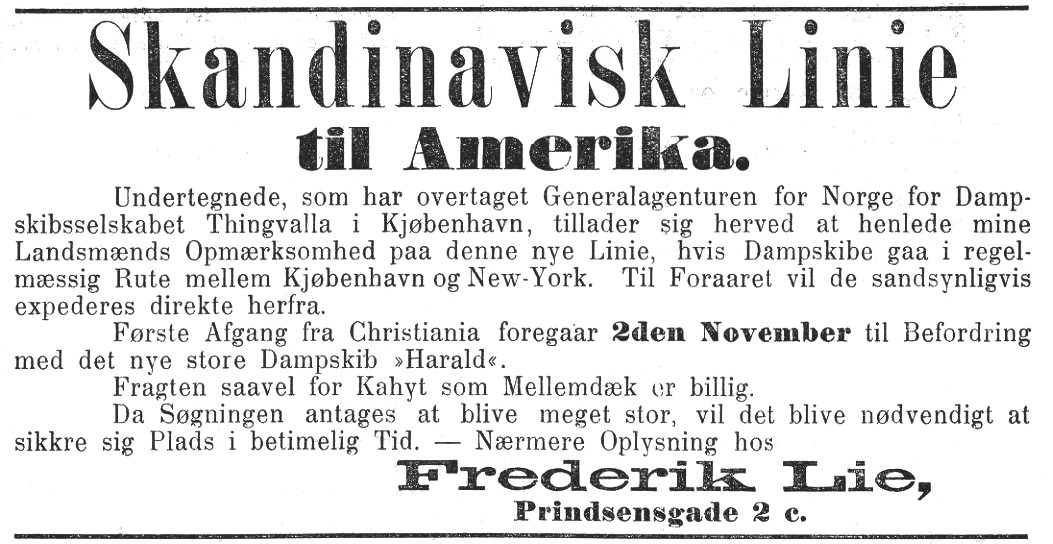
Norway soon became an important part of the new service. An advertisement published on October 22, 1880 announced that Frederik Lie had taken over the general agency for Norway and advertised the departure of the Harald from Christiania on November 2. It also indicated that the company's steamships were expected to be dispatched directly from Christiania from the following spring.
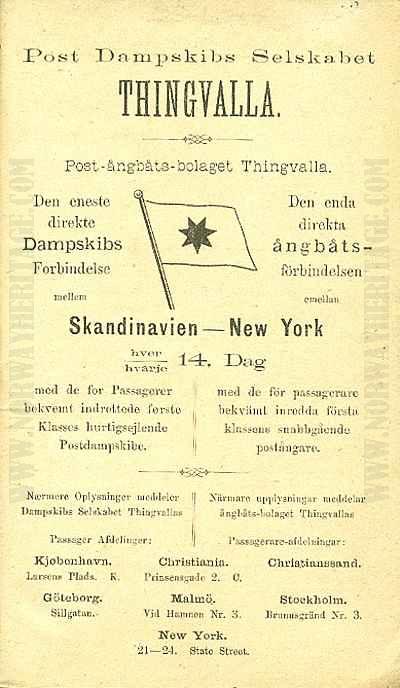
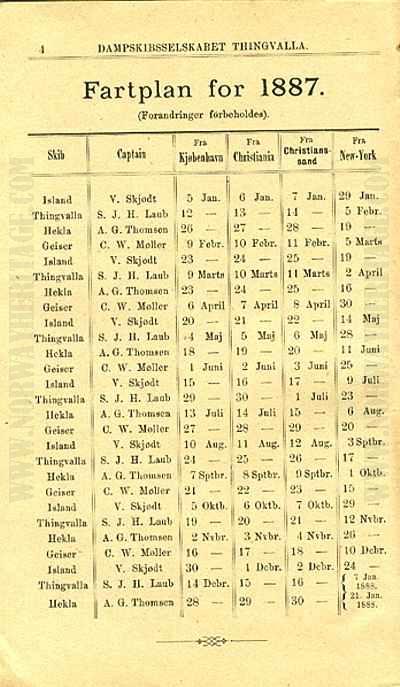
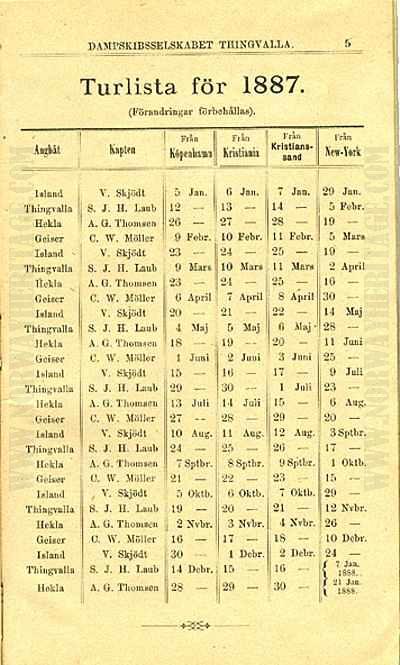
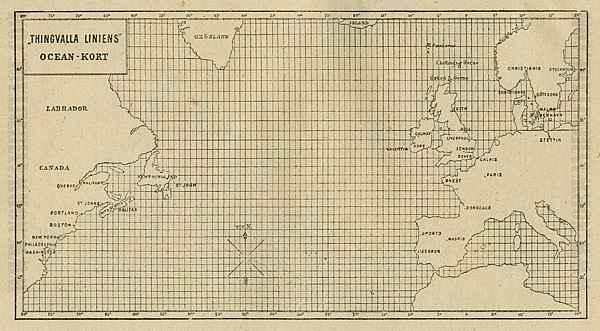
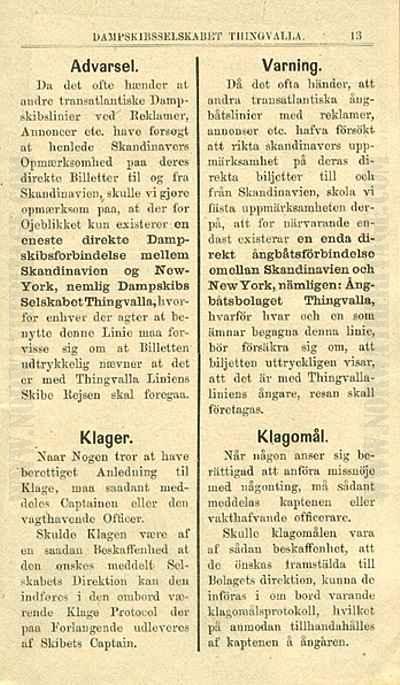
The regular route developed into Copenhagen–Christiania–Christiansand–New York, with departures every fourteen days. By 1887 the company advertised the service as the only direct steamship connection between Scandinavia and New York.
For Norwegian emigrants, particularly those who could conveniently reach Christiania or Christiansand, this offered an important alternative to the established routes through Britain or Germany. They could board the transatlantic steamship in Norway and remain aboard until New York, avoiding the transfers between feeder steamships, railways and Atlantic steamers required by many competing routes.
The advantage was less pronounced for emigrants from western and northern Norway. Reaching Christiania or Christiansand could itself involve a considerable journey, and for many of these passengers the established connections by feeder steamer to Britain remained equally practical.
The Thingvalla Fleet
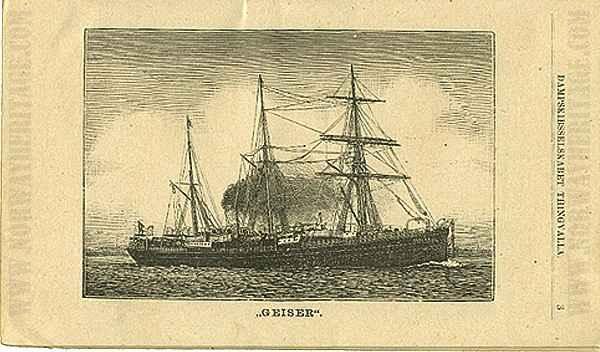
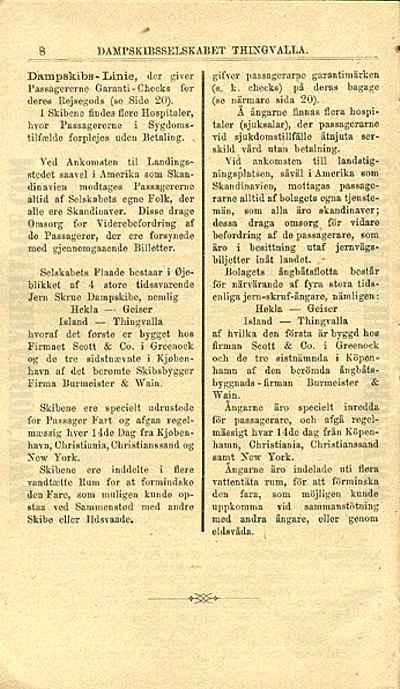
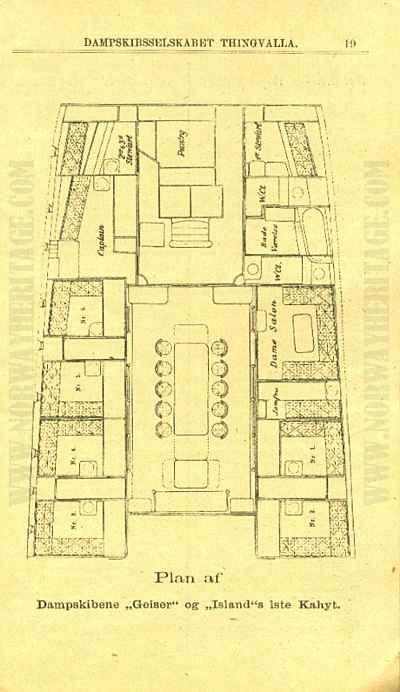
The original Thingvalla was a comparatively small iron steamship of about 2,500 gross tons. Establishing a regular transatlantic service required additional vessels, and the company gradually expanded its fleet. The Geiser and Island, each of about 2,800 gross tons, entered service in 1881 and 1882, followed by the somewhat larger Hekla, of 3,258 gross tons, in 1884.
These vessels formed the core of the line during its early growth. They were equipped for both cabin and steerage passengers, and contemporary company material emphasized their subdivision into watertight compartments as a safeguard in the event of collision or damage.
Two additional steamships were acquired in 1888 and renamed Danmark and Norge. In 1891 the company added the former White Star liner Celtic, which entered Thingvalla service as the Amerika.
Although the fleet expanded, the Thingvalla steamers remained relatively small compared with many of the increasingly large vessels operated by the major British and German transatlantic companies. Their importance lay less in size or speed than in the direct Scandinavian service they provided.
A Scandinavian Journey
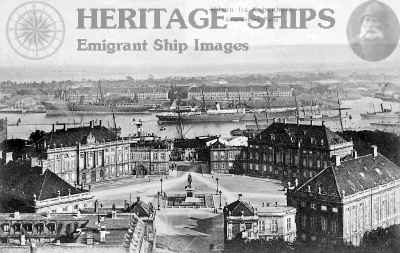
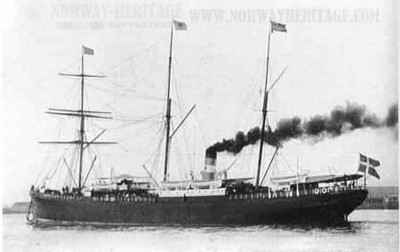
Thingvalla line ships Amerika and Norge at Copenhagen — Buy a copyThe S.S. ThingvallaCredit: Søren Thorsøe
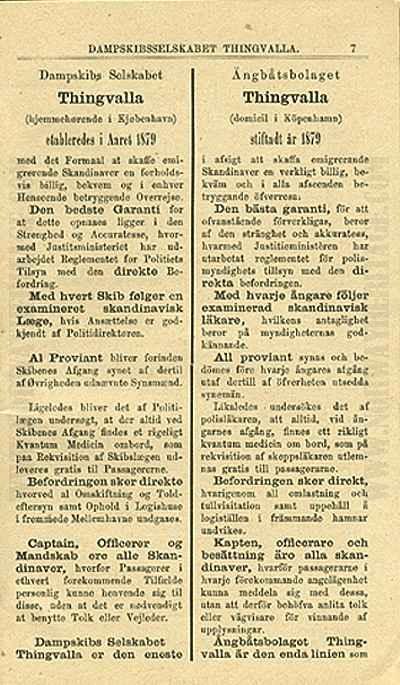
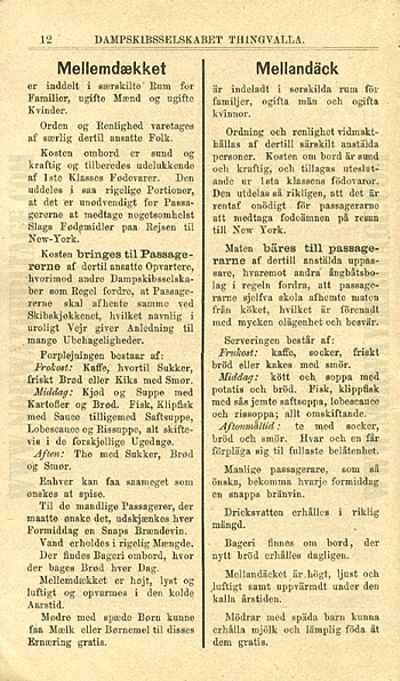
The Scandinavian character of the service was an important part of the Thingvalla Line's appeal. Company advertising emphasized that passengers travelling directly from Scandinavia avoided transfers, customs inspections and stays in lodging houses at foreign intermediate ports. The captain, officers and crew were Scandinavian, enabling passengers to communicate with the people responsible for their journey in familiar languages.
The company also attempted to make the passage part of a continuous journey rather than simply transportation between two seaports. Passengers with through tickets were met by the company's Scandinavian representatives on arrival in America, who assisted them with onward transportation to their final destinations. The ships carried a qualified Scandinavian doctor, medicine prescribed by the ship's doctor was provided without charge, and hospital accommodation was available for passengers who became ill during the voyage.
These arrangements were naturally described in favorable terms in the company's promotional material, but they illustrate what the Thingvalla Line considered important when competing for Scandinavian emigrant traffic: direct transportation, familiar languages, medical assistance and organized onward travel after arrival in America.
The service quickly attracted substantial numbers of emigrants. On the Island's maiden voyage in September 1882, about 300 passengers embarked at Copenhagen and another 400 at Christiansand. During that year the company's three steamships completed 21 round voyages and landed 10,681 steerage passengers and 537 first-class passengers at New York.
Accidents and Disasters
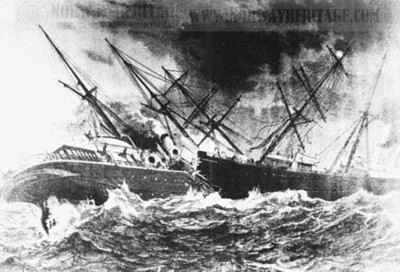
The Geiser and Thingvalla collisionSinking of the Danmanrk — Buy a copy
The history of the Thingvalla Line was marked by several serious accidents.
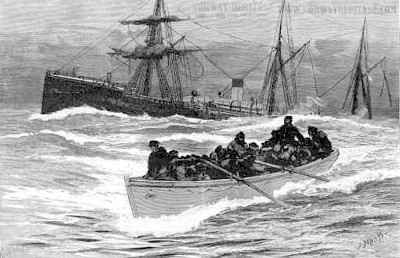
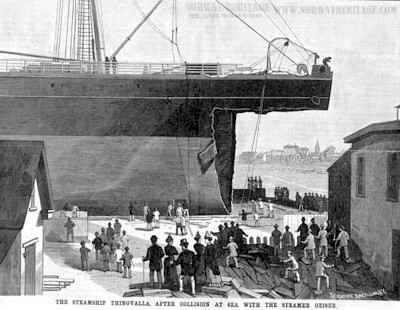
The worst occurred during the night of August 14, 1888, when the outward-bound Thingvalla collided with the homeward-bound Geiser in fog off Nova Scotia. The Thingvalla had sailed from Copenhagen on August 1 and, after calling at Christiania and Christiansand, was carrying 455 emigrants. The Geiser sank within minutes, with the loss of more than 100 lives. The Thingvalla was badly damaged but remained afloat, and her passengers were transferred to the Hamburg-American Line steamship Wieland before she proceeded to Halifax for repairs.
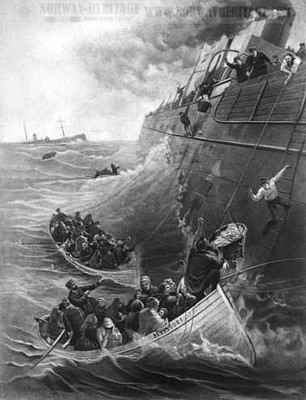
The Thingvalla in dock after the collison — Buy a copyAbandoning the S.S. Danmark
The following year another of the company's ships came close to disaster. In April 1889, the Danmark suffered serious damage to her machinery in the North Atlantic. After attempts were made to tow the disabled vessel, it became apparent that she could not be saved. About 800 passengers and crew were transferred to the Missouri of the Atlantic Transport Line and eventually landed safely in the Azores. The Danmark was abandoned and was never seen again.
In May 1890, the Thingvalla herself was involved in another serious incident when she collided head-on with an iceberg while bound for New York with about 400 passengers. Despite severe damage to her bow, temporary repairs enabled her to reach New York under her own power.
The succession of accidents was a serious setback for a company competing for emigrant passengers in an increasingly competitive North Atlantic market. It also came at a time when larger and more modern passenger steamships were beginning to change expectations of transatlantic travel.
The End of the Thingvalla Line
During the 1890s the company faced increasingly difficult conditions. Passenger numbers declined, while its relatively small steamships were becoming outdated compared with the larger and more modern vessels entering North Atlantic service.
Attempts were nevertheless made to improve the service. In 1898 the company was considering the construction of two substantially larger steamships, while improvements were also being made to existing passenger accommodation. Separate third-class cabins for families and women travelling alone were introduced aboard the Hekla.
The planned expansion did not take place. During the summer of 1898 negotiations began between DFDS and the financial interests behind the Thingvalla Line, and an agreement was reached for DFDS to take over the company from October 1, 1898.
The Thingvalla, Island, Hekla and Norge passed to the new owners and initially continued in transatlantic service. The Thingvalla Line name disappeared, however, and DFDS reorganized the passenger operation as the Scandinavian America Line.
The Thingvalla Line had operated for less than two decades, but in that time it had established a regular direct transatlantic service from Scandinavian ports and carried thousands of Scandinavian emigrants to America. The service established during the Thingvalla period provided the foundation upon which DFDS developed the Scandinavian America Line after 1898.
The collision between the S/S Thingvalla and the S/S Geiser - STORY OF THE SURVIVORS The Thrilling Story of the Sinking of the Gesier, The S/S Thingvalla arrives in port. From The Halifax Morning Herald Mon. 20 Aug. 1888. THE CATASTROPHE OFF SABLE ISLAND, Captain Møller's Version. – A Passenger says The Thingvalla Officers Are to Blame. – A Woman's Heart-rending Story.
The Sinking of the S/S Danmark A newspaper account concerning the sinking of the S/S DANMARK. It has been transcribed and submitted by Kristin Brue.
The SURVIVORS OF the S/S NORGE This transcript of an article printed in The Alexandria Post on Thursday 21 July 1904, was submitted by Debbie Dahl-Cole. Tom Solberg who is a genealogist for the Douglas County Historical Society in Minnesota furnished the article.
The Sinking of the Norge - This article was forst printed in the Budstikken, May 2005. The Budstikken is a publication of the Valdres Samband. The article was transcribed for this site by Jo Anne Saddler, and is reprinted here with kind permission of Valdres Samband and Dan Hovland
The S/S Norge disaster - newspaper reports - The New York Times July 4 - 6. Transcribed by Jo Anne Sadler 2006. This is the story of the sinking of the Norge as reported day by day in the press. The ship went down on June 28th 1904, and by July 4th the news were all over the front pages of the mayor newspapers. Jo Anne Sadler has transcribed the reports from The New York Times spanning from July 4th to July 6th. The same stories were also printed in the Norwegian newspapers.
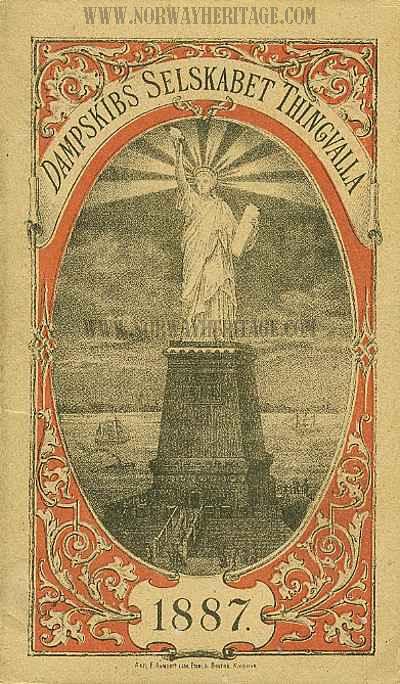
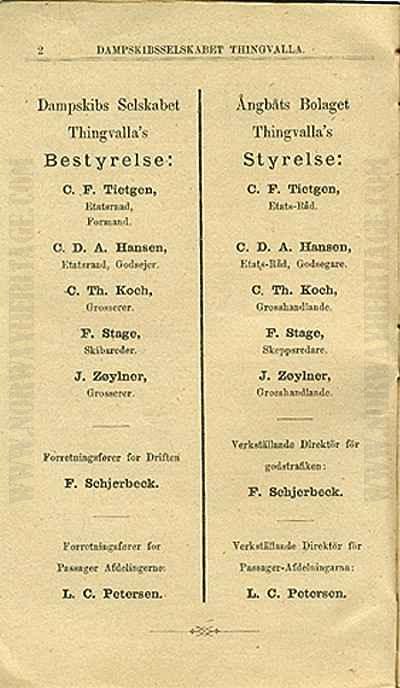
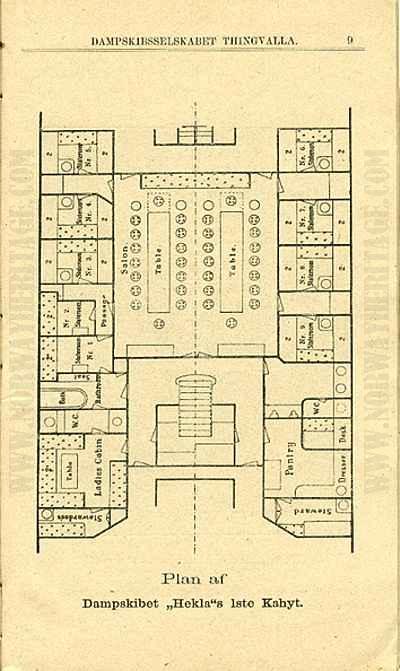
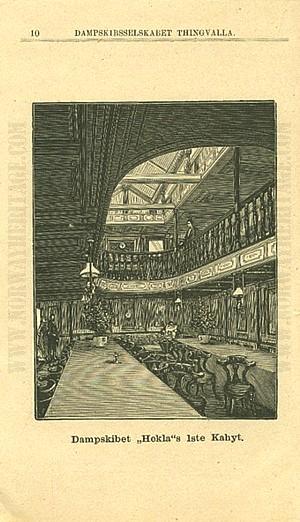
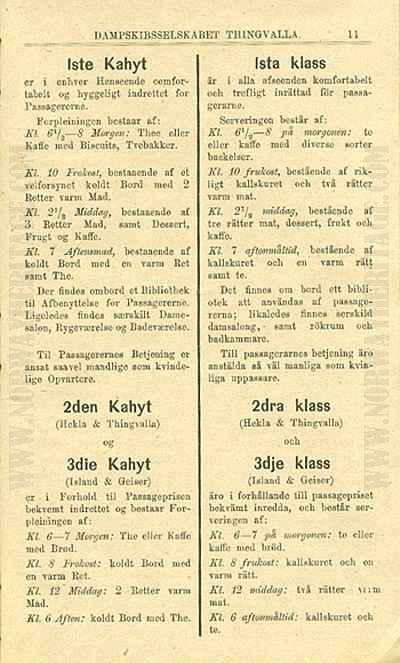
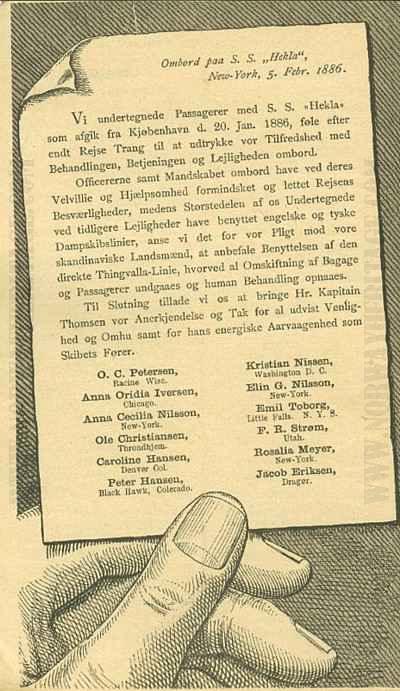
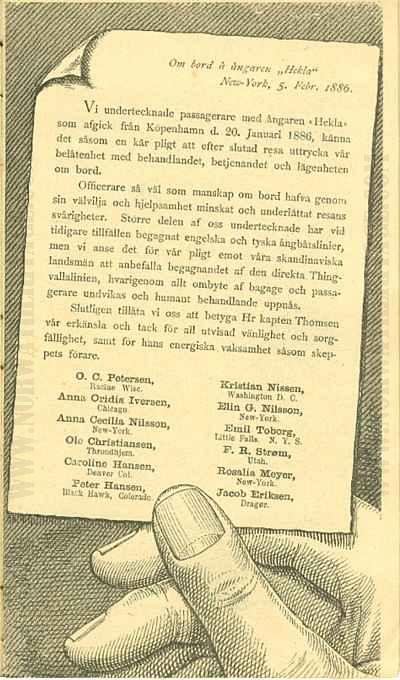
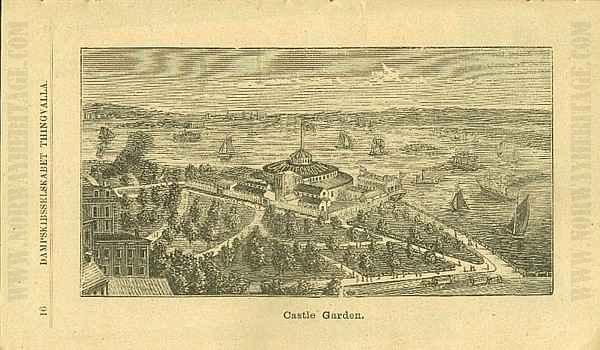
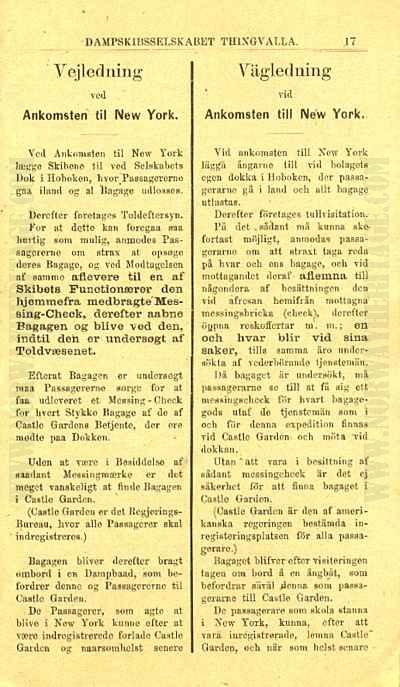
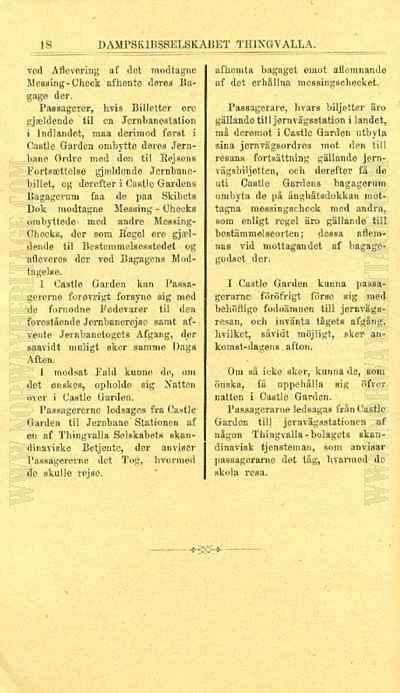
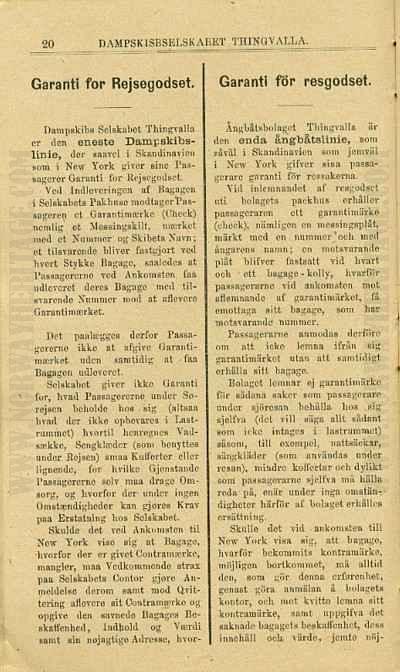
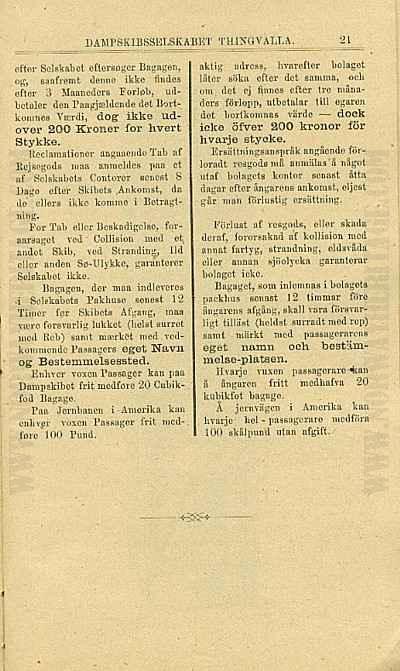
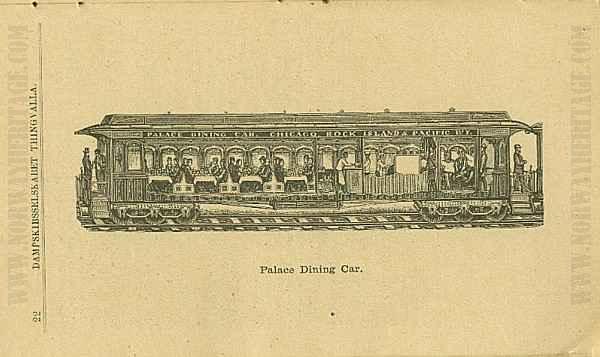
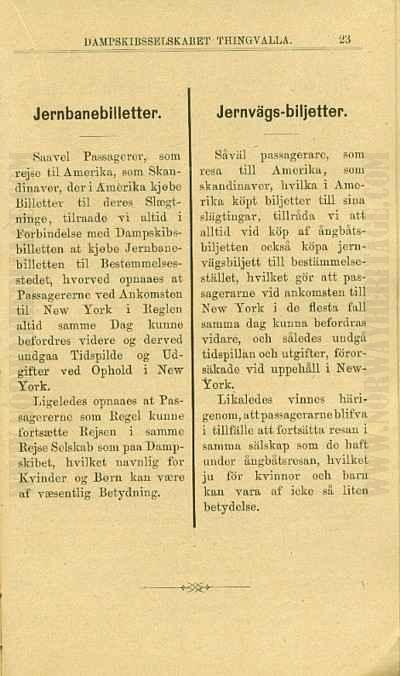
A Thingvalla Line promotional pamphlet 1887 - This booklet was issued by the Thingvalla Line in 1887, and gives an interesting insight in the progress of emigration. This is promotional pamphlet which was forwarded to potential travelers and emigrants. The booklet is written in Danish and Swedish, and is partly translated to English here. It gives a short introduction of the company, and it's fleet. It gives a short description of the conditions aboard the ships with details about the menu on the different classes. It has many details about the different matters an emigrant should be concerned with in connection with the purchase of tickets, the ocean travel, the arrival to Castle Garden and the inland voyage. There are also many interesting pictures.