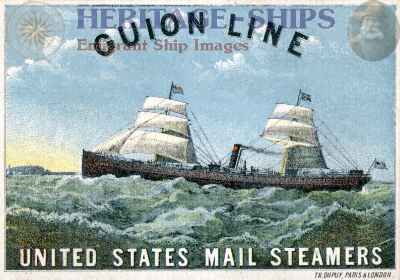
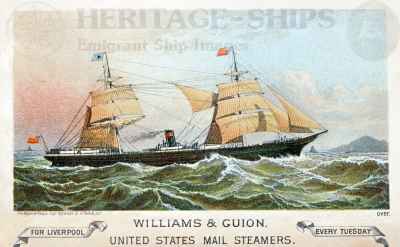
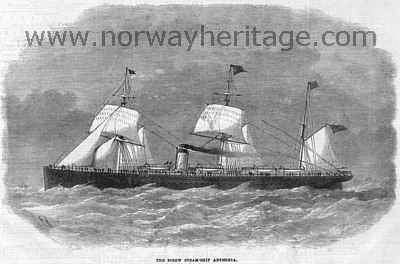
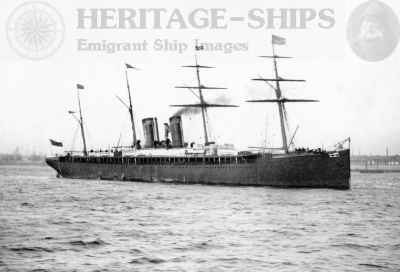
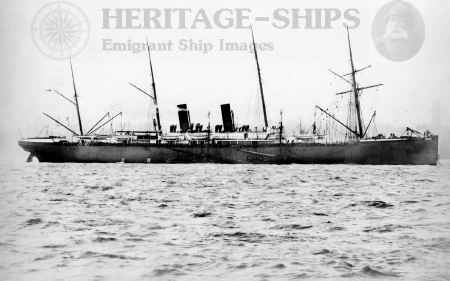
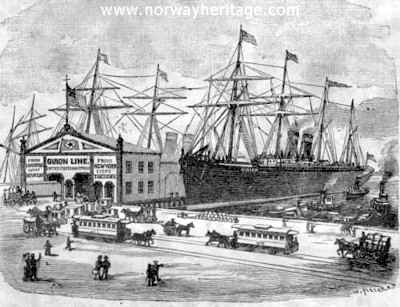
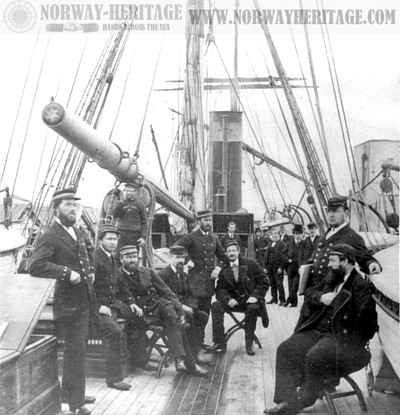
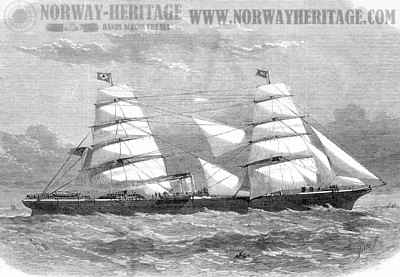
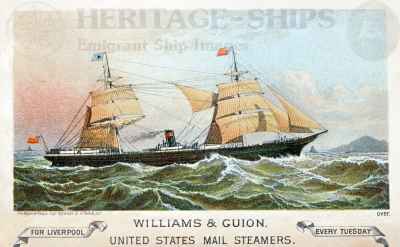
The Guion Line had its origins in the emigrant trade between Liverpool and the United States. During the sailing-ship era, the firm of Williams & Guion was associated with the Black Star Line of packet ships and developed a substantial business carrying emigrants across the Atlantic. By the 1860s, however, steamships were rapidly taking over the passenger trade.
Stephen B. Guion had already become closely involved in steamship emigration traffic. He was connected with the development of steerage business for the Cunard Line and subsequently acted as passenger and freight agent for the service that became the National Line. Recognizing that steam was replacing the sailing packet in the emigrant trade, he established the Liverpool & Great Western Steamship Company and ordered four steamships of about 3,000 tons each. Although this was the company's official name, it was generally known simply as the Guion Line.
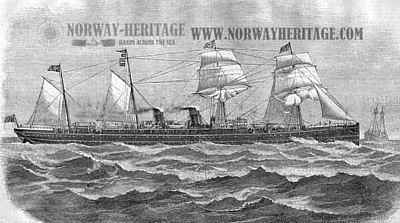
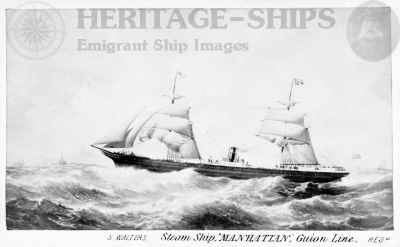
The first of the new steamships, the Manhattan, sailed from Liverpool for New York via Queenstown in August 1866. She was followed by the Chicago, Minnesota and Nebraska. The early westbound passages generally took about 12 to 14 days. As additional ships entered service, the service was increased from fortnightly to weekly in 1869.
The Guion Line in Norway
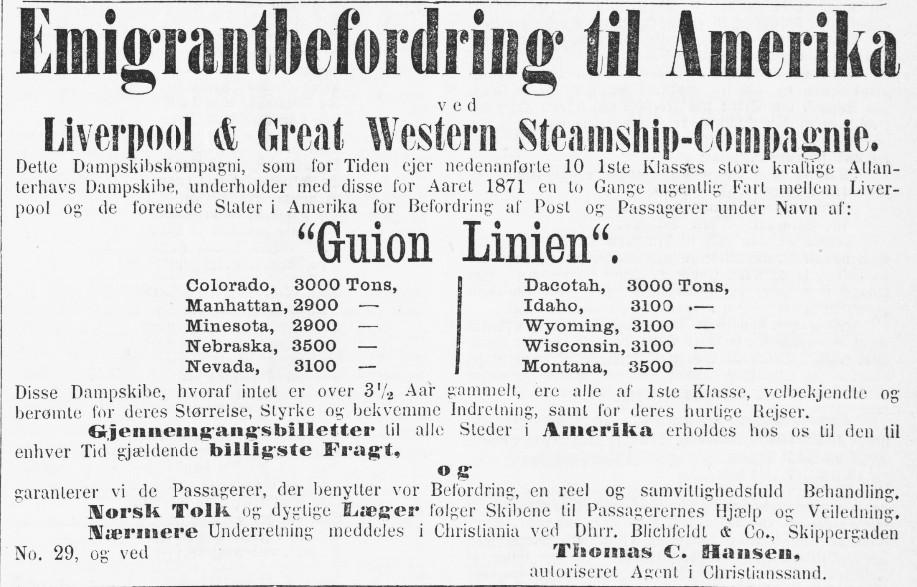
A Norwegian advertisement printed in Kristianssands Stiftsavis og Adresse-Contors Efterretninger, 18th April 1871
Norway became part of the Guion Line's international emigrant network at an early stage. The first authorized general agency in Norway was Blickfeldt, Knoph & Co. in Christiania, which received authorization in 1867 to convey emigrants by the Guion Line from Liverpool to New York. By 1870, the authorized route was explicitly described as running from Norway via Hull to Liverpool and from there across the Atlantic to New York.
By 1871, the Norwegian organization included local authorized agents in addition to the general agency in Christiania (Oslo). An advertisement published in Christianssand (Kristiansand) in April that year directed prospective emigrants either to Blickfeldt & Co. in Christiania or to the local authorized agent, Thomas C. Hansen, in Christianssand.
The advertisement offered through tickets to destinations throughout America, demonstrating that the journey being sold to Norwegian emigrants extended well beyond the Atlantic crossing. It also advertised Norwegian interpreters and doctors aboard the ships and promised passengers reliable and conscientious treatment. Such services and assurances became an important part of the competition among the transatlantic lines for the rapidly growing Norwegian emigrant traffic.
A Norwegian advertisement issued by Blickfeldt & Co. for the 1872 season provides a particularly detailed picture of how the company marketed its service. It advertised ten large transatlantic steamships under the name “Guion Linien” and emphasized their size, strength, comfort and speed. The company also announced frequent sailings between Liverpool and the United States to carry both mail and passengers. These descriptions were promotional claims, and the advertised fleet should not be understood as a list of ten ships simultaneously operating the service. Contemporary fleet records show that the composition of the active fleet was changing during this period.
The same advertisement presented the journey in terms that prospective emigrants could readily understand. The passage from Christiania to England was said to take two to three days, followed by nine to eleven days from Liverpool to New York. From New York, the advertised railway journey to Chicago took another 36 to 40 hours, with travel times to other destinations depending on the distance.
Through Travel to America
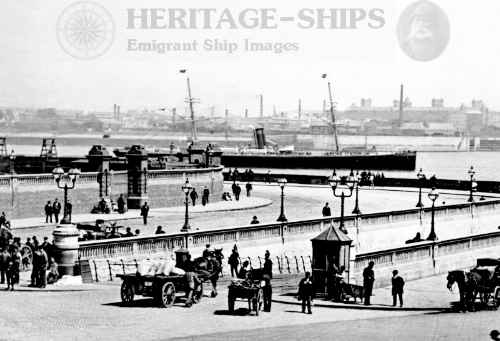
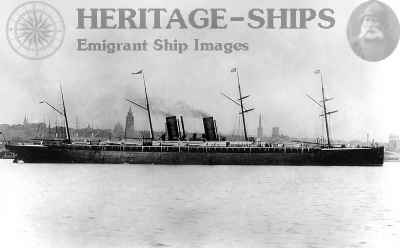
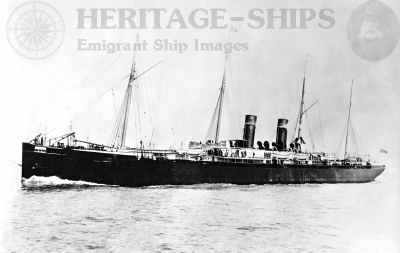
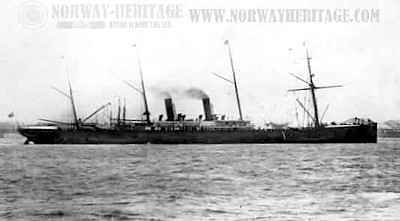
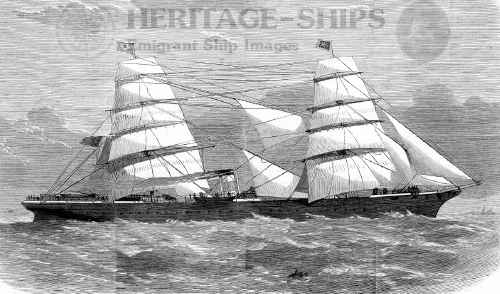
Guion Line steamship Wisconsin or Wyoming at Liverpool. These ships sailed with emigrants and other passengers between Liverpool and New York. — Buy a copy
The Guion Line's Norwegian business involved considerably more than selling a berth on a steamship from Liverpool to New York. The emigrant journey was organized as a chain of connecting services involving steamships, railways and agents on both sides of the Atlantic.
Norwegian and Swedish emigrants traveling by this route were commonly carried across the North Sea by Wilson Line steamships to Hull. There they were met by representatives of the Atlantic passenger lines, who assisted with baggage and conducted them to the railway for the journey across England to Liverpool. At Liverpool they boarded the Guion Line steamship for New York.
After arrival in America, passengers holding through tickets could continue by rail to their final destinations. By the mid-1880s, Guion's own passenger handbook specifically listed connections with the Erie, New York Central, Union Pacific, Central Pacific and other American railroads for forwarding European passengers inland from New York.
The scale of the organization was reflected in the company's agency network. Guion's 1886 passenger handbook listed Norwegian agents in Bergen, Christiania, Christiansand and Trondhjem, alongside representatives in Copenhagen, Gothenburg, Malmö and Stockholm. (Christiania, Christiansand and Trondhjem are the present-day Oslo, Kristiansand and Trondheim.)
Conditions during the transfer through England were not always satisfactory. A British report on emigrants passing through Hull in 1882 criticized the arrangements for Guion passengers. While emigrants booked with other lines were generally taken to lodging houses where they received breakfast or dinner before continuing by train, Guion passengers were transferred directly from the arriving steamships to the railway. According to the report, this meant that they could spend much of the day without a meal.
By the mid-1880s, the Guion Line offered three principal levels of passenger accommodation: saloon, intermediate and steerage.
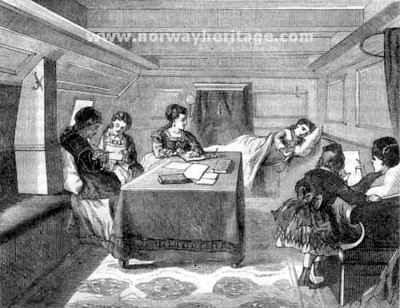
The company claimed to have been the first line between Liverpool and New York to introduce an intermediate class. It was intended for passengers who wanted better accommodation and food than steerage provided without paying saloon fares. Intermediate passengers slept in rooms containing two, four or six berths and were provided with beds, bedding and linen. They also had their own dining room and a better standard of meals, although they did not have access to the saloon or the deck areas reserved for first-class passengers.
Steerage accommodation was more basic. According to the company's passenger handbook, married couples and their children were accommodated together, while single women and single men were placed separately. Each passenger over twelve was assigned a berth, but steerage passengers were expected to bring or purchase their own bedding, plates, mugs and eating utensils.
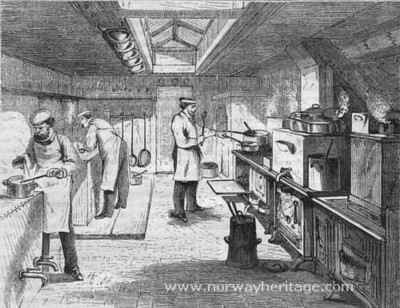
Food, however, was provided by the company. The advertised daily meals included coffee or tea, bread, butter, porridge, meat or fish, potatoes and soup, with pudding on Sundays. The company emphasized that the provisions were cooked and distributed by its own employees and that passengers did not need to bring their own food. These descriptions came from Guion's own passenger handbook and naturally presented the accommodations in favorable terms.
Competition among the major North Atlantic lines intensified during the 1870s. The success of the new White Star steamships, particularly their combination of speed, efficient compound engines and improved passenger accommodation, encouraged Guion to develop faster ships of its own.
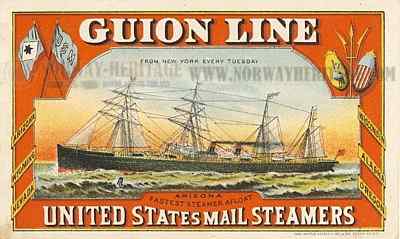
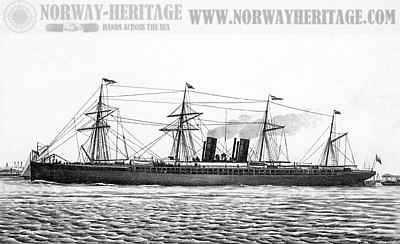
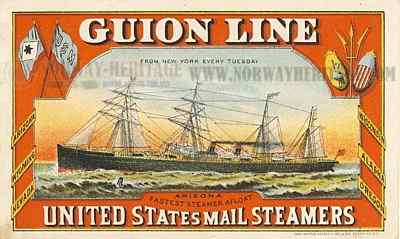
The breakthrough came with the Arizona, completed in 1879. At more than 5,000 tons, she was one of the largest steamships then operating on the North Atlantic. In July 1879 she crossed from New York to Queenstown at an average speed of 15.96 knots, fractionally exceeding the previous best eastbound passage.
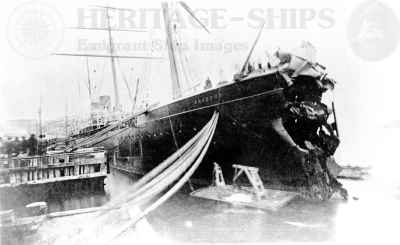
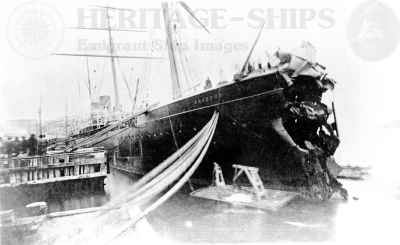
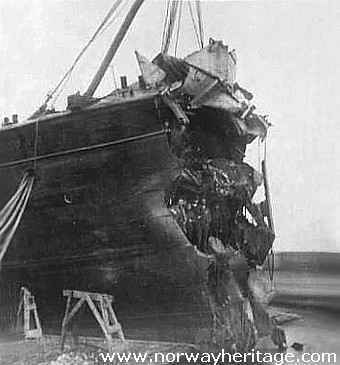
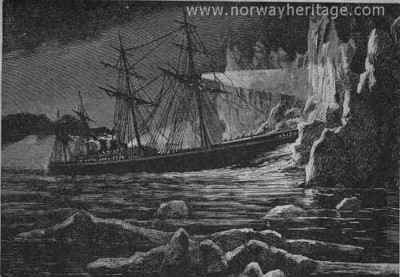
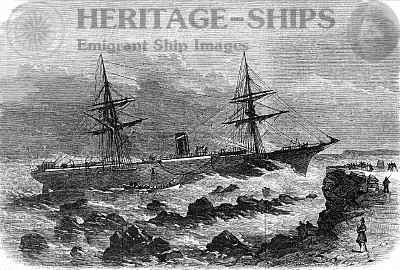
Later that year the Arizona dramatically demonstrated another quality. While steaming at high speed through mist near the Newfoundland Banks, she collided head-on with an iceberg. Her bow was badly crushed, but the forward bulkhead remained intact and no one was seriously injured. After temporary repairs at St. John's, Newfoundland, she continued to Liverpool under her own power. The incident enhanced rather than damaged her reputation for strong construction.
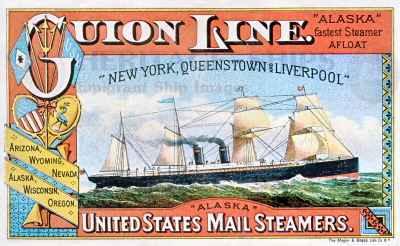
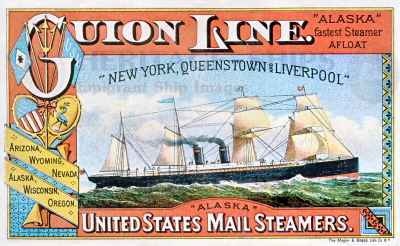
The larger Alaska followed in 1881 and became the first ship to be popularly described as a “greyhound of the Atlantic.” She was followed by the Oregon in 1883. In April 1884 the Oregon crossed from Queenstown to New York at an average speed of 17.48 knots and subsequently improved on that performance.
The emphasis on speed came at a considerable financial cost. The new ships were expensive to build and operate, and their heavy coal consumption contributed to the financial difficulties that eventually overtook the company.
Decline of the Guion Line
Arizona at St. John's for repairs after she collided head-on with an iceberg. — Buy a copy
The Oregon itself became an early indication of Guion's financial difficulties. In 1884 she passed to the Cunard Line because outstanding installments to her builders had not been paid. Stephen Barker Guion died the following year.
The remaining fleet continued to operate during the following years, but it was aging. By 1892 the Wisconsin and Wyoming had each been in service for more than twenty years, while the Nevada was even older. These ships were withdrawn, leaving the Alaska and Arizona to maintain a fortnightly Liverpool–Queenstown–New York service. Their high coal consumption made them economical only when heavily booked. They were finally withdrawn in the spring of 1894, leaving no practical alternative but to wind up the company.