The Norwegian bark (barque) Admiral Peter Tordenskiold, also known as Tordenskiold, was built in 1848 at Consul Hans Clausen's shipyard in Kristiansund, Norway. She was launched in August that year and measured 213 Norwegian commercial lasts. Her original owners were Madam H. Falkenberg and H. Falkenberg of Larvik. According to the Norwegian Veritas registers of 1862 and 1867, the vessel was constructed of pine, a timber commonly used in Norwegian wooden shipbuilding. The registers record metal sheathing of the underwater hull, dated 1859 in the 1862 edition and 1860 in the 1867 edition. Such sheathing helped protect wooden hulls against marine borers and fouling during long-distance voyages. The 1867 register also records repairs carried out in 1862.
The Admiral Peter Tordenskiold was employed in international merchant shipping, visiting European, North American, South American and Mediterranean ports. She was advertised for emigrant transport from Larvik to New York in 1850 and from Christiania to Quebec in 1853. Later in her career, the vessel became involved in an incident during the American Civil War that resulted in a compensation claim against the United States government.
The Advertised Emigrant Voyage of 1850
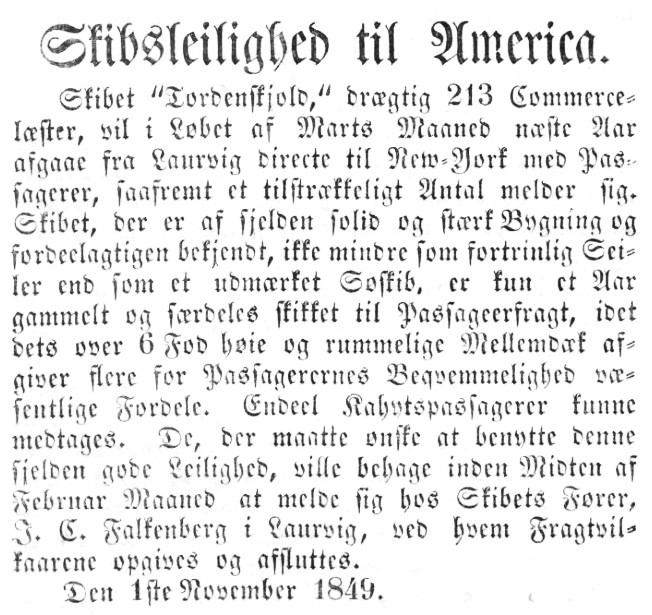
Advertisement offering passenger accommodation aboard the Tordenskiold for a proposed voyage from Larvik to New York in March 1850
In November 1849, the Tordenskiold was advertised for an emigrant voyage directly from Larvik to New York during March of the following year, provided a sufficient number of passengers registered before the middle of February. The advertisements described her as a strongly built vessel, only one year old, and an excellent sailer. Particular emphasis was placed on the passenger accommodation. Her spacious 'tweendeck was more than six feet high, which was presented as a considerable advantage for the comfort of emigrants. A limited number of cabin passengers could also be accommodated. The vessel was advertised under Captain J. C. Falkenberg, with prospective passengers invited to register with the master at Larvik or through shipping agent Parnemann in Brevik.
The planned direct voyage did not take place as advertised. On 7 April 1850, the Tordenskiold, under Captain Falkenberg, arrived at Shields from Larvik. She subsequently loaded coal at Newcastle and departed for New York on 2 May. On 8 May, she was reported off Start Point, Devon, still bound for New York. The vessel eventually arrived on 11 June, after a passage of forty days from Newcastle. During the Atlantic crossing, the Tordenskiold reportedly passed a large iceberg at latitude 48°13′ N, longitude 49°04′ W, near Newfoundland. The change from the advertised direct voyage to a sailing via Newcastle, where the vessel loaded coal, may indicate that insufficient passengers had booked passage from Larvik. However, this remains uncertain. It is also possible that a smaller number of passengers, including cabin passengers, travelled aboard.
No evidence has yet been found confirming that emigrants were carried on this voyage. Following her arrival in New York, the Tordenskiold continued in merchant service. In July 1850 she was reported loading for Panama, while later shipping reports mention a voyage towards Trieste with a cargo including resin.
Trading Voyages, 1851–1852
During the following years, the Tordenskiold continued in long-distance merchant service. On 5 January 1852, under Captain Falkenberg, she was reported at Callao, Peru, having arrived from Iquique. On 9 June she departed Callao for Europe. On 12 September 1852, she was reported off Cowes, England, from Callao, subsequently continuing towards Antwerp. These voyages illustrate the vessel's employment in international trade well beyond the North Atlantic routes.
The Emigrant Voyage to Quebec, 1853
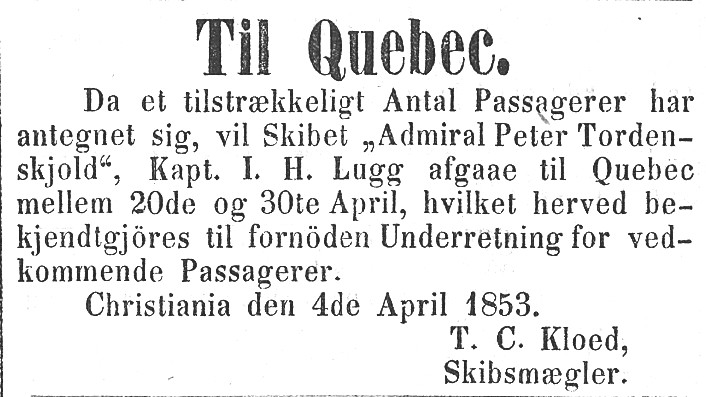
Newspaper advertisement for the voyage in 1853
In the spring of 1853, the Admiral Peter Tordenskiold was again advertised for emigrant transport, this time from Christiania to Quebec under Captain J. H. Lugg. An advertisement dated Christiania, 4 April 1853, announced that a sufficient number of passengers had registered and that the vessel would depart between 20 and 30 April. The notice was issued by shipping agent T. C. Kloed.
The Admiral Peter Tordenskiold departed Christiania on 30 April 1853. On 12 May, she was reported at Torbay, on the south coast of England, having arrived from Christiania. She subsequently continued across the Atlantic and reached Quebec on 24 June, 55 days after leaving Norway. Although the advertisement confirms that sufficient passengers had booked passage before departure, the number of emigrants actually carried has not yet been established from the available records. Following her arrival at Quebec, the Admiral Peter Tordenskiold departed for London on 27 July with a cargo of planks. She arrived at Gravesend on 7 August.
Merchant Voyages
After returning from Quebec, the Admiral Peter Tordenskiold continued in international merchant service under Captain Lugg. In October 1853 she sailed from London towards the eastern Mediterranean, with shipping reports mentioning Alexandria and Syra among her destinations. On 24 February 1854, she was reported at Falmouth from Heraclea, and subsequently arrived at Gravesend on 10 March. In April she sailed from the Thames towards Cardiff. Later that year, the vessel was reported departing Alexandria for Liverpool on 16 September, arriving there on 14 November. In December she was loading at Liverpool for Constantinople.
In May 1861, shortly after the outbreak of the American Civil War, the Admiral Peter Tordenskiold became involved in an incident concerning the Union blockade of Charleston, South Carolina. The American Civil War had begun in April, and President Abraham Lincoln had ordered a naval blockade of Confederate ports to prevent the movement of goods and supplies. This created difficulties for neutral merchant vessels trading with ports in the southern states. The Norwegian barque Admiral Peter Tordenskiold, under Captain H. J. Lugg, had entered Charleston during a temporary absence of the Union blockading force. When the blockade was resumed, the American naval commander refused to allow the vessel to leave with her cargo. The incident was particularly controversial because an English vessel had reportedly been permitted to depart under similar circumstances. The Admiral Peter Tordenskiold subsequently left Charleston and arrived at New York on 11 June 1861.
The detention of the Admiral Peter Tordenskiold became the subject of a diplomatic claim against the United States. In his annual message to Congress on 1 December 1862, President Abraham Lincoln specifically mentioned the Norwegian barque and recommended that compensation be granted to her owners. Lincoln noted that the vessel had been prevented from leaving Charleston with cargo in May 1861, even though an English vessel had previously been granted permission to depart under comparable circumstances. He also stated that the relevant documents would be submitted to the appropriate congressional committees. On 14 February 1863, the United States Congress passed a special act authorising compensation of $14,309.13 to the owners of the Admiral P. Tordenskiold, or their legal representatives. The legislation specified that the money was to be paid through the appropriate representative of the King of Sweden and Norway, reflecting the diplomatic arrangements of the union between the two countries at the time.
The Wreck at Appledore, 1881
On the night of 20 December 1881, the Admiral Peter Tordenskjold, now of Kragerø, was totally wrecked on the North Tail sandbank in Barnstaple Bay, off the coast of North Devon, England. The vessel, commanded by Captain H. Bunde, was on a voyage from Cardiff to Madeira with a cargo of coal when she stranded during a severe gale at approximately 11 p.m. According to a report published in Jarlsberg og Larviks Amtstidende on 29 December, the captain and four members of the crew lost their lives, while six seamen survived. A detailed account of the disaster was subsequently given by one of the survivors, ordinary seaman Hans August Mathisen. In a statement dated Appledore, 9 January 1882, he explained that the crew had immediately displayed a light after the vessel grounded. Three distress rockets were then observed from the shore. Approximately two hours later, the vessel broke apart. Mathisen and another seaman were carried towards the shore on a section of the quarterdeck. His companion managed to jump ashore, while Mathisen entered the water and was nearly overcome by the heavy seas before being assisted by men on shore. The two survivors were taken to the lighthouse, where they found four other members of the crew who had already reached land on pieces of wreckage. Mathisen's statement was interpreted by Captain Chr. Johannesen of the Norwegian bark Victoria, of Holmestrand, and was also signed by George Baker, Vice-Consul for Sweden and Norway at Appledore. The statement was issued to correct what Mathisen described as inaccurate accounts of the disaster. The wreck claimed five lives, including Captain Bunde, and brought the vessel's voyage to a tragic end.
Sources:
[Advertisements dated 1 and 29 November 1849, offering passenger accommodation aboard the Tordenskiold for a proposed voyage from Larvik to New York in March 1850.] [Shipping and Mercantile Gazette, 9 May 1850.] [Shipping and Mercantile Gazette, 28 June 1861.] [Abraham Lincoln, Second Annual Message to Congress, 1 December 1862. United States Statutes at Large, Vol. 12, p. 915, Private Act, Chapter XXXV, approved 14 February 1863: “An Act for the Relief of the Owners of the Norwegian Bark Admiral P. Tordenskiold.”] [Det Norske Veritas, Registers of Shipping, 1862 and 1867.] [Jarlsberg og Larviks Amtstidende, 29 December 1881.] [North Devon Journal, Thursday, 19 January 1882]
Chronological History
Year
Event
1848
Aug. launche at konsul Hans Clausens shipyard
1849
Feb 21 in Trapani
1849
July 29 Gravesend from Christiania
1850
April 7 Shield from Larvik, Capt. Falkenberg
1850
Captain J. S. Falkenberg. Departed Larvik. Arrived New York June 11.
1850
May 2 Newcastle (loaded coal) for New York
1850
Passed a large iceberg at 48º 13’ north - 49º 4’ west
1850
June 11 New York from Newcastle (40 days)
1850
Juli 27 loading in New York for Panama
1850
Aug leaving for Tries/Triest with resin and more
1852
Jan. 5 Callao from Iquique, Capt. Falkenberg
1852
June 9 leaving Callao for England
1852
Sept. 12 off Cowes: from Callao, left 14th for Antwerp, Falkenberg
1853
Captain J. H. Lugg. Departed Christiania Apr. 30. Arrived Quebec June 24.
1853
May 12 at Torbay: from Christiania
1853
July 27 Quebec for London with plank
1853
Aug. 7 Gravesend from Quebec
1853
Oct. 1 London for Alexandria
1853
Oct. 10 off Deal: from the Thames to Syra
1854
Feb. 24 Falmouth from Eraclia, Capt. Lugg
1854
March 10 Gravesend from Heraclea
1854
April 4 from the Thames: to Cardiff
1854
Sept. 16 leaving Alexandria for Liverpool
1854
Nov. 14 Liverpool from Alexandria
1854
Dec. 1 loading in Liverpool for Constantinopel
Leave a Comment
Do you have more information about this subject, or a question about the text above? Leave a comment here.
Questions about passenger lists, relatives or other research are best asked in the forum,
where many more readers will see them. Comments that fit better in the forum may be moved there by the moderator.
Comments are reviewed before they appear publicly. Fields marked with * are required.
Members: log in to post with your member name.