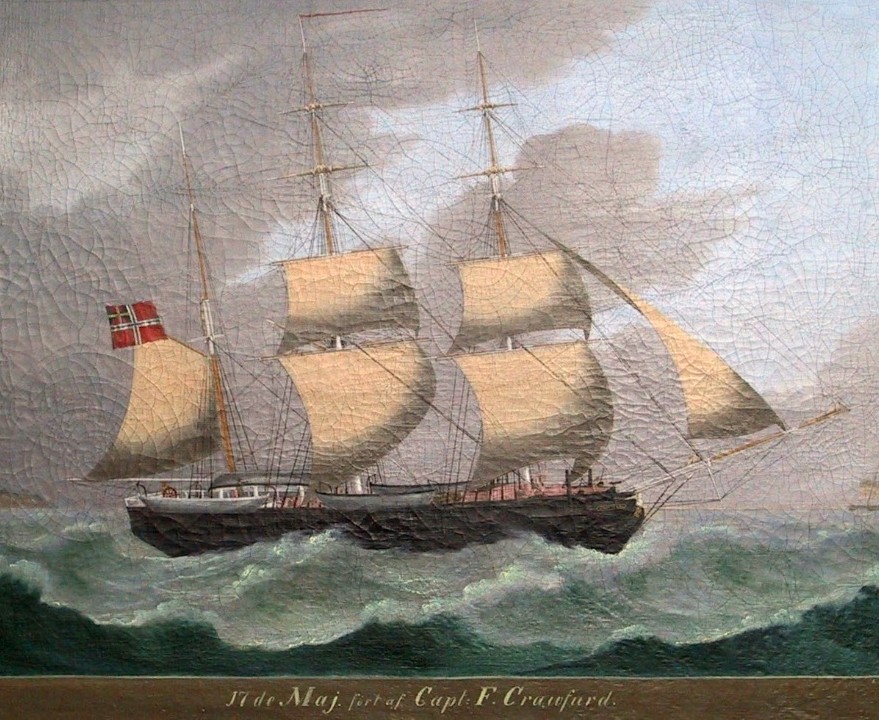
The Norwegian bark 17de Mai had an unusually varied career. Originally the Danish brig Coromandel, the vessel was according to some sources built on the Coromandel Coast of India. By 1836 it had reached Norway, where it was rebuilt at Arendal and subsequently entered service under the name 17de Mai. During its Norwegian career, the vessel was employed in ordinary Atlantic trade, made a pioneering whaling voyage to the South Pacific, rounded Cape Horn, and eventually carried Norwegian emigrants from Bergen to New York.
Early Carreer:
During its early career, the vessel sailed in the Danish merchant fleet. Historical records of the ship survive from the Government-General of the Danish West Indies for the period 1826–1833, when Captain Mammen sailed the brig on routes between Saint Thomas and Hamburg.
From Coromandel to 17de Mai
In February 1836, the brig Coromandel was advertised for sale at public auction. The vessel had recently arrived from Boston under Captain Frederik Møller and was lying at Arendal. The advertisement described her as a copper-bottomed and copper-sheathed brig of 136 commerce lasts, to be sold together with her inventory.
The vessel was subsequently rebuilt at Arendal in 1836 at a reported cost of 3,688 speciedaler and renamed 17de Mai (also occasionally referred to as "Syttende Mai"). She was owned by Christian Stephansen of Arendal, and A. Bie Jørgensen became her master.
Contemporary and later sources give somewhat different figures for her tonnage. Lloyd's reportedly listed her at 303 tons in 1837, while she was measured at 146½ commerce lasts in 1846. An advertisement in 1848 described her as 133 commerce lasts. Her recorded dimensions were approximately 96.7 feet in length, 27.9 feet in breadth, and 16.2 feet in depth.
During her first years as 17de Mai, the vessel was employed in international trade. In November 1836 she cleared from Arendal for Drammen under Captain Jørgensen. In 1838 she sailed from New York for Antwerp. On this voyage she encountered severe storms before reaching Europe, and she arrived at Antwerp in March. She was still trading between Norway and continental European ports in the early 1840s, including Antwerp and Vlissingen.
The South Pacific Whaling Expedition
The 17de Mai Painter: L. Petersen. Owner: Grimstad Sjømannsforening
In 1843, 17de Mai was selected for a much more ambitious undertaking. A group of Norwegian investors, principally from Arendal but also from Christiania and several other Norwegian towns, organized a South Pacific whaling expedition.
The initiative came from Christian Stephansen, one of Arendal's leading businessmen. In a circular dated June 29, 1843, investors were invited to subscribe to a proposed fifty shares of 600 speciedaler each. Interest was considerable, and on September 8 the enterprise was formally constituted with 39½ shares subscribed. Christian Stephansen, Emil Kallevig, and R. B. Herlofsen were elected to its board.
The investors included merchants, shipowners, public officials, and other prominent individuals from several parts of Norway. Most of the capital came from Arendal, but investors also participated from Christiania, Larvik, Skien, Fredrikshald, Christianssand, Stavanger, Holmestrand, and even Stockholm.
Captain Fredrik Crawfurd of Grimstad was appointed master of 17de Mai. Because Norway had little experience with this type of whaling, foreign expertise was recruited. A young Frenchman with nine years of previous experience was engaged as the expedition's "fishing captain," responsible for the actual whaling operations. Seven additional French whalers were hired, four of them harpooners.
For the expedition, Stephansen's brig 17de Mai was converted into a bark and extensively fitted out for whaling. Among her equipment were six whaleboats constructed of cedar, a material chosen for its light weight and suitability for the purpose.
The crew numbered 32 men, including the officers. The organizers attempted to recruit a Norwegian physician and advertised in Christiania, offering 20 speciedaler per month. No Norwegian doctor accepted the position, and a French physician was eventually engaged at a salary of 80 francs per month.
By the middle of December 1843, preparations were complete. 17de Mai sailed from Arendal on December 21 with the Norwegian members of the expedition aboard. She was to call at Le Havre to embark the French participants before proceeding on her long voyage.
The expedition took 17de Mai around Cape Horn, and she is recorded as the first ship from Arendal to have rounded the cape. About a year after her departure, the vessel reached Honolulu in the Sandwich Islands, now Hawaii. By then, according to a later account of the expedition, she had taken approximately 800 barrels of whale oil, 25 barrels of spermaceti oil, and 6,000 pounds of baleen.
Despite this promising result, the expedition did not fulfill the expectations of its investors. 17de Mai eventually returned to Norway after approximately two years with only about one-third of a full cargo.
A retrospective account published in 1893 attributed part of the disappointing result to serious difficulties among the crew. According to this account, the foreign fishing captain and his men became dissatisfied and caused considerable trouble aboard the vessel. Captain Crawfurd was credited with having handled the difficult situation successfully and bringing the expedition to a safe conclusion.
The voyage nevertheless produced about 1,100 barrels of whale oil in total. Financially, the result was apparently not disastrous. The investors initially considered sending 17de Mai on another whaling expedition without requiring additional capital from the shareholders.
An Attempted Second Expedition
Captain Crawfurd, however, had had enough of the difficulties encountered during the first voyage and declined to command another expedition. Command of 17de Mai subsequently passed to Hans F. Bøckmann.
A second South Pacific expedition was planned for 1847. Before proceeding to the whaling grounds, 17de Mai was to sail from Arendal to New York, where Captain Bøckmann would recruit experienced American whalers and obtain provisions for the voyage.
The vessel was also advertised as a passenger ship. An advertisement in April 1847 described 17de Mai as a well-known and fast-sailing vessel that would depart from Arendal for New York around the middle of the following month. The advertisement emphasized that careful arrangements had been made for the comfort of passengers.
17de Mai finally departed Arendal on May 29, 1847. In addition to a cargo of iron, she carried nearly twenty emigrants bound for America. Her crew numbered 24 men. She arrived at New York on July 12.
The plan was to recruit American whalers in New York before continuing to the South Pacific, but circumstances prevented the expedition from proceeding. Five of the vessel's best sailors deserted after her arrival. Replacing them would have been expensive, and provisions in New York were reported to cost approximately twice as much as had been anticipated. The expense of fitting out the vessel for the intended voyage therefore became too great.
Under his instructions, Captain Bøckmann decided not to continue with the whaling expedition. Instead, 17de Mai took freight back across the Atlantic and arrived at Liverpool in September 1847.
This effectively brought the South Pacific whaling venture to an end. The company abandoned its plans for further ship-based whaling and 17de Mai returned to ordinary freight service.
The Vessel Offered for Sale
By February 1848, 17de Mai was being offered for sale privately by the management of the South Pacific expedition. Later that year, a public auction was announced for November 24 at Arendal.
The auction notice provides a particularly detailed contemporary description of the vessel. 17de Mai, then stated to measure 133 commerce lasts, was described as being constructed of high-quality oak, pine, and teak and as an exceptionally good sailing vessel. Particular attention was drawn to her South Pacific whaling voyage of 1844–46.
The vessel had received new copper sheathing of high-quality Muntz yellow metal the previous year. Because of her construction and fittings, she was considered especially suitable both for whaling and ordinary freight service. She could be purchased either with or without the barrels, fishing equipment, kettles, and other gear associated with her use as a whaling vessel.
Sold to Bergen
The vessel remained at Arendal until early 1849. In February, newspapers reported that the former South Pacific whaler 17de Mai had been sold to Bergen for a cash price of 6,000 speciedaler.
She had been purchased by the Bergen merchant Franz Folchedal. Captain Fritz Serck took command and brought the vessel from Arendal to Bergen in March 1849.
This change of ownership opened another chapter in the vessel's career. Rather than returning to the South Pacific, 17de Mai was now employed in the growing transatlantic traffic between Norway and the United States.
Emigrant Voyage from Bergen to New York, 1849
In May 1849, the bark 17de Mai, Captain F. Serck, cleared from Bergen for New York. She subsequently crossed the Atlantic with Norwegian emigrants aboard.
The vessel arrived at New York on June 25, 1849. The passenger list filed at the New York Custom House was dated June 26 and identified the vessel as the Norwegian bark 17de Mai from Bergen. In this American record her tonnage was given as 330 tons.
The 1849 voyage marked another transformation in the career of a vessel that had already served in several very different branches of nineteenth-century maritime activity. Built in India as the Danish brig Coromandel, she had become the Norwegian 17de Mai at Arendal in 1836. She subsequently participated in Atlantic commerce, was converted into a bark for an ambitious Norwegian South Pacific whaling venture, carried emigrants from Arendal to New York in 1847, and, after being sold to Bergen, entered the Norwegian emigrant trade again in 1849.
Her history illustrates the versatility of sailing vessels in the mid-nineteenth century and connects several important aspects of Norwegian maritime history: international commerce, the early development of Norwegian oceanic whaling, and the beginning of large-scale Norwegian migration across the Atlantic.