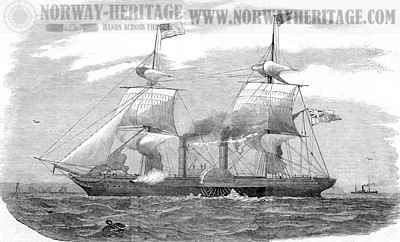
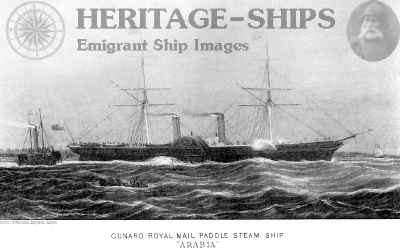
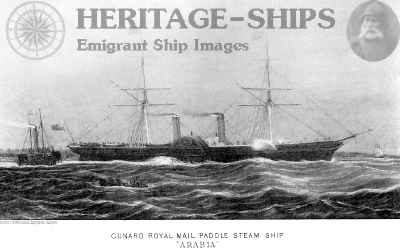
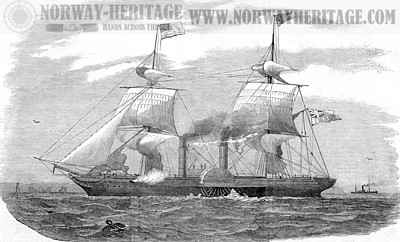
The Arabia was almost an identical sister of the S/S La Plata, a vessel originally laid down as the Arabia (1), until purchased on the stocks by the Royal West India Mail Company.
Her
engines were side levers of 950 horse power, by Napier, of Glasgow. She was larger in capacity, and considered to be handsomer in equipment, than the other Cunarders previously built. The figurehead of the Arabia was an Arab chief, in a warlike attitude. The stern, which was elliptical, was beautifully ornamented. The promenade deck extended the entire length of the vessel.
The Arabia was of the following dimensions : 285 feet keel and fore rake; beam, 41 feet; depth of hold 28 feet; Customhouse measurement, 2.333 37-100 tons ; the engines of 9 feet stroke; the diameter of the cylinders 103 inches; and the diameter of the paddle-wheels 36 feet. She was provided with tubular boilers, which were fired from amidships. She had two masts, unlike the other vessels of the Cunard Company at the time, which had three; and there were two funnels. With exceptionally fine lines forward, and powerful engines, she was remarkably fast in smooth water, and often managed 15 knots, but rough weather pulled her down at once. She was very "wet", and her machinery shook her to pieces, but under normal conditions was good for 13 knots. Her boilers were peculiar, being the biggest box generators built up to that time, having the tubes running athwartships and furnaces facing one another in a rather inconvenient Manner. They were shipped in sections after she was launched and riveted together inside the ship. They were efficient enough, but were terrible coal eaters, burning 120 tons a day under favorable circumstances.
The internal arrangements of the Arabia were very similar to those in the other vessels of the Cunard fleet, the comfort and convenience of passengers being the first consideration. Beneath the upper deck were saloons, stewards' pantry, &c. Between the pantry and the saloon there were two well-furnished libraries. The saloon itself was capable of dining 160 persons; and here a different style had been adopted from that to be seen in the other ships of the line. As the vessel had no mizenmast, the saloon formed an unbroken apartment, and the absence of the mast had also given an opportunity to introduce a cupola, filled with stained glass. The cabinet work was of bird's-eye maple, panelled with a marqueterie of ebony. The ceiling blended oak beams, with green, gold, and white alternately. In the upholstery, crimson hangings had been adopted. The sofas were covered with Utrecht crimson velvet, and the floor was laid with a rich tapestry carpet. The stern lights of the saloon were filled with stained glass, representing groups of camels, with their drivers, and other Oriental sketches; and the opposite end of the saloon was decorated with plate-glass mirrors, in highly-wrought gilt frames.
There were no fireplaces, the whole of the apartments was heated by steam pipes traversing the floors, and the temperature could be regulated at pleasure. The gentlemen's retiring saloon was panelled with bird's-eye maple, and curtained and carpeted in the same way as the saloon. The ladies' boudoir, on the same deck, was of satinwood, exquisitely carved in arabesques, and through the openings of which a crimson silk background was introduced. The sofas were covered with Utrecht velvet. A velvet pile carpet was laid on the floor, and the panels were adorned with paintings on glass, representing scenes in Arabia and other parts of the East; amongst which was a view of Jerusalem, another of Mount Ararat, and an encampment in the desert. The sleeping apartments were hung with Tourney curtains, and the floors were laid with Brussels carpets. The Arabia was the last wooden Cunarder to be built as three years later iron construction was started with the
Persia. The best time performed by the Arabia from New York to Liverpool was 9 days 17 hours in August 1853.