The Argo was a copper-sheathed bark registered in Christiania (Oslo), with the flag code A103. An advertisement from 1853 gave her burden as 184 Norwegian commercial lasts and described her as having a strong hull and an eight-foot-high between-deck (steerage).
The Voyage of 1852
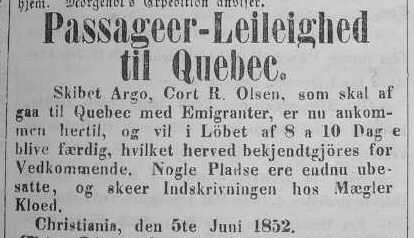
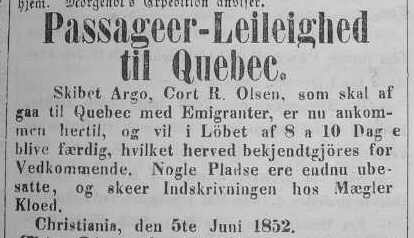
Advertisement printed in Morgenbladet 1852
An advertisement dated June 5, 1852, announced that the Argo, commanded by Captain R. Olsen, had arrived at Christiania and was expected to be ready to sail for Quebec with emigrants within eight to ten days. Some berths were still available, and bookings could be made through the shipbroker Kloed. The Argo departed from Christiania in mid-June with a reported 207 emigrants. Most of the passengers were in severe financial hardship after waiting for several months near the waterfront for an opportunity to leave. Steffen Olsen had initially undertaken to arrange their passage, but those arrangements had fallen through. The matter had prompted comments in Drammens Blad and a response from Olsen in Christiania-Posten.
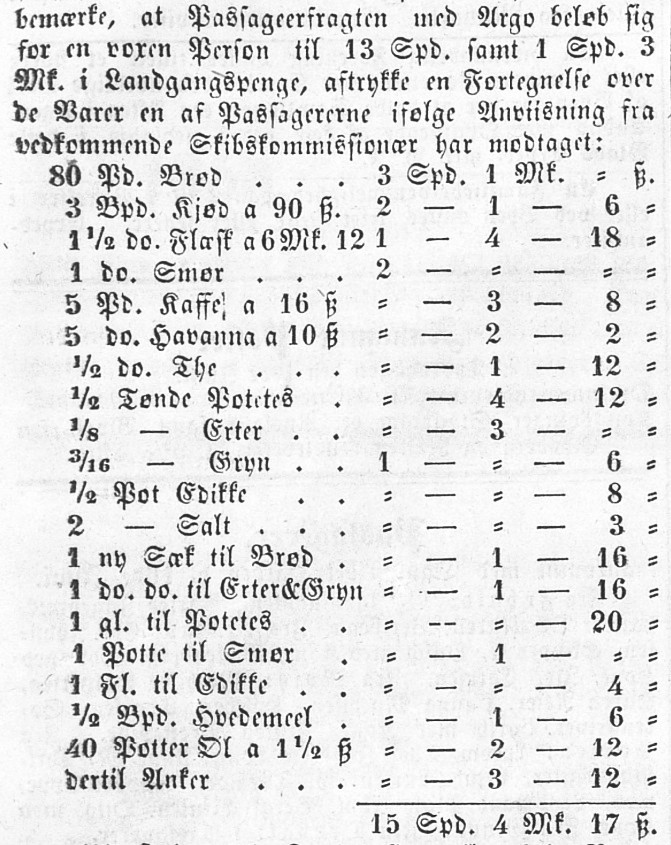
Most of the emigrants came from Valdres, with smaller numbers from Ringebu, Sandsvær, and Østerdalen. Thirteen were from Christiania, most of them artisans. The newspaper listed 130 adults, 15 children aged ten to fifteen, 23 aged five to ten, 32 aged one to five, and seven infants under one year. Passage cost thirteen speciedaler per adult, with an additional landing charge of one speciedaler and three mark. To illustrate the supplies required for the crossing, the newspaper reproduced a list of provisions purchased by one passenger on the advice of the ship’s agent. These included bread, meat, pork, butter, coffee, sugar, tea, potatoes, peas, groats, vinegar, salt, wheat flour, and beer, together with sacks, containers, and a small cask. The total cost of the supplies was just over fifteen speciedaler.
List of provisions printed in Christiania-Posten,18. juni 1852
The Argo reached Quebec on August 12. For passengers continuing inland, the Atlantic crossing was only one stage of a much longer journey. Their onward travel could involve river steamers, railroads, wagons, journeys on foot, and passage across the Great Lakes. Captain Olsen arranged with a transportation company to carry the emigrants and their baggage to Milwaukee for seven dollars per adult, with children traveling at half fare. On August 14, their baggage was loaded aboard a large steamer, which left Quebec at five o’clock that afternoon and reached Montreal at six the following morning. Olsen accompanied his passengers as far as Montreal, where he took leave of them. Shortly afterward, Thorsten Nilsen Majestad from Valdres fell overboard while unloading his baggage. His fellow passengers witnessed his struggle, but no suitable rescue equipment was immediately available. His body was eventually recovered by dragging the water. He left behind a family who had lost both a loved one and their provider.
At Buffalo, a group of 132 Norwegian emigrants boarded the steamer Atlantic, commanded by Captain Patty, for passage to Detroit. The vessel reportedly carried 576 passengers, including the Norwegians, a number of Germans, and American travelers. At about two o’clock in the morning on August 20, the Atlantic collided with the steamer Ogdensburg on Lake Erie and sank. Many of the Argo’s passengers were among the victims. Sixty-seven Norwegian emigrants were reported to have drowned. See: Disaster on Lake Erie in 1852
The Voyage of 1853
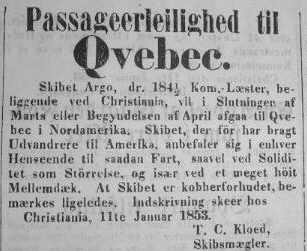
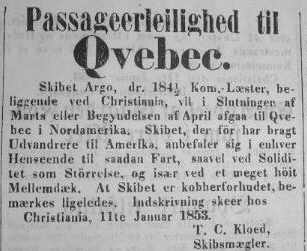
Newspaper announcement printed in Morgenbladet January 11, 1853.
An advertisement dated January 11, 1853, announced that the Argo would sail from Christiania for Quebec in late March or early April. It stated that the vessel had carried emigrants to America for several years and recommended her as particularly suitable for passenger service. Bookings could be made through the shipbroker T. C. Kloed in Christiania.
The Argo departed from Christiania on April 13 and arrived at Quebec on May 28. According to a notice published in Christiania-Posten on Saturday, May 7, 1853, the Argo carried 250 passengers on her voyage that year, a number the writer considered excessive. The notice also criticized the arrangement of the berths in the between-deck, which ran athwartships rather than fore and aft, an arrangement regarded as less favorable for passengers. The shipowner was accused of placing profit ahead of passenger welfare.
After arriving at Quebec the Argo emigrants encountered severe complications regarding their onward transportation to the western states. Elias Stangeland had traveled from North America to Norway earlier that year, presenting contracts from the Buffalo-based company Maxwell and Patten to arrange secure, prepaid passage for emigrants upon arrival. However, the initial reports published in Norway presented a sharply divided picture of the actual conditions in Quebec. Supporters of Stangeland argued that Maxwell and Patten were reputable businessmen and that any disruption in Quebec stemmed from fierce competition among railway runners and corrupt local officials who misinformed passengers to secure higher fares. According to this perspective, the Argo passengers were misled by these third-party agents upon arrival in Quebec and were diverted away from the intended transit route, preventing them from meeting company representatives in Buffalo where refunds for prepaid freight were being issued.
Conversely, critical reports published in the emigrant press offered a far more damaging account of the operation. These sources alleged that Maxwell and Patten possessed no actual transportation line or binding contracts between Quebec and Buffalo, and that the entire arrangement was a speculative venture meant to drive passengers onto the company's propeller ships in Buffalo. When freight costs from Quebec to Buffalo rose by one dollar that spring, the profit margin for the agents dissolved, leading Maxwell and Patten to abandon logistics in Quebec altogether. Consequently, the Argo passengers lost the money they had prepaid in Norway, as no company representative was available to honor their agreements or manage their transit. They were ultimately saved from total financial loss only when an agent for a competing American steamboat line accepted their Norwegian contracts and sought to recover the funds from Maxwell and Patten directly.
The Voyage of 1857
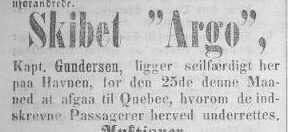
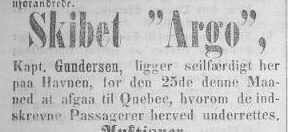
An advertisement published on April 25, 1857, announced that the Argo, commanded by Captain Gundersen, was lying in the harbor ready to sail. Her departure for Quebec was scheduled for May 25, and registered passengers were asked to make the necessary preparations.
She departed on May 26 with 252 passengers, chiefly from Gausdal, Vardal, and Røros. About fifty came from Christiania, most of them artisans. According to a contemporary newspaper report, the passengers carried at least $7,000 between them, since the ship’s agent had exchanged that amount into dollars on their behalf.
Newspaper announcement printed in Morgenbladet April 25, 1857
Among those aboard were Amund Mortensen Holthagen and Elling Johansen Syverud. A letter sent home described seasickness, illness, and deaths during the crossing. The following passage is translated from the letter:
“Karen, Christian, and I were seasick at first, but the others remained quite well throughout, except for Amund, who was confined to bed until his life came to an end. He died on June 4 at five o’clock in the morning and was buried at sea at ten that morning. A burial service was held, and we sang the hymn ‘Vor Tanke bort fra Jorden Iler.’
“There were eight deaths aboard the Argo. Apart from Amund, all those who died were small children. Gulbrand Ovren lost his son, and Johanes and Berte Bjørge lost their child. The other children belonged to people we did not know. The deaths were most likely caused by ‘Krilla,’ or ‘Krufsa,’ as they called it.”
[Translated form a transcription printed in the book "Fra Amerika til Norge, Norske utvandrerbrev 1838 - 1857" (From America to Norway, Norwegian emigrant letters 1838 - 1857) by Orm Øverland and Steinar Kjæheim.]
The letter attributed the deaths to an illness described by the names “Krilla” and “Krufsa,” interpreted in the accompanying transcription as measles.
Among the passengers were also Ole Syversen Enger, his wife, and their three children. On June 27, they continued from Quebec up the St. Lawrence River aboard the steamer Montreal. The vessel caught fire off Cape Rouge, causing a major loss of life. Ole, his wife, and two of their children died, while their ten-year-old son Elias was rescued. Estimates cited for the disaster ranged from 200 to 300 deaths, with Scottish emigrants said to have accounted for most of the victims.
Passenger Records
The Argo’s voyages described here predated the surviving Canadian passenger-list series beginning in 1865 and the Norwegian police emigration registers beginning in 1867. Passenger lists for these voyages are therefore not available in those regular archival series. Contemporary newspapers, private letters, and other records may nevertheless provide names and details about individual passengers.
Chronological History
Year
Event
1848
Aug. 31 Marseille from Sundsvall, Capt. Olsen
1850
July 30 off Dover, from Torrevieja
1850
Nov. 6 at the Needles: from Norway to Rochfort
1851
Feb. 4 Cardiff for Gibraltar, Capt. Olsen
1851
Oct. 1 Barcelona from Newcastle
1851
Nov. 4. Leaving Barcelona for Torrevieja
1851
Nov. 8. Torrevieja from Barcelona, left 12th for Christiania
1851
Dec. 12 Christiania from Torrevieja with salt
1852
April 16 Gravesend from Christiania
1852
May 22 leaving London for Christiania
1852
June 4 Christiania from London in ballast with a few goods
1852
Captain R. A. Olsen. Departed Christiania June 15. Arrived Quebec Aug. 12.
1852
Sept. 6 leaving Quebec for Grimsby
1852
Oct. 26 off Deal: from Quebec to Hull
1852
Oct. 29 Hull from Quebec
1852
Nov. 20 leaving Hull for Christiania
1853
Captain G. Müller. Departed Christiania Apr. 13. Arrived Quebec May 28.
1853
July 29 departed Quebec for Llanelly
1856
July 16 Deal from Quebec
1857
Jan 23 departed Queenstown for Christiania, Capt. Gundersen
1857
April 16 arrived in Christiania from Arendal
1857
Captain Gundersen. Departed Christiania Apr. 25. Arrived Quebec June 15.
1857
June 26 departed Quebec for London
1857
Aug. 15 departed Quebec for London
1857
Sept. 30 arrived at Gravesend from Quebec
1857
Oct. 31 arrived at Christiania from London in ballast