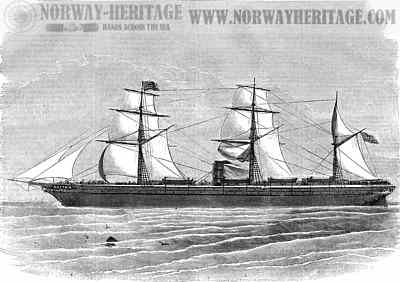
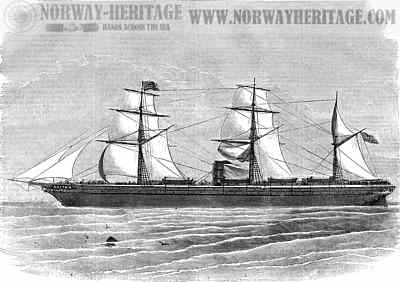
On September 13, the Austria was making good progress across the Atlantic, and those aboard expected to reach New York on September 18. At about two o'clock in the afternoon, however, smoke was seen rising from one of the after hatchways. Within a short time, flames were spreading from the lower deck.
One of the most detailed accounts of the disaster was given by Chartres Brew, an English civil servant travelling to British Columbia. According to Brew, the fire spread with extraordinary speed. The engines continued to run for some time, while smoke and flames made parts of the ship inaccessible. As the vessel headed into the wind, the flames were driven aft toward the quarterdeck, where many of the cabin passengers had gathered.
Attempts were made to launch the lifeboats, but confusion and overcrowding made this extremely difficult. One boat was apparently destroyed near the propeller, while another capsized after passengers crowded into it before it had been properly lowered. An iron lifeboat containing 39 people also capsized several times; only 23 of its occupants eventually reached safety.
As the fire spread, passengers were forced toward the stern. Some of those below deck were unable to escape, while others were pulled through a skylight. Eventually the heat and flames became so intense that people began jumping from the quarterdeck into the sea.
Brew escaped by lowering himself from the ship toward an overturned boat. After cutting it free, he was thrown into the water when the boat drifted toward the still-moving propeller and capsized again. He subsequently managed to right another overturned boat and, despite having no proper oars, used pieces of wood to move away from the burning vessel and assist another survivor.
Rescue came from the French barque Maurice, commanded by Captain Ernest Renaud of Nantes. Brew was taken aboard at about 6:30 p.m., after approximately five hours in the water and the damaged boat. The Maurice had already rescued about 40 people. More survivors arrived later in one of the Austria's lifeboats, while several others were picked up from wreckage. By the end of the night, 67 survivors had reached the French vessel. Several were badly burned.
According to the account, the fire had begun during an attempt to fumigate the lower deck with burning tar. An iron chain had been heated for the purpose, but became too hot to hold and fell onto the deck. A container of tar was overturned, and the fire spread almost immediately. Attempts to extinguish it proved ineffective.
The precise circumstances surrounding the actions of Captain Heydtmann remained uncertain. Brew reported hearing that the captain had rushed on deck, attempted to help launch a boat, and disappeared after the boat capsized. Other contemporary reports differed as to exactly how he was lost.
The scale of the disaster became apparent when the survivors were counted. Of the 538 people reported aboard the Austria, only 67 were known with certainty to have been rescued by the Maurice. A Norwegian barque was seen near the burned-out vessel the following morning, raising hopes that a few additional survivors might have been found, but this could not be confirmed in the account.
The loss of the Austria was therefore one of the most catastrophic consequences of fire aboard an emigrant steamship. Brew's testimony is particularly valuable because it records not only the rapid spread of the fire, but also the confusion surrounding the launching of the boats and the difficulties faced by passengers attempting to escape from below deck.
Chronological History
Year
Event
1857
Launched June 23
1857
Indian Mutiny transport
1857
Arrived Plymouth with serious storm damages
1858
May 1, first voyage Hamburg-Southampton-New York
1858
Destroyed by fire in the North Atlantic, 471 lives lost