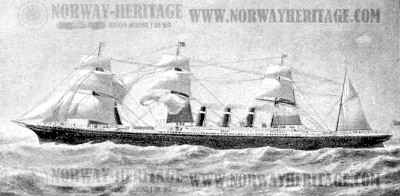
S.S. City of Rome, Inman Line

Ship Data

Type Built Burden Dimensions Line / Owner
S.S. 1881 at Barrow by Barrow Shipbuilding Co. 8,415 gross 560.2ft x 52.3ft Inman Line

Constructed of iron, clipper stem, three funnels, four masts, single screw and a speed of 16 knots. There was accommodation for 271-1st, 250-2nd and 810-3rd class passengers. She was considered by many to be the most beautiful steamer ever built.
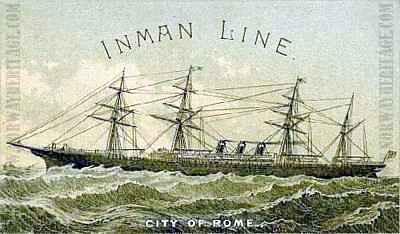
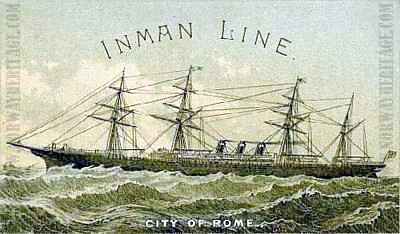
City of Rome, Inman Line steamship
Old tradecard showing the S/S City of Rome, on this picture she is rigged as a four-masted bark
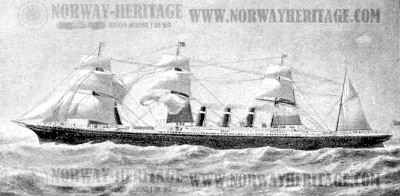
 
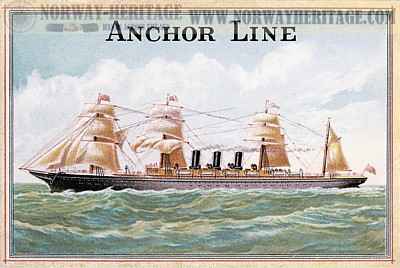
City of Rome, Anchor Line steamship
On this picture showing with her sails up. Both above pictures the ships are seen with Inman Line colros on funnels (black, white band and black top).
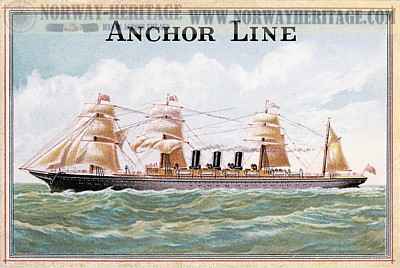
 
City of Rome, in Anchor Line service
City of Rome with funnels painted black for Anchor Line service.

This card was issued by the agent and has an announcement on the reverse side
Support Norway Heritage: Purchase a copy


From "The Atlantic Ferry" by A. J. MAGINNIS (p.49):
..the City of Rome was launched at Barrow on June 14th, 1881, and sailed on her first voyage from Liverpool, October 13th, 1881. This graceful vessel was the subject of much comment when being built, but the great expectations were, however, not realized. The construction of the hull, beyond being exceptionally strong, calls for no comment. She was built of iron throughout, and was 560 feet long, 52 1/4 feet broad, and 37 feet deep, and of 8144 tons; three funnels were for the first time fitted, which being uniformly spaced with four masts, gave the vessel a noble appearance in conjunction with the graceful bow and general outline of the hull. For the machinery, which was also by the Barrow Company, the three-crank engine was adopted, but it differed from the other types in the fact that there were six cylinders, three high-pressure, each 46 inches, and three low-pressure, each 86 inches diameter, fitted tandem fashion, with a stroke of 6 feet. A great departure was made in the working of the slide-valves by means of spur-wheels, which geared the weigh-shaft (on which the eccentrics were, fitted) with the crank-shaft, and thus enabled the valves to be fitted at the back of the cylinders. Hollow shafting was also fitted throughout, except for the propeller length. The boilers, which were of the usual type in iron, carrying 90 Ibs. pressure, were eight in number, with forty-eight furnaces' placed two and two in fore and aft line, which enabled a water-tight bulkhead to be fitted fore and aft on each side, so as to form the coal bunkers; this excellent arrangement was, however, altogether altered, as well as other parts of the machinery, after she was, returned to the builders, with a view of attaining a speed more in accordance with the newer Atlantic vessels. After completion of these alterations, she was again put in the Express Service, under the auspices of the Anchor Line, in 1884, where she remained until 1891.
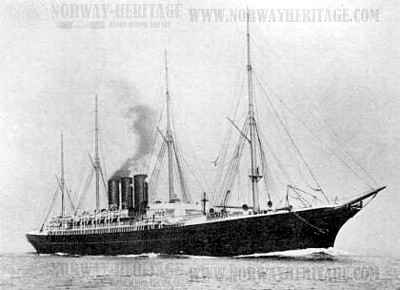

 
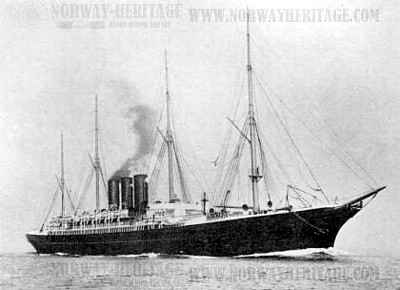
Photograph of the S/S City of Rome
Photograph of the S/S City of Rome, note that the rig has been altered, yards having been removed. This picture shows her rigged as a four-masted schooner
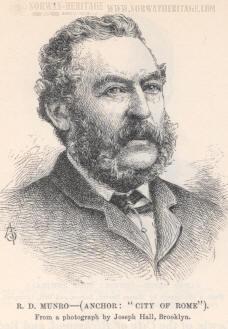
Capt. R. D. Munroe, Commodore of the Anchor Line fleet

Chronological History

Year Event
1881 June 14, launched for the Inman Line
1881 Oct. 13, maiden voyage Liverpool - Queenstown [Cobh] - New York (5 voyages)
1881 Liverpool Oct. 13 → New York Oct. 24. 1480 passengers arrived at 20:00 evening.
1882 Liverpool Apr. 6 → New York Apr. 15. 1410 passengers arrived at 23:00 evening after crossing the Ocean in 8 days 5 hours and 30 min..
1882 Liverpool May 12 → New York May 20. Queenstown 1882-05-12, 1625 passengers arrived New York at 06:00 morning after crossing the Ocean in 7 days 12 hours and 45 min..
1882 Liverpool June 15 → New York June 23. Queenstown 1882-06-16, arrived New York at 10:00 morning after crossing the Ocean in 7 days 16 hours and 45 min.<BR>Also reported to depart 1882-06-16 and arrive 1882-06-24.
1882 Liverpool July 20 → New York July 28. Queenstown 1882-07-21, 928 passengers arrived New York at 08:00 morning after crossing the Ocean in 7 days 15 hour and 10 min..
1882 Sold to The Barrow Steam Ship Co. Ltd., operated by Anchor Line, name remained City of Rome
1882 Aug. 25, first voyage for the Anchor Line, Liverpool - Queenstown - New York
1882 Liverpool Aug. 26 → New York Sept. 3
1890 Rebuilt to accommodate 75-1st, 250-2nd and 1,000- 3rd class passengers
1898 September, used to repatriate 1690 Spanish troops from Portsmouth, USA to Santander, Spain after the Spanish - American war
1902 Scrapped in Germany

Other ships named "City of Rome"

Ship Line / Owner
City of Rome Anchor Line

Pictures

Leave a Comment

Comments are reviewed before they appear publicly. Fields marked with * are required.

Your email will never be shown publicly.
10000 characters remaining