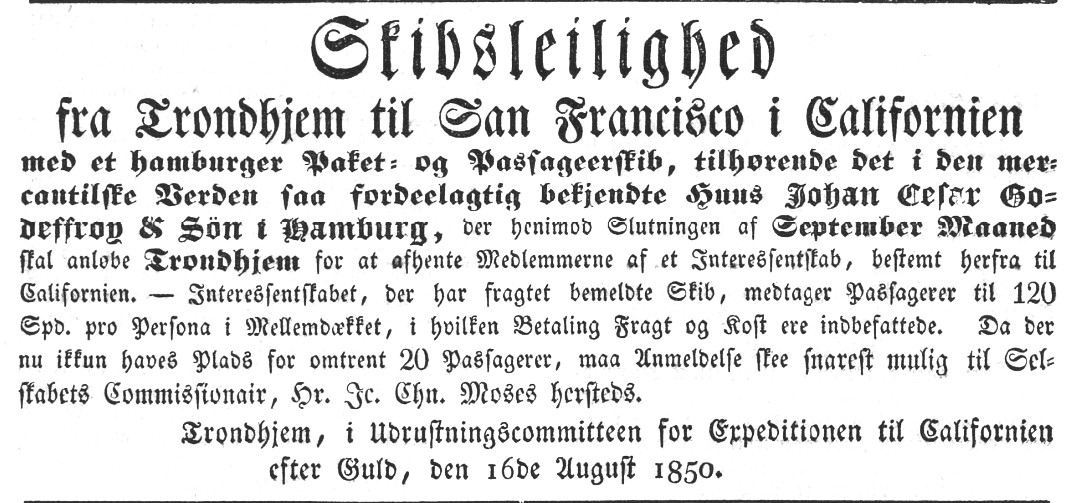
Newspaper announcement from Trondhjems borgerlige Realskoles alene-priviligerede Adressecontoirs-Efterretninger 1850.08.29
An advertisement published in Trondheim on August 16, 1850, provided details about the organization of the California expedition. It announced that a Hamburg packet and passenger ship belonging to the merchant house Johan Cesar Godeffroy & Son of Hamburg, a firm described as well known in commercial circles, was expected to call at Trondheim toward the end of September to take aboard members of a local syndicate bound for California. The syndicate had chartered the vessel and also offered passage to additional travelers. The fare was 120 Speciedalers per person for accommodation in the steerage or lower deck, with both freight and provisions included in the price. At the time the advertisement appeared, space remained for only about 20 additional passengers, and prospective travelers were urged to apply as soon as possible to the syndicate’s commissioner in Trondheim, Jc. Chn. Moses. The notice was issued in Trondheim on August 16, 1850, by the "Outfit Committee for the Expedition to California for Gold".
The Sophie, under the command of Capt. C. H. T. v. Leesen, was cleared for departure on October 26, 1850, and sailed from Trondheim with 106 passengers bound for the goldfields of California. The emigrants intended to sail aboard Sophie all the way to San Francisco. The voyage initially proceeded southward across the Atlantic. At Christmas, Sophie was off Madeira, where the passengers celebrated with julegrøt, traditional Norwegian Christmas porridge. On January 20, 1851, the ship reached Rio de Janeiro, where fresh provisions were to be taken aboard before the voyage continued. Instead, the expedition encountered a serious setback.
Upon arrival in Rio de Janeiro, the captain refused to continue the voyage, claiming that Sophie was no longer fit for the passage around Cape Horn. An inspection confirmed that the ship was in poor condition and required extensive repairs before the voyage could continue. The cost of carrying out the necessary work in Brazil was beyond the resources available to the chartering syndicate and the passengers. As a result, the planned voyage to California had to be abandoned. The prolonged and unexpected stay in Rio placed the emigrants in an extremely difficult position. Their original travel plans had collapsed, much of their available capital was at risk, and yellow fever was widespread in the city at the time.
A letter written by one of the emigrants later provided a detailed account of what happened next. According to the letter, all hope of continuing to California aboard Sophie had been abandoned because of the ship’s poor condition and the cost of refitting her in Rio. Labor was extremely expensive, and the emigrants had also arrived during a particularly unfavorable season, when yellow fever was widespread in the city. After five or six weeks in Rio and considerable discussion about what they should do, arrangements were made for a large group of the emigrants to settle in Brazil. The Hamburg commercial firm Schröder & Co. was establishing a colony at Dona Francisca in the province of Santa Catharina on land that the Emperor of Brazil had presented to the Prince of Joinville of France.
On March 4, 1851, the emigrants who had accepted this alternative left Rio aboard a small American schooner. The letter writer stated that 73 members of the group traveled aboard the schooner. They spent five days on the open sea, with very limited accommodations and most of the passengers having to lie or stand on deck. After reaching a small coastal town called St. Francischo, they continued by boat to the new colony, which lay about one Norwegian mile, approximately 10 kilometers, from the sea. On the same day, the colony also received its first German immigrant ship, carrying 117 passengers.
Other accounts stated that 74 of the Sophie emigrants accepted the offer to become colonists in Brazil. The difference between this figure and the 73 passengers mentioned in the contemporary letter was not explained in the available accounts.
Life at Dona Francisca
The Norwegian settlers soon began acquiring and clearing land. The letter writer joined four others in purchasing property as a five-man partnership. According to his calculation in Norwegian currency and measurements, they paid about 2 Ort per Mæling, with a Mæling representing approximately one-quarter of an acre. The land was heavily forested and filled with roots. Once the trees had been cut and burned, however, crops could be planted among the remaining roots. The settlers grew, or expected to grow, rice, maize, potatoes, coffee, cotton, oranges, lemons, bananas, and other crops. The climate allowed cultivation throughout much of the year, with new crops being planted as others were harvested.
Six weeks after arriving, the settlers planted a small quantity of potatoes. Although much of the seed had been damaged, they were able to eat potatoes from their own harvest about two months later. Progress was nevertheless slow. The colony’s manager, Mr. Schröder, became ill for six weeks, and according to the letter, the distribution and organization of the settlers’ land largely came to a halt during his illness. The Norwegians also worked at cutting timber, sawing boards, and building houses. They needed to construct new accommodations because another passenger ship from Germany was expected, and the newly arrived immigrants would require the buildings in which the Norwegians were temporarily living.
Some of the settlers also considered other ways of earning money. A group of fourteen planned to collect valuable tropical woods, including Pernambuco wood, sandalwood, yellowwood, and lignum vitae, with the hope of exporting them to Europe together with rice, sugar, and cotton. Gold also remained in their thoughts. The settlers had cleared a house site beside a river where they believed they had found traces of gold dust, although the site had not been thoroughly examined. Once their houses had been built and some crops planted, part of the group intended to travel farther into the mountains along a river where Brazilians claimed that gold could be found.
Disease and Death
Illness soon became a serious problem in the colony. Dysentery and typhoid fever were particularly common. The letter, dated July 2, 1851, reported that four of the 73 Norwegian settlers had died by that time:
S. Hansen from Helgeland, L. Stensem from Ytterøy, Luthersen from Horten, and Nordbye from Laurvig.
L. Stensem had belonged to the letter writer’s own group. Before his death, he asked that his property be liquidated and the proceeds sent to Lorents Møen at Ytterøy. The settlers intended, when circumstances permitted, to transfer the money through a bill of exchange drawn on Hamburg. By early July, the outbreak of illness had subsided, and the surviving members of the group were reported to be healthy again. The settlers lived among Brazilians, Germans, and French settlers, which created considerable language difficulties and forced the Norwegians to begin learning other languages. At that time, the colony had neither a church nor a pastor, although plans had been made to build a church and bring in a pastor from Germany. The Lutheran faith was intended to be the colony’s established religious confession.
The Fate of the Colony
The settlement did not provide the secure future many of the emigrants had hoped for. By 1854, only a small number of the Norwegian colonists were still living in Santa Catharina. A minister who visited that year mentioned only nine of them by name. Disease, the climate, and the hardships of establishing a new settlement caused many of the Sophie emigrants eventually to leave the colony. Some died, while others moved elsewhere. The passengers who had not joined the colony after the loss of Sophie followed different paths. Some returned to Norway, while others managed to continue to California on their own. The surviving letter from Dona Francisca, written on July 2, 1851, provided an unusually detailed contemporary account of the fate of the expedition only a few months after its original plan to reach California had collapsed.