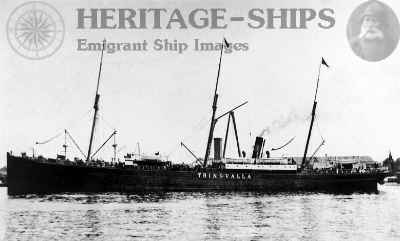
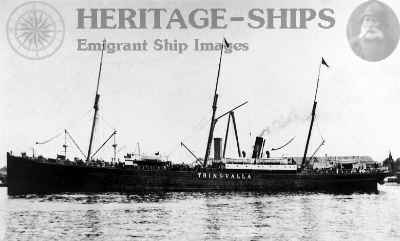
Her tonnage was 2,524 tons gross, 1,745 under deck and 1,630 net. She had one funnel and three masts. Originally she was rigged as a
bark, later
probably as a barquentine. in the 1887-88 Lloyd's Registry of Shipping, she is listed as being
schooner rigged. She was an iron construction, and had a single screw. She had 2 decks and spar deck, 6 cemented bulkheads and partial double bottom 600 tons. Aft Peak Tank and Forward Peak Tank. She had a
compound engine with 2 inverted cylinders of 30 and 60 inches diameter respectively, stroke 36 inches, operating at 60 p.s.i. delivering 225 horsepower (900 indicated horsepower) giving her a speed of 10 knots. The engine was built by the same company as the hull. There was passenger accommodation for 50-1st, 50-2nd and 900-3rd class. The ship was named after the field in Iceland where the old assemblies of the people were held according to Norse custom and usage, and where resolutions were passed for the benefit of their commonwealth. The year 1874
when the "Thingvalla" was built marked the 10th centenary of settlement in Iceland.
In 1888 the S/S Thingvalla collided with and sank the Thingvalla Line vessel "Geiser" off Sable Island with the loss of 105 lives:
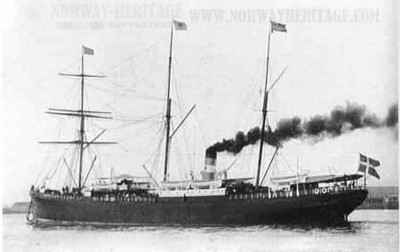 The Thingvalla painted in Thingvalla Line colors
[DFDS 1866-1991, p. 236, shown by the kind permission of Søren Thorsøe] |
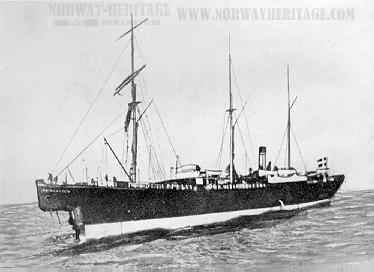 S/S Thingvalla after the collision with S/S Geiser |
Sources: [North Atlantic Seaway by N.R.P. Bonsor, vol.3,p.1050,][Lloyd's registry of shipping]
[Skandinavien-Amerika Linien, DFDS' passager- og fragtfart på Amerika, Søren Thorsøe, Simonsen, Krogh-Andersen, Frederichsen][DFDS 1866-1991 by Søren Thorsøe a.o., p. 236]