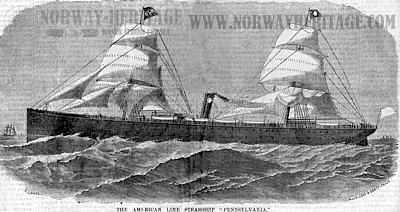
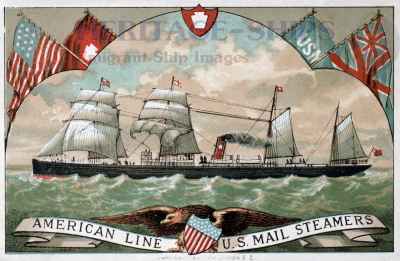
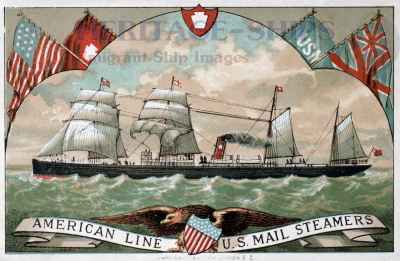
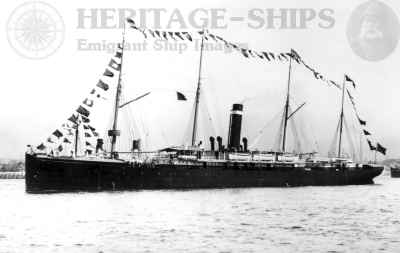
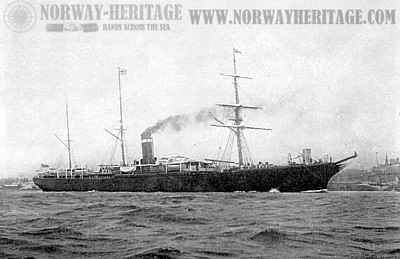
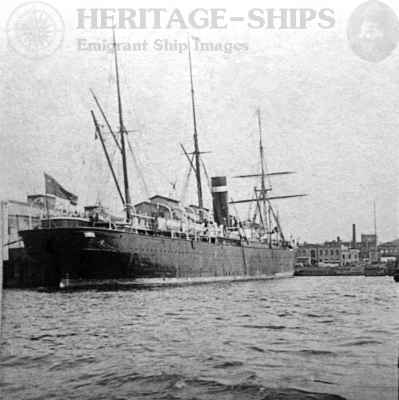
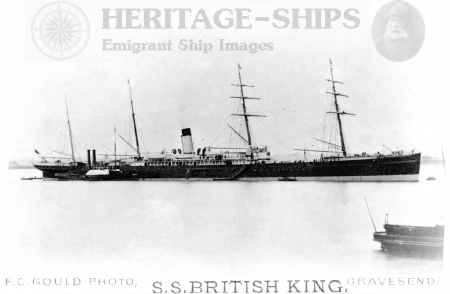
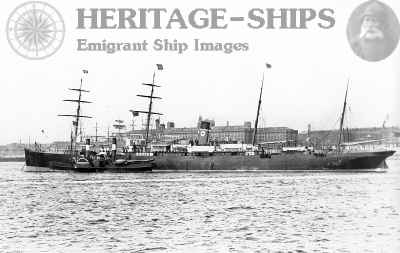
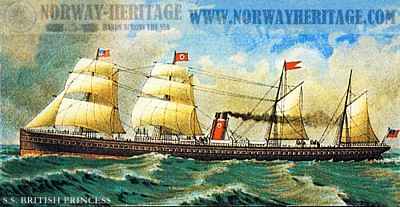
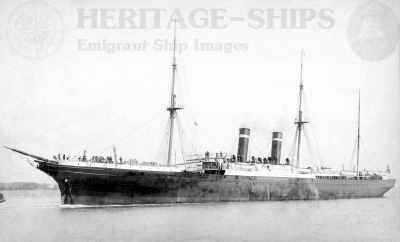
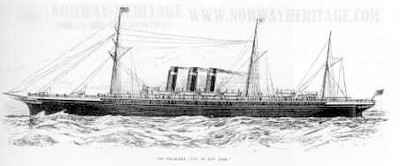
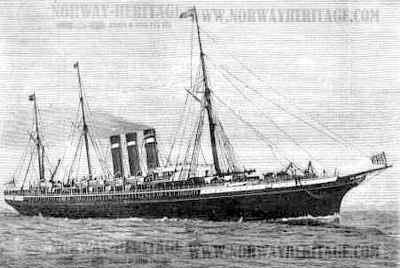
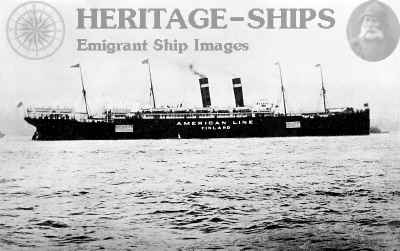
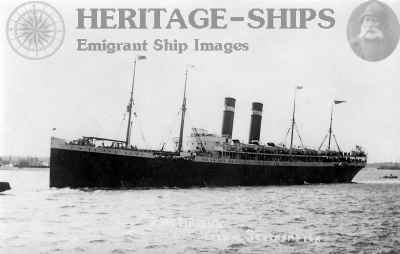
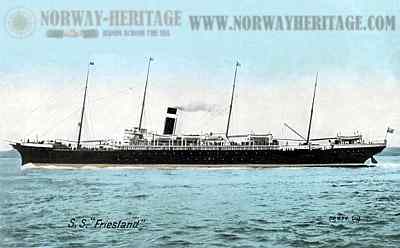
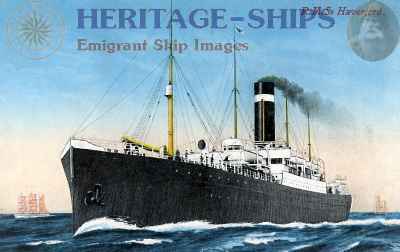
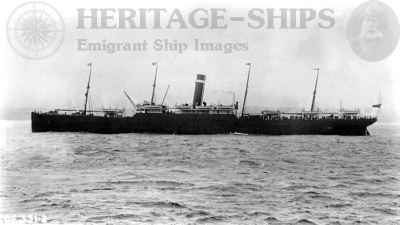
The S.S. Pennsylvania, built in 1873, was the line's first steamer. — Buy a copyAmerican Line steamships British Crown, British Empire, British King, British Prince, British Princess and British Queen — Buy a copy
he American Line was established as the American Steamship Company in 1872. Among the principal interests behind the company were Clement A. Griscom and the Pennsylvania Railroad Company. This connection with one of the major American railroad systems was important from the beginning, as the company aimed to provide not only transportation across the Atlantic but convenient connections to destinations throughout the United States and Canada.
The company's first four steamships, the Pennsylvania, Ohio, Indiana and Illinois, were sister ships built by the Cramp Shipbuilding Company in Philadelphia. These iron screw steamers of about 3,100 gross tons represented an attempt to establish an American-flagged passenger service in a North Atlantic trade increasingly dominated by British and other European companies.
The first service was established in 1873 between Liverpool, Queenstown and Philadelphia. The Pennsylvania inaugurated the service in May of that year, and regular weekly sailings followed. Contemporary Norwegian advertising described the vessels as new first-class mail steamships fitted with powerful machinery and modern passenger conveniences, and even claimed that a life-saving buoy was provided for every passenger. The ships normally departed Liverpool on Wednesdays for Philadelphia.
The American Line in Norway
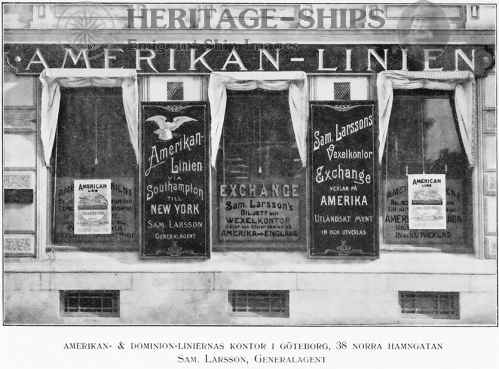
The American Line entered the Norwegian emigrant market remarkably soon after beginning its transatlantic service. Norwegian newspaper advertisements for the line appeared as early as 1874, and a regular system of transportation from Norway to destinations in America was clearly established.
From June 3, 1874, the company's general agent in Norway, A. Sharpe, was authorized for the conveyance of emigrants by the American Line via Hull and Liverpool to Philadelphia and onward to their final destinations in America. This shows that the service offered to Norwegian emigrants was conceived as a through journey rather than simply an Atlantic passage.
In Norway the service was promoted as "Den amerikanske Linie" and emphasized that its United States mail steamships formed the only transatlantic line sailing under the American flag. Passengers were conveyed from ports including Christiania, Christianssand, Bergen and Throndhjem to Hull, continued by railway across England to Liverpool, and there boarded the American Line steamships for Philadelphia.
Philadelphia distinguished the American Line from many of its competitors. While New York was the principal American gateway for most transatlantic lines, the close relationship between the American Line and the Pennsylvania Railroad made Philadelphia particularly suitable for passengers continuing inland. Contemporary advertising offered transportation not only to Philadelphia but also to New York, Boston, Baltimore and destinations throughout the United States, Canada and New Brunswick.
For many Norwegian emigrants, Philadelphia was therefore only another stage in a much longer journey. The authorization of 1874 specifically covered transportation to the passenger's final destination in America, demonstrating how the steamship and railroad services were combined into a connected transportation system.
The advertisements also show that the company was establishing an agency network in Norway almost from the beginning, with representatives in Christiania and Christianssand and additional agents being sought in towns and rural districts.
Seen from the emigrant's perspective, the American Line was therefore not simply a steamship service between Liverpool and Philadelphia. It formed part of an increasingly coordinated system linking Norwegian agents and feeder steamships, British railways, transatlantic liners and American railroads. Much of the journey from Norway to the final destination in America could be arranged before the emigrant left home.
International Navigation Company
The character of the American Line changed substantially after it was acquired by the International Navigation Company of Philadelphia in 1884. International Navigation was already closely associated with the Red Star Line, operating between Antwerp and New York and Philadelphia. Although the individual line names continued to be used, American Line and Red Star Line increasingly formed parts of a common transatlantic organization, with ships employed on different services according to operational requirements.
International Navigation expanded further in 1886 when it acquired the Inman Line, one of the established British operators between Liverpool and New York. The Inman name continued to be used for several years, but in February 1893 it disappeared as a separate line name and its ships and services were transferred to the American Line.
The consolidation became particularly apparent later in 1893. A contemporary newspaper report concerning the newly organized International Navigation Company under the laws of New Jersey described its intention as bringing a substantial part of the transatlantic passenger and freight trade under common control. One of its first objectives was the consolidation of the American Line and Red Star Line, with the aim of providing improved express steamship connections with northern European ports.
The Red Star Line nevertheless retained its own identity and continued to be associated principally with Antwerp, while the American Line became the principal name used for the company's services from British ports. Contemporary advertising frequently presented the two lines together, and the distinction between their fleets became less clear than the separate line names might suggest.
The Southampton Service
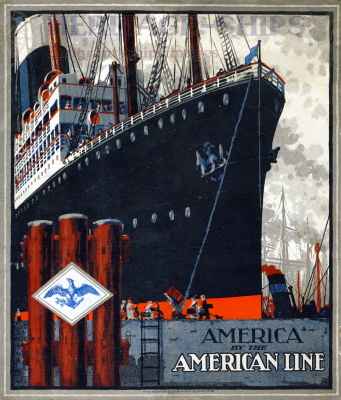
The transfer of the former Inman services brought a major change to the American Line. In 1893 the company established an express service between New York and Southampton, using former Inman steamships as part of the new operation. The American Line was thereby transformed from the comparatively modest Philadelphia service of its early years into an important competitor in the express passenger trade between New York and Europe.
The corporate organization expanded still further with the formation of the International Mercantile Marine Company in 1902. American Line, Red Star Line, White Star Line, Atlantic Transport Line, Dominion Line and other associated companies were brought together within the same shipping group. Their established names and routes continued to be used, while ships could be transferred between services according to changing requirements.
Arrival and Onward Travel in New York
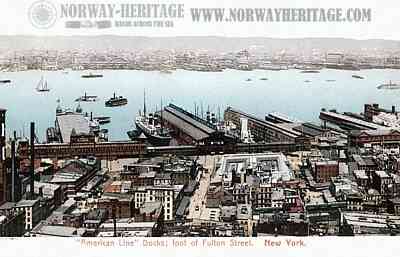
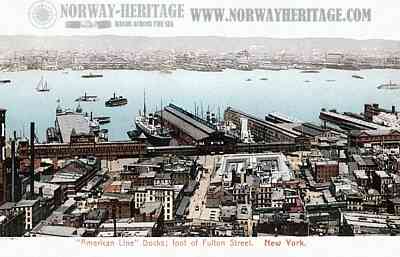
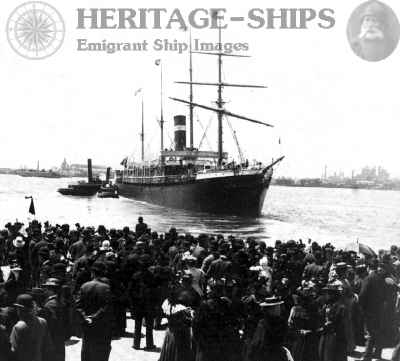
American Line Docks, at the foot of Vesey and Fulton street — Buy a copy
The development of the Southampton service was accompanied by improved passenger facilities in New York. In 1893 the American Line acquired Pier 14 at the foot of Fulton and Vesey Streets, one of the largest steamship piers in the city.
The pier was arranged on two levels, allowing passengers and their baggage to be handled separately from freight, trucks and carriages. This separation made embarkation and disembarkation more orderly at a time when large passenger steamships also carried substantial quantities of cargo.
The location was particularly convenient for passengers continuing their journey by railroad. Pier 14 adjoined the Cortlandt Street Ferry of the Pennsylvania Railroad and was close to ferry connections serving several other major railroad systems. Passengers arriving from Europe could therefore transfer from the ocean steamer to transportation leading to destinations throughout the United States.
For emigrants and other passengers travelling beyond New York, such arrangements were an important part of the transatlantic journey. Arrival at the steamship pier rarely marked the end of the voyage. The transfer from ship to ferry and railroad formed the next stage of a journey that for many had begun thousands of miles away in Europe.