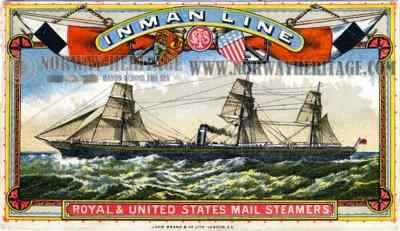
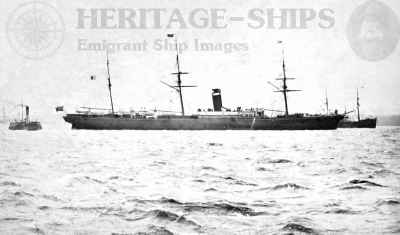
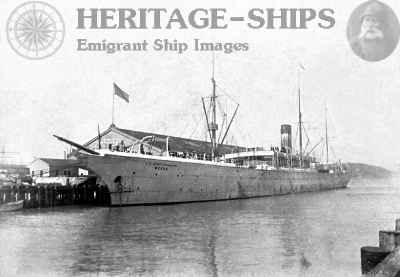
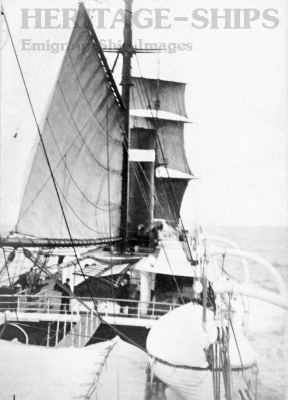
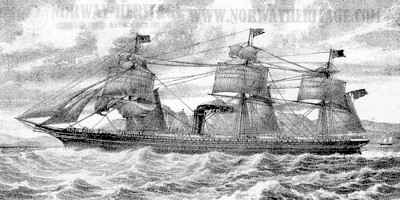
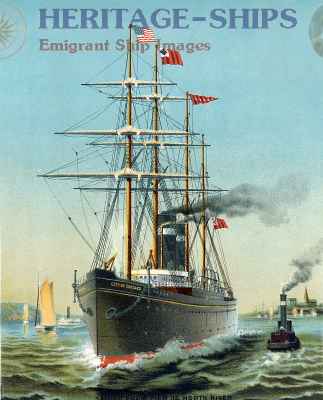
The Inman Line was founded in Liverpool in 1850 as the Liverpool & Philadelphia Steam Ship Company. William Inman was one of the original partners and soon became the driving force behind the company. Within a few years he had gained control of the business, which became generally known as the Inman Line.
The company initially operated between Liverpool and Philadelphia, but New York soon became increasingly important. Emigrant traffic formed a significant part of the business from an early date. In 1852, accommodation for 400 steerage passengers was added to each of the company's first two steamships, the City of Glasgow and City of Manchester.
By 1857, New York had become sufficiently important for the company to change its name to the Liverpool, New York & Philadelphia Steam Ship Company. That year the line carried about 70,000 passengers, making it one of the leading passenger carriers on the North Atlantic.
Liverpool, Queenstown and New York
In 1859, Inman began calling at Queenstown (now Cobh) in Ireland, specifically to attract Irish emigrants. Liverpool–Queenstown–New York subsequently became the company's principal passenger route and remained so for the rest of the Inman Line's existence.
Emigrant traffic greatly outnumbered cabin traffic. In 1870, for example, Inman carried approximately 40,500 steerage passengers and 3,600 cabin passengers on 68 voyages between Liverpool and New York. Its total passenger traffic that year exceeded that of its nearest competitor, the National Line, by about 9,000 passengers.
The Inman Line in Norway
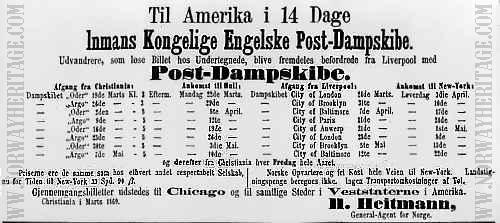
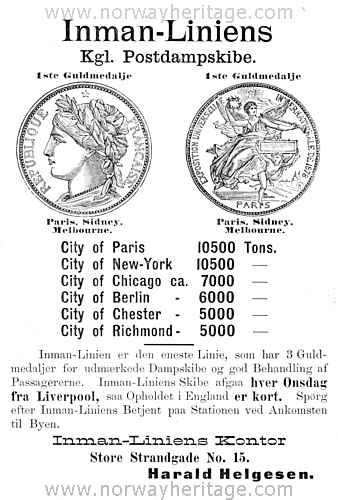
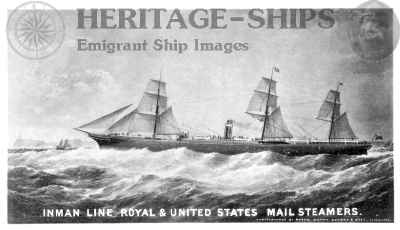
Advertisement for Inman Line sailings
The Inman Line was actively represented in Norway by at least 1866. In Christiania, H. Heitmann, whose office was at Jernbanetorvet, acted as agent for both the Inman Line and the Wilson Line. This cooperation enabled Norwegian emigrants to purchase through tickets covering the different stages of their journey to America.
An advertisement from 1866 announced a Wilson Line departure from Christiania (Oslo) for Hull every Friday afternoon. From Hull, passengers continued by railway across England to Liverpool, where they boarded an Inman steamship for New York. Inman's mail steamships departed Liverpool every Wednesday, supplemented at the time by additional sailings on alternate Fridays and Saturdays.
The arrangement between Inman and Wilson was specifically promoted as a through service. Norwegian emigrants could purchase tickets not only to New York but also to destinations in the American interior, including Chicago, Milwaukee and La Crosse.
The fare covered the railway journey in England and America, board and lodging while in England, and meals aboard the Inman steamship from Liverpool. The advertisement also stated that passengers had nothing further to pay upon landing in either England or America and that their baggage would be delivered free of charge to the railway station.
For Norwegian emigrants, the journey therefore consisted of several coordinated stages:
From Christiania (Oslo) or another Norwegian port – Hull – railway to Liverpool – Inman steamship to New York – railway to the final destination in America.
The arrangement illustrates how the transatlantic shipping companies and their agents competed for emigrants by organizing the entire journey rather than merely selling passage across the Atlantic.
Competition between the North Atlantic passenger lines intensified during the 1870s. The arrival of the White Star Line in 1871 presented Inman with a particularly strong challenge. White Star's new steamships combined speed with improved passenger accommodation, forcing established companies such as Inman to modernize their fleets and services.
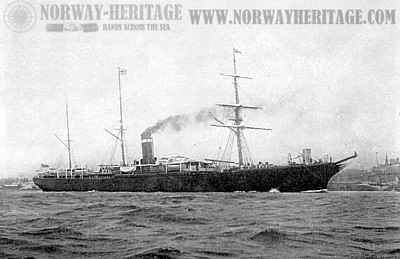
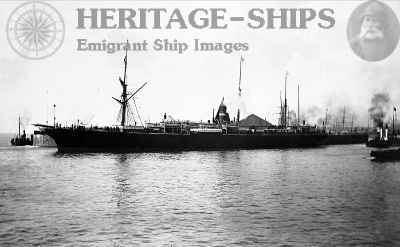
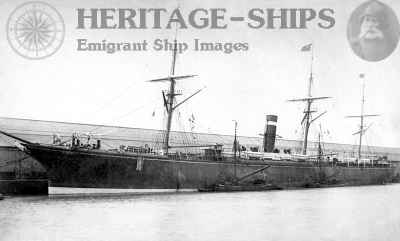
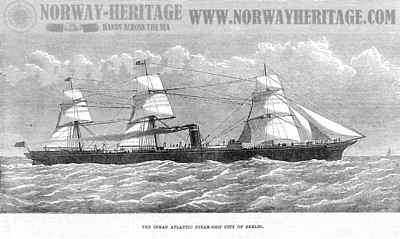
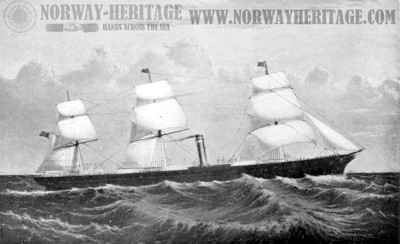
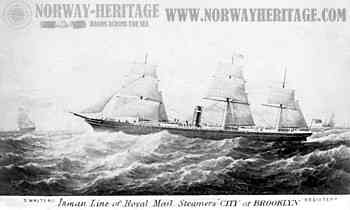
Inman responded with new ships, including the City of Montreal, City of Chester and City of Richmond. The larger City of Berlin followed and was designed in part to strengthen the company's position in the competition for speed on the Atlantic.
Competition was not limited to speed. Shipping companies also competed through fares, sailing frequency, food, accommodation and the organization of connecting transportation. For emigrants, these practical considerations could be as important as the performance of the transatlantic steamship itself.
Traveling with the Inman Line
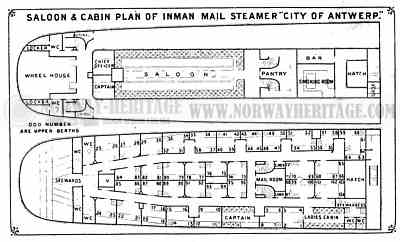
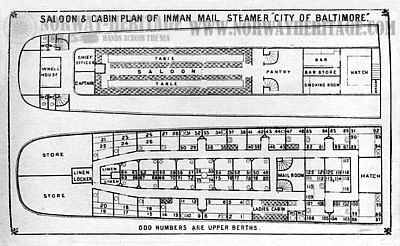
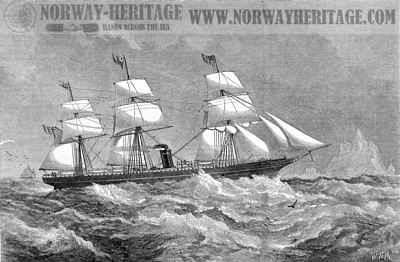
Contemporary Inman advertising presented the company's ships as among the largest, fastest and most comfortable passenger steamships in the world. Considerable attention was given to first-class accommodation, with large saloons, staterooms, ladies' sitting rooms, smoking rooms, libraries and bathrooms.
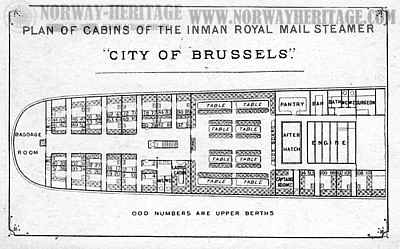
The same advertising also emphasized the accommodation provided for steerage passengers, who made up a much larger proportion of Inman's traffic. According to an Inman Line advertising card, steerage passengers were accommodated on the same deck as the cabin passengers. Sleeping accommodation was divided into enclosed compartments containing a limited number of passengers rather than one large open sleeping space.
The company described these quarters as well lighted, heated and ventilated, with ample space provided for meals and promenading. Cooked food was included and was served by the company's stewards.
These descriptions came from the company's own advertising and naturally presented conditions aboard in the most favorable terms. They nevertheless provide useful evidence of the improvements in steerage accommodation that shipping companies were promoting as competition for emigrant passengers increased.
The company experienced increasing financial difficulties during the 1880s. In 1886 it came under the control of the American-owned International Navigation Company and subsequently operated as the Inman & International Steamship Company.
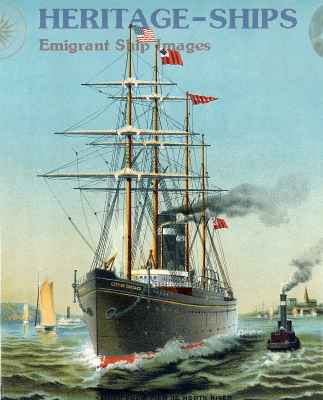
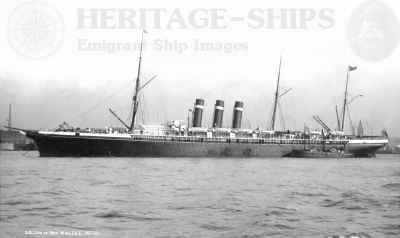
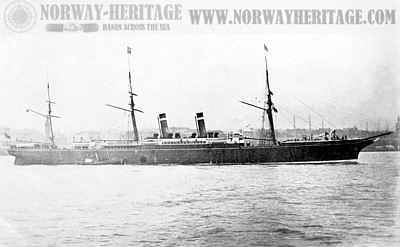
Under the new ownership, two exceptionally large express steamships were introduced: the City of New York in 1888 and the City of Paris in 1889. The City of New York was the largest steamship in the world when completed and was the first large North Atlantic express liner fitted with twin screws. Her sister City of Paris subsequently captured the transatlantic speed record from Cunard's Etruria.
The Inman Line name did not survive for much longer. In February 1893, the company's Liverpool–New York service ceased operating under the Inman name, and its ships and services were transferred to the American Line.
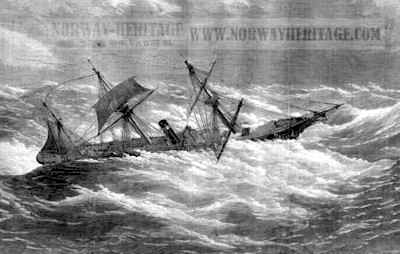
During its years of operation, the Inman Line experienced several serious accidents and losses. In March 1864, the City of New York was wrecked on Daunt's Rock, but no lives were lost. The Glasgow was destroyed by fire and foundered at sea in July 1865, also without loss of life.
A much greater tragedy occurred in January 1870, when the City of Boston disappeared without trace while homeward bound from New York to Liverpool. All 177 passengers and crew aboard were lost.
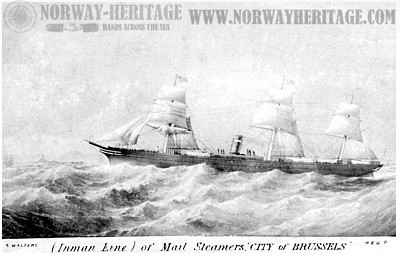
In July 1873, the City of Washington was wrecked near Cape Sable. Despite the loss of the ship, everyone aboard survived. Ten years later, in January 1883, the City of Brussels sank following a collision with the Kirby Hall in the River Mersey, resulting in the loss of ten lives.
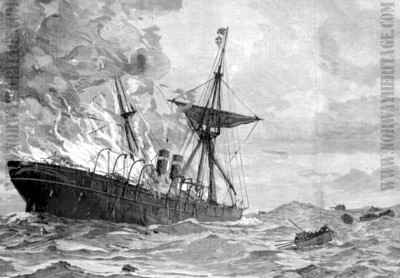
Another dramatic incident occurred in August 1887, when the City of Montreal caught fire at sea. The ship was destroyed, but all passengers and crew were rescued by the Furness Line steamship York City, and no lives were lost.
Finally, in July 1892, the City of Chicago was wrecked near the Old Head of Kinsale on the Irish coast. Once again, the ship was lost without loss of life.