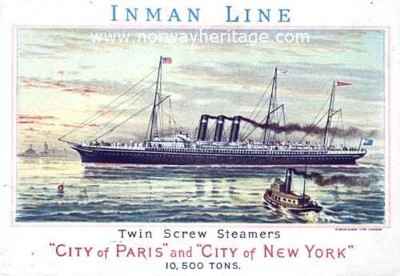
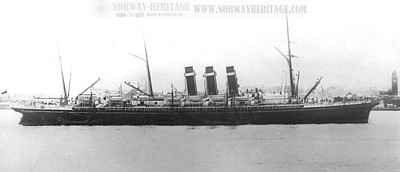
S.S. City of Paris (2), Inman Line

Ship Data

Type Built Burden Dimensions Line / Owner
S.S. 1888 at Glasgow by J. & G. Thomson & Co. 10,499 gross 527.6ft x 63.2ft Inman Line

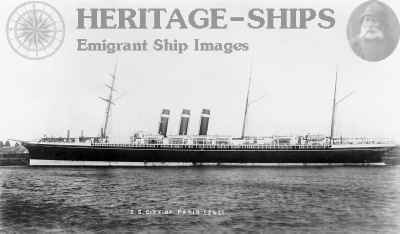
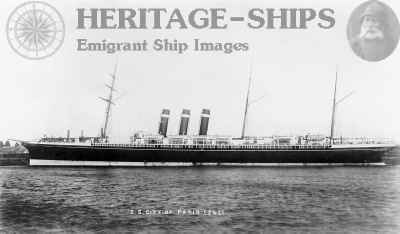
The Inman Line steamship City of Paris (2)
Support Norway Heritage: Purchase a copy

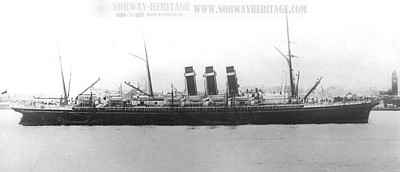
At the time of launching the "City of Paris" was considered to be the most complete, the most luxurious, and the most commodious of its kind on the ocean. Her appearance was much the same as her sister ship, the City of New York which had been launched earlier the same year. However, the City of Paris was described as having better lines than the City of New York. There were also differences in fittings, in rig, in machinery and appointments.

The City of Paris was constructed with 3 masts, all the lower masts being of iron, with the topmasts of wood mounted in sockets. She was barkentine rigged. On the foremast there were a foreyard, a topsail-yard, and a top-gallant-yard. The main and mizzen masts were fore and aft rigged, fitted also with gaff topsails.

The steamers City of Paris and City of New York were of about 10,800 tons burden; 560 feet, in length, 63¼ feet beam, and 59 feet of depth from the top of the upper cabins to the keel. The distance from keel to bridge was 70 feet. The promenade deck was open from stem to stern and the distance around it was 1,120 feet. The four principal decks had 108,000 square feet of surface. The entire vessel had about 1,000,000 cubic feet of space. The cabin passengers had 400,000 cubic feet of that, the machinery and boilers 322,000, the cargo and emigrants the remainder. The City of Paris was fitted to carry 1,371 passengers.

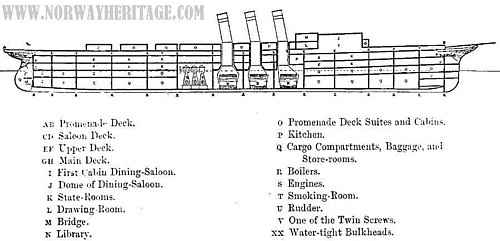
She had a complete double bottom to increase the security and keep her from sinking in case of damages to the hull. The space between the two bottoms could be used for water ballast when needed. It would be pretty hard to break the vessel's bottom, as the plates were tested by the application of 60,000 tons of tensile force and by bending them double without breaking when cold. There were in the whole ship 40,000 such plates, weighing 7,000 tons. The hull was divided into 15 water-tight compartments. They were separated by solid bulkheads athwartships, rising 18 feet above the water line and having no doors or openings of any kind. It was impossible to pass from one compartment to the next without going to the saloon deck and passing over the top of the bulkhead.

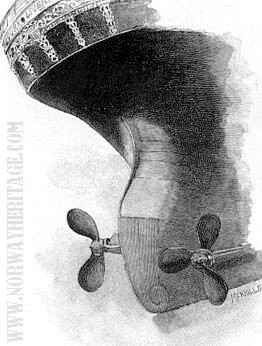
On her trail trip the City of Paris made over the measured mile a speed of 22.19 knots per hour, and averaged nearly 20 knots per hour. She had two screws, one on each side of the rudder, and each screw had its own set of triple expansion engines. This would prevent the consequent disabling of the ship in case of breaking down of machinery. The City of New York and the City of Paris were the first passenger vessels in the Atlantic service thus equipped. If one screw, shaft, or engine was to brake down the other would drive the ship ahead without great loss of speed. This came in handy in 1896 when she broke her starboard tube shaft when 320 miles east of Sandy Hook on way from New York to Southampton

Further safety was insured by having a longitudinal bulkhead between the two engines. This however, did not prevent both engine rooms from being flooded after springing leak in March 1890. It was then criticised that the ship had not been equipped with bilge pumps on her upper decks, no donkey boilers or deck pumps. According to reports the crew had great problems getting the water out, using buckets, and it was assumed the pumps could not be operated without the power from one of the engines.

Every bit of moving power in the ship was duplicated. She had 54 furnaces, and they devoured a ton of coal every five minutes. She had the forced draught apparatus, which was new to Atlantic steamers; great fans making 400 revolutions a minute drove the air into the burning coal, and 14 miles of boiler tubes carried the heat into the water to make steam. If all the motive power should break down, which was considered almost impossible, the vessel could make three knots an hour under sail with her barkentine rig.

The rudder and steering gear were also novelties. The rudder measured 250 square feet of surface an each side, and was well under the ship, with its axis near the centre. It was called the Thompson & Biles rudder, and had been successful on several war ships, but this was its first employment on an Atlantic liner. The turning or the twin screws in opposite directions also aided in quick steering. All the steering gear was below the water line, and it was moved by hydraulic machinery, controlled from the bridge. Hydraulic power was used in many ways throughout the ship. Except the air pumps, all the 32 auxiliary machines used for hoisting sails or cargo, moving ashes and coal, working the dumb waiters, or hoisting the anchor were moved by hydraulic power.

The ship was constructed with a "rolling chamber". This was just abaft the engines beneath the lower deck. It was shaped something like the number 8. It was half filled with 240 tons of water, and when the ship rolled the water rushed towards the downward side, creating a strong resistance to the returning roll of the ship

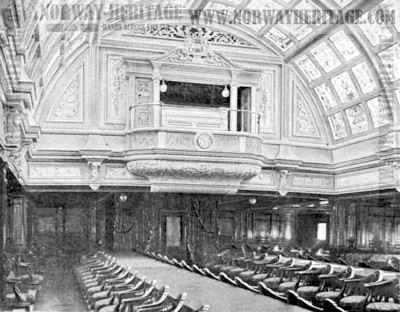
S/S City of New York, main saloon
The main saloon of the City of New York
, was of the same arrangement as on the City of Paris

The main saloon was just forward of the bridge. It was surmounted by a magnificent iron arched roof, 63 feet long and 25 feat wide. This roof was double, the inside being of stained glass in artistic designs. Between this glass and the outer roof were hundreds of incandescent lights. At, night the outer roof was closed by iron shutters and the saloon brilliantly illuminated.

The pantry was on the port side, and in the bulkhead between it and the saloon there were sliding windows, so that dishes could be passed through, thus making it unnecessary for the waiters to leave the saloon. The kitchen was directly beneath the pantry. It was out of sight and out of smell for the passengers. A hydraulic dumbwaiter ran from the pantry down to the kitchen, and on down into the depth of the ship to the icehouse. As rising through each deck it lifted on its top a lid which covered the opening. When it descended it left the lid neatly in place behind it.

The kitchen itself was floored with handsome tiling, and looked more as if it belonged to a fashionable hotel. Just forward of the kitchen was the butchers' room, where four expert butchers prepared the meat for the cooks. Near the kitchen was also a bakery, where all the baking was done separately.

Above the main saloon, and opening upon it, was the ladies' drawing room which was unusually large. One of its novel features was the arrangement of the portholes. They had two slides, that used in the day time was of stained glass, and at night a mirror, increasing the brilliancy of the apartment. A little further aft was the library, a very large and commodious apartment, well provided with writing tables. The stained-glass slides over the portholes were inscribed with quotations, and the panels between the windows were decorated with the names of great writers.

The smoking room was on the spar deck. It had a tile floor and handsome panels of tiling. To the comfort of the smokers were almost two hundred commodious red leather seats. The staterooms were arranged in sections of 24 each, with a stewardess and several bell boys for each section. The best staterooms had each a private bathroom. There were numerous bathrooms and lavatories for general use. The finest staterooms were those arranged in suites of two, with bath, and with accommodations for five persons. There were 20 such suites, and in the day time they were veritable parlors. The divans were arranged like those in a Pullman sleeper and were made into berths at night. The fifth berth was contained in a folding contrivance in a corner. All the staterooms in the ship were provided with patent ventilators. The air was forced down the ventilators from the deck by an electrical machine. The smaller staterooms were fitted with all kinds of folding contrivances to economize space. The washstand could be shut up into a space a little larger than a book. Occupants of the finer rooms could have their meals served in the rooms at any hour. This was a distinctly novel feature.

The second cabin staterooms were aft. There were no suites there, but otherwise the rooms except in decoration, were constructed just like the first-class rooms. They were plainer, but quite as comfortable. The second-cabin passengers had their own dining saloon and smoking room, the latter being on the promenade deck. There were separate pantries and kitchens for that department. It had no interior communication with the first cabin. The only way of passing from one to the other was on deck.

The building of the ship was subsidized by the British Governement to be fitted out so that she could be used as a merchant cruiser. During the construction she was strengthened and fitted to support heavy Armstrongs. The battery consisted of 12 breech loading Armstrongs, and rapid fire six-inch rifles. The guns could be mounted four on each broadside, two at the bow, and two at the stern. Later, in May 1898, when in American ownerships, she came under requisition for war service, and became the US Armed Cruiser Yale.

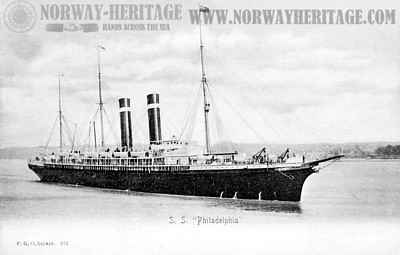
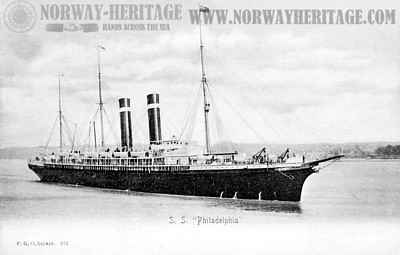
Philadelphia, steamships
S/S City of Paris (2)
after she was rebuilt and renamed Philadelphia
Support Norway Heritage: Purchase a copy

Chronological History

Year Event
1888 Oct. 23, launched
1889 Apr. 3, maiden voyage Liverpool - New York
1889 Liverpool → New York Apr. 11. Arrived at 04:00 morning.
1889 Liverpool → New York May 8. Queenstown 1889-05-02, arrived New York at 11:00 morning after crossing the Ocean in 5 days 22 hours and 12 min..
1889 City of Paris, Capt. Frederick Watkins, arrived after having finished the quickest passage ever made across the Atlantic Ocean, NY times reported to be 5 days, 23 hours and 7 minutes
1889 Record breaking eastward voyage: Sandy Hook to Queenstown, in 6 days and 29 minutes
1889 Liverpool → New York June 5. Queenstown 1889-05-30. 1046 passengers (Passengers from Trondheim via Christiania).
1889 Liverpool → New York July 3. Arrived in New York at 06:00 morning after a journey of 6 days from England<BR>Also reported arrive 1889-07-04.
1889 Liverpool → New York July 30. Queenstown 1889-07-25, arrived in New York after a journey of 6 days from England<BR>Also reported arrive 1889-07-31.
1889 The newspapers announced that she arrived after having made the second fastest trip on record across the ocean from Queenstown to Sandy Hook Lightship and within three minutes of her record achievement of 5 days 23 hours and 7 minutes
1889 Liverpool → New York Aug. 27. Queenstown 1889-08-22, 1104 passengers arrived New York at 05:00 morning. Crossing the Ocean in only 5 days 14 hours and 50 min. <BR>Also reported arrive 1889-08-28.
1889 The Aug 27 arrival was reported as a record breaking voyage of 5 days 19 hours, 17 min.
1889 Liverpool → New York Sept. 24. Queenstown 1889-09-19, arrived in New York at 09:00 morning<BR>Also reported arrive 1889-09-25.
1889 The Sept. 24 arrival: a crossing in six days and sixteen minutes, a fast run in spite of fog
1889 Oct. 7: A female steerage passenger and her child were swept overboard and drowned, and ten other passengers were severely injured. The saloon was flooded
1889 Slight damage after being hit by a big wave that broke over her on way from New York to Liverpool. She was running almost before the wind when the sea struck her resulting in some damage to the deckhouse
1889 Liverpool → New York Oct. 22. Queenstown 1889-10-17, arrived New York at 13:00 afternoon<BR>Also reported arrive 1889-10-23.
1889 Liverpool → New York Nov. 20. Queenstown 1882-11-14, 974 passengers arrived in New York at noon after a journey of 6 days from England.
1889 Crossed in 6 days 5 hours and 12 minutes from Queenstown, a very good time, considering the fact that she met with very bad weather
1889 Liverpool → New York Dec. 16. Queenstown 1889-12-12<BR>Also reported arrive 1889-12-19.
1890 Liverpool → New York Feb. 11. Queenstown 1890-02-06. Arrived New York at noon<BR>Also reported arrive 1890-02-12.
1890 Liverpool → New York Mar. 12. Queenstown 1890-03-06.
1890 Mar. 19: departed New York for Liverpool
1890 Mar. 30: Arrived at Queenstown under tow of the steamer Aldersgate, water flowed into the engine rooms due to a brake down in the machinery, causing damages letting the water in.
1891 Liverpool → New York May 20. Queenstown 1891-05-14.
1891 Liverpool June 10 → New York June 18
1891 Liverpool → New York July 15. Queenstown 1891-07-09.
1891 Liverpool → New York Aug. 12. Queenstown 1891-08-06.
1891 Liverpool → New York Sept. 9. Queenstown 1891-09-03.
1891 Liverpool → New York Oct. 7. Queenstown 1891-10-01.
1891 Oct. 21: arrived Queenstown with several injured passengers after encountering severe weather
1891 Liverpool → New York Nov. 4. Queenstown 1891-10-29<BR>Only 5 days and some hours crossing the Ocean.
1891 Liverpool → New York Dec. 2
1891 Liverpool → New York Dec. 31. Queenstown 1891-12-24.
1892 Liverpool → New York Mar. 29. Also reported arrive 1892-03-30<BR>Crossing the Ocean in 5 days and 22 hours from England.
1892 Liverpool → New York Apr. 27. Crossing the Ocean from England in 5 days and 21 hour.
1892 Liverpool → New York May 25. Arrived at 11:00 late morning.
1892 Liverpool → New York June 21. Crossing the Ocean in 6 days from England.
1892 Liverpool → New York July 26. Crossing the Atlantic in 5 days 19 hours from England.
1892 Liverpool → New York Aug. 24
1892 Liverpool → New York Sept. 21. Crossing the Ocean in 6 days from England.
1892 Liverpool → New York Oct. 18
1892 Liverpool → New York Nov. 16
1892 Liverpool → New York Dec. 14
1893 Liverpool → New York Mar. 1. Queenstown 1893-02-23. Arrived in New York at 11:00 before noon.
1893 Taken over by American Line, remaned Paris
1898 May, became the US Armed Cruiser Yale
1898 October, returned to American Line
1899 May 21, grounded on Manacles
1899 Refloated and rebuilt, fitted with quadruple expansion engines, funnels reduced from 3 to 2, new tonnage 10,786 gross, renamed Philadelphia
1922 Sold to New York - Naples SS Co.
1923 Scrapped at Genoa

Pictures

Leave a Comment

Comments are reviewed before they appear publicly. Fields marked with * are required.

Your email will never be shown publicly.
10000 characters remaining