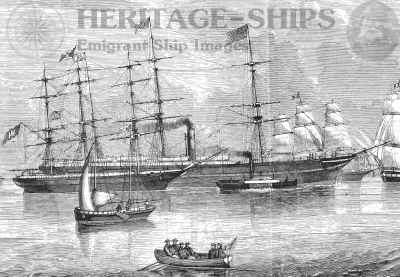
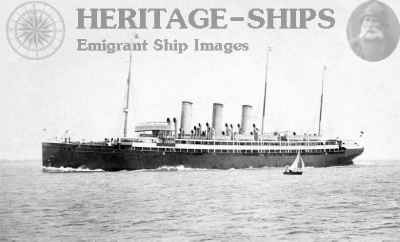
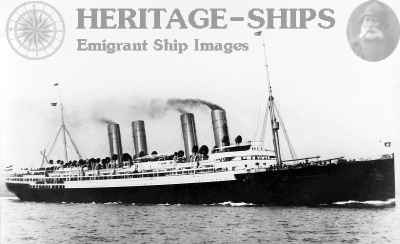
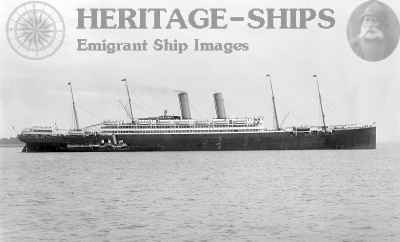
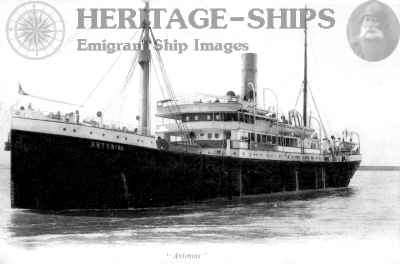
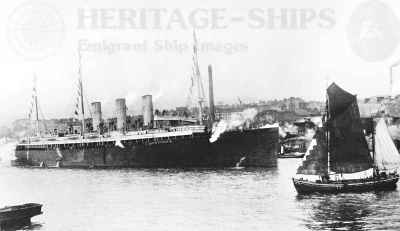
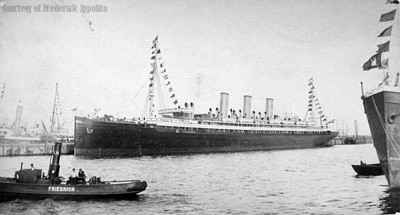
Hammonia (1) behind and the Deutschland in front — Buy a copy
The Hamburg America Line was founded in Hamburg on May 27, 1847, under the name Hamburg-Amerikanische Packetfahrt-Actien-Gesellschaft, generally known by the abbreviation HAPAG. The company was established to maintain a regular service between Hamburg and New York and initially operated sailing ships. Its first service was inaugurated in 1848 by the Deutschland. The early sailing ships carried both cabin and steerage passengers, and the westbound passage to New York averaged about 40 days.
The company gradually changed from sail to steam during the 1850s. Its first North Atlantic steamship service began on June 1, 1856, when the Borussia departed Hamburg for New York. She was followed by the Hammonia the following month. From December 1857, Southampton became an intermediate port of call on the service, a practice that continued for about ten years.
The steamship service expanded rapidly. By March 1858, HAPAG was operating fortnightly departures from Hamburg, and by 1866 a steamship left Hamburg every week.
The Hamburg America Line in Norway
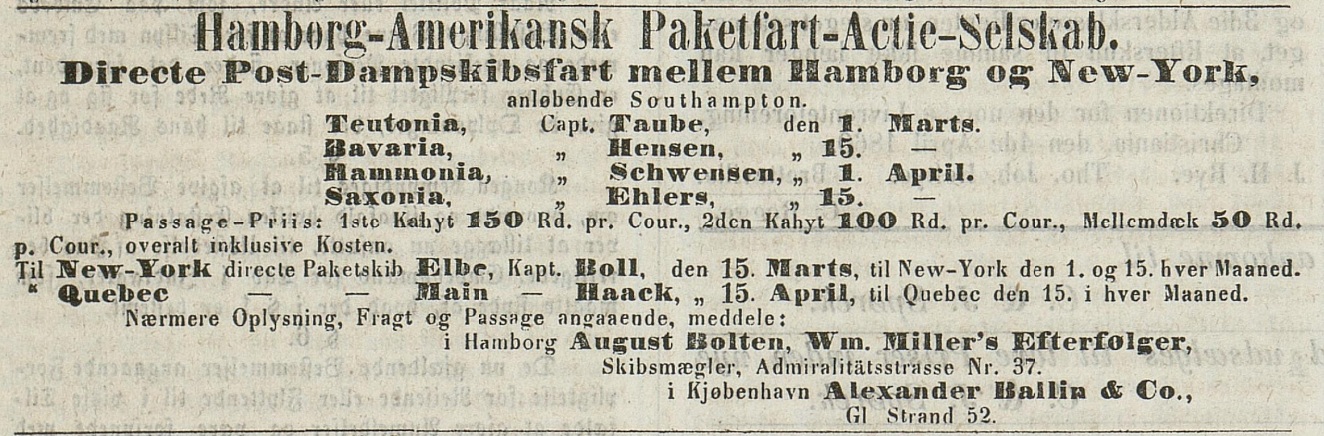
Christiania-Posten - April 15th 1860
HAPAG entered the Norwegian emigrant market at an early stage of its steamship operations. In Norway, the company was initially referred to as August Bolten's steamship line, after the Hamburg shipbroker August Bolten.
An advertisement published in the Christiania-Posten on April 15, 1860, offered passage between Hamburg and New York aboard the company's steamships. Some of the advertised sailings called at Southampton on the way to America. The fare for an adult traveling in steerage was 50 riksdaler, including meals.
For Norwegian emigrants, however, Hamburg was normally the starting point of the transatlantic passage rather than the beginning of their journey. Passengers first had to reach Germany. From Christiania (Oslo), they could travel by connecting steamship to Hamburg, while emigrants from other parts of Norway could use ports with direct steamship connections to Hamburg when such services were available. At Hamburg they transferred to a HAPAG steamship for the Atlantic crossing.
The German route therefore differed significantly from the route used by most Norwegian emigrants traveling with British transatlantic companies. Passengers using the British lines commonly crossed the North Sea to Hull and continued by railway across England to Liverpool. Those traveling with HAPAG instead proceeded south to Hamburg before beginning the transatlantic part of their journey.
Traveling with the Hamburg America Line
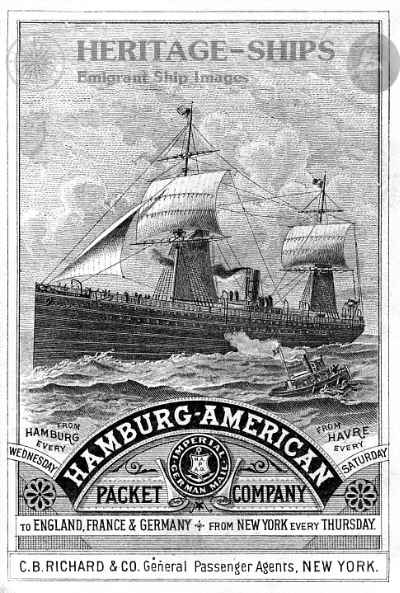
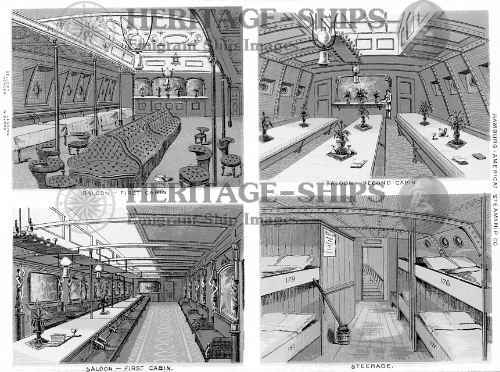
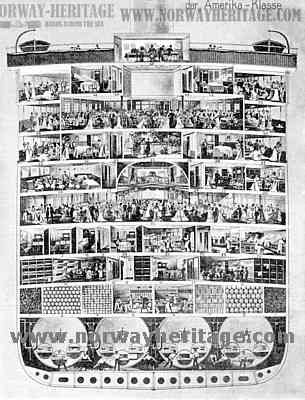
Cover of an 1872 advertising booklet showing the steamship Frisia. — Buy a copyThis old advertising booklet from 1876 shows interior views of HAPAG's ships. In the lower right, we can see, among other things, the steerage accommodation. — Buy a copy
As HAPAG expanded its passenger services, conditions aboard its steamships also developed. A company booklet issued around 1876 provides a detailed contemporary description of the accommodation offered to passengers and of the facilities the company considered important when competing for the transatlantic passenger trade.
First-class passengers occupied furnished staterooms and had access to saloons, a ladies' sitting room and a promenade deck. Second-class accommodation was located forward of first class and included heated, lighted and ventilated staterooms.
For most emigrants, however, the relevant accommodation was steerage. This was situated below the second cabin and was divided into separate compartments for single men, women and families. According to the company's own description, the quarters were spacious, light and well ventilated. Stewards and attendants speaking several languages were available to assist passengers, and an experienced physician traveled aboard each steamship.
Medical attendance and medicines were provided without additional charge.
The kitchens were situated on the upper deck, an arrangement that HAPAG specifically promoted as keeping cooking odors away from the passenger accommodation. Food was included in the passage paid by emigrants, as is also shown by the Norwegian advertisement of 1860.
These descriptions came from the company's own promotional material and naturally emphasized comfort, safety and good service. They should therefore be read as advertising rather than as an independent account of conditions aboard. Nevertheless, they provide useful evidence of how HAPAG organized its passenger accommodation and of the facilities it considered important when attracting emigrants in the 1860s and 1870s.
Competition for Scandinavian Emigrants
HAPAG was only one of several companies competing for the growing Scandinavian emigrant traffic. Its principal German competitor was Norddeutscher Lloyd, which had operated a steamship service between Bremen and New York since 1858. The British transatlantic companies were also strongly established in Scandinavia, using connecting steamship services across the North Sea to bring emigrants to their ports of departure in Britain.
Competition increased further with the establishment of the Danish Thingvalla Line in 1879. The new company was established to provide a direct connection between Scandinavia and America. Its westbound service originated in Copenhagen and called at Christiania and Christiansand before crossing the Atlantic to New York.
This offered an important advantage to Scandinavian emigrants. Norwegian passengers could board the transatlantic steamship in Norway rather than first traveling to England or Germany. The Thingvalla Line consequently became a competitor not only to the German companies but also to the British lines serving the Scandinavian market.
Despite HAPAG's long-established presence in Norway and elsewhere in Scandinavia, British companies continued to carry a large share of the traffic. A history of HAPAG notes that until 1886 the greater part of the passenger traffic from the Scandinavian countries to North America was handled by British North Atlantic lines using connecting services across the North Sea.
In 1886, Albert Ballin made an early attempt to challenge the British lines in the Scandinavian emigrant trade. He proposed a HAPAG service from Stettin to New York via Scandinavian ports, and steamships began operating from Stettin via Gothenburg that summer. The venture was intended primarily as a means of strengthening HAPAG's position in negotiations with the British companies rather than as the establishment of a permanent Scandinavian service. An agreement with the competing lines was reached later that year.
The episode illustrates the intense commercial competition surrounding Scandinavian emigration. Shipping companies competed not only through fares, speed and accommodation aboard their transatlantic steamships, but also through the organization of the journey from the emigrant's home country to the port of embarkation.
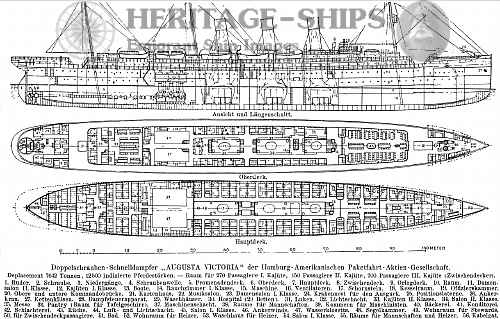
At the same time that HAPAG was competing for emigrant passengers, the company was modernizing its main North Atlantic service. Under Ballin's influence, plans were made for a new generation of twin-screw express steamships between Hamburg and New York.
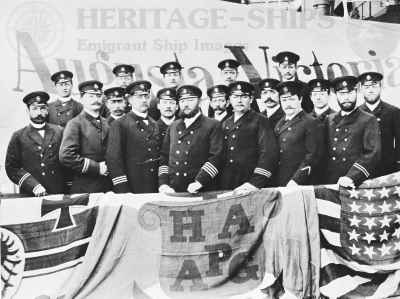
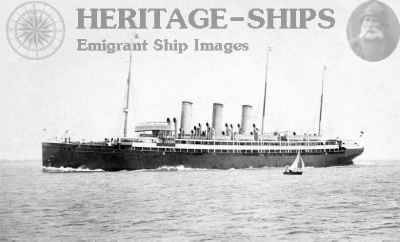
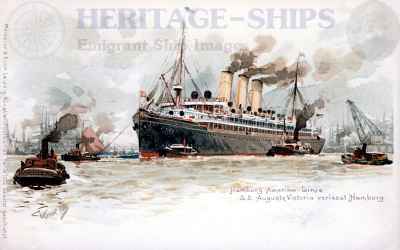
The Augusta Victoria entered service in 1889 and was followed by the Columbia, Normannia and Fürst Bismarck. The Augusta Victoria also reintroduced Southampton as a port of call after an absence of about twenty years. On her maiden voyage she completed the passage from Southampton to New York in 7 days and 22 hours. The Fürst Bismarck later completed the same route in 6 days, 14 hours and 7 minutes.
The express liners represented only one part of HAPAG's passenger business. The company continued to operate ships intended primarily for emigrants as well as mail and express services. By 1890, an express steamer left Hamburg for New York via Southampton every Saturday during the season, a direct mail steamer sailed on Sundays, and a Carr-Union emigrant steamer departed on Wednesdays.
This distinction is important when considering the emigrant experience. The luxurious accommodation and high speeds promoted for the express liners did not necessarily represent the ships on which the majority of emigrants traveled. HAPAG operated different types of vessels for different sections of the passenger market, and steerage capacity remained an important part of its North Atlantic business.
The Scandia Line
In 1893, HAPAG established a regular Scandinavian service to New York under the name Scandia Line. The route connected Stettin and Gothenburg with New York and included calls at Norwegian ports, principally Kristiansand. Norwegian emigrants could therefore board the transatlantic steamship in Norway rather than first traveling to Hamburg.
In 1893, the new Scandia Line was advertised in Norway as a direct Scandinavian emigrant service. Departures were announced from Helsingborg on February 16, Gothenburg on February 17, and Kristiansand on February 18. Passengers from Copenhagen departed on the same day as those from Helsingborg.
Passengers were carried directly from Kristiansand to New York, avoiding transfers, stays in foreign lodging houses, customs inspections of baggage at intermediate ports, railway journeys, and the risk of loss or damage to their belongings.
The advertisement emphasized that life aboard was arranged according to Scandinavian customs. The food was described as wholesome and plentiful, while the ship's doctors, cooks, and attendants were Scandinavian.
Particular attention was given to the accommodation for steerage passengers. The ships were specially fitted for their transportation, with the steerage divided into small compartments so that families and acquaintances could remain together during the voyage. Each passenger received a new mattress and pillow, which became their property, while eating utensils were also provided aboard.
The advertisement promised that passengers would be met by company representatives upon arrival in New York, who would assist them and arrange onward transportation for those holding railway tickets to destinations in the interior.
The advertisement concluded by warning that the Scandia Line could accommodate only a limited number of Norwegian passengers and that the direct service was therefore expected to be fully booked. Those intending to emigrate in the spring were advised to make arrangements as soon as possible.
The Scandia Line operated from 1893 to 1895. For Norwegian passengers, it represented an important departure from the usual pattern of travel with HAPAG, in which they first had to make a separate journey to Germany before beginning the Atlantic crossing.
HAPAG resumed direct sailings from Scandinavia in the summer of 1903, and the service continued until the autumn of 1904.
During the 1890s HAPAG developed into a much larger international shipping company. In addition to its principal New York service, the company operated routes to Boston, Baltimore, Philadelphia, New Orleans and Canada, as well as services outside the North Atlantic. In 1892 it acquired services to Boston and Montreal, and in the following years it introduced large intermediate steamships designed to carry relatively few first-class passengers, large numbers of steerage passengers and substantial quantities of cargo.
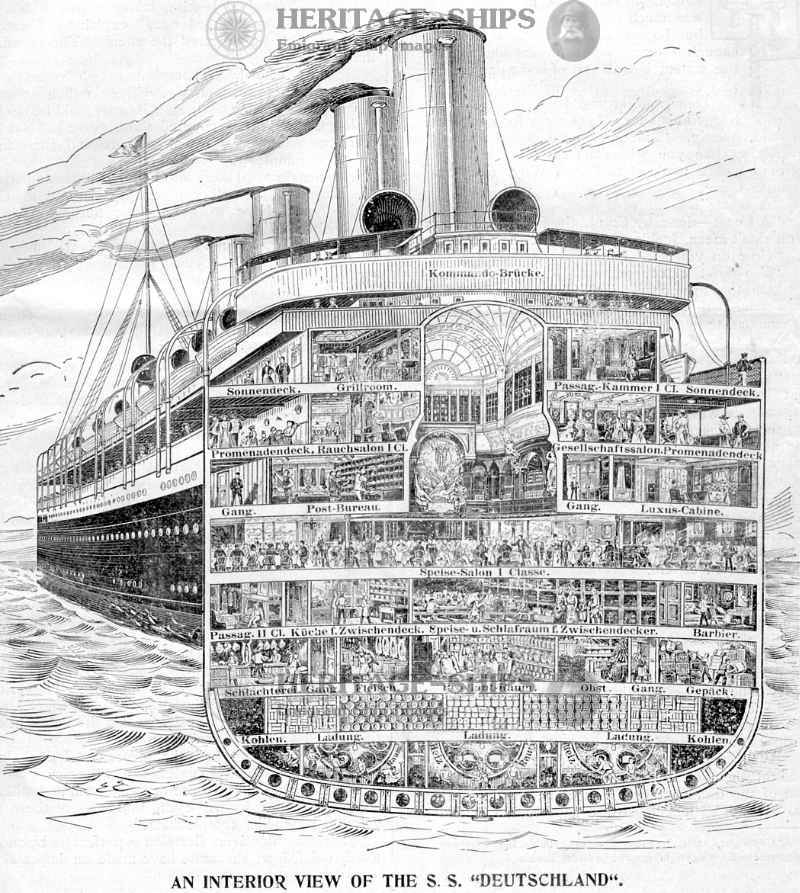
Competition on the North Atlantic was intense, not only between British and German shipping companies, but also between the two major German rivals, HAPAG and Norddeutscher Lloyd. In 1900, this rivalry produced a spectacular race across the Atlantic, when HAPAG's Deutschland overtook Norddeutscher Lloyd's Kaiser Wilhelm der Grosse and reached Plymouth 5½ hours ahead of her rival. Read more: THE RECORD RACE ACROSS THE ATLANTIC.
By the beginning of the twentieth century, HAPAG was increasingly combining size and passenger capacity with improved accommodation. The company's experience with very fast ships eventually led it to place greater emphasis on moderate speed and higher levels of comfort, a policy that became increasingly important in the competitive North Atlantic passenger trade.
By 1914, HAPAG had developed a worldwide network. Its fleet included 442 ships, of which 201 were ocean-going steamships, operating 74 separate services and calling at more than 350 ports.