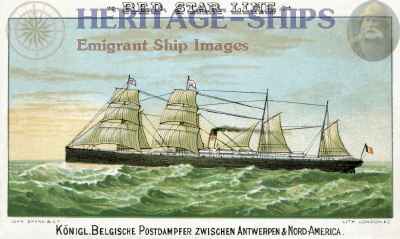
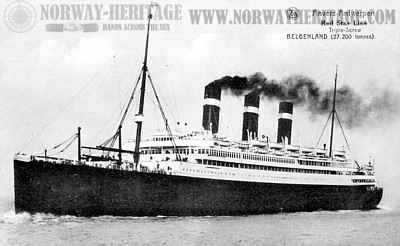
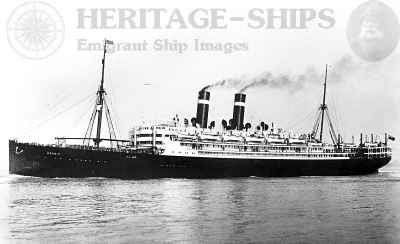
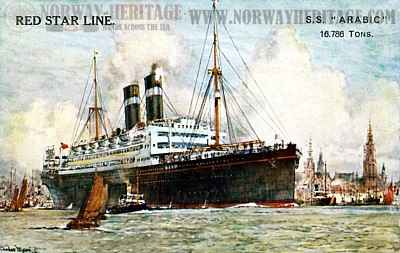
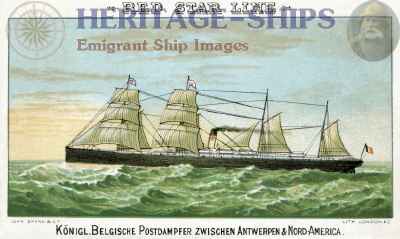
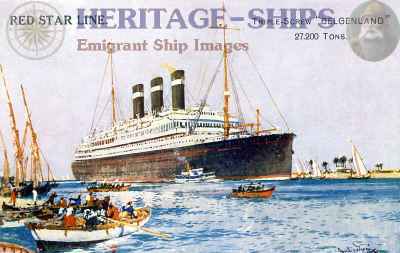
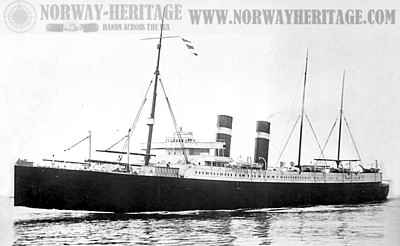
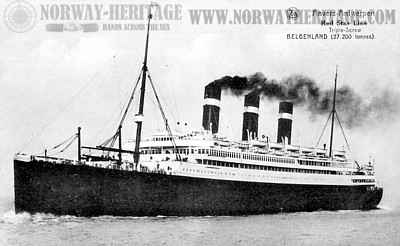
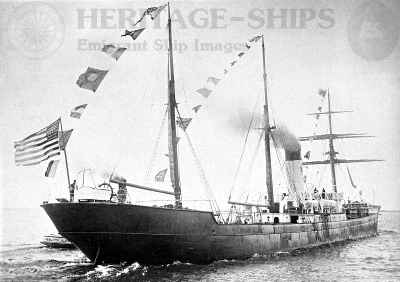
The Red Star Line steamship Belgenland. Red Star Line ships had buff-colored funnels with a black band at the top and a red star. — Buy a copy
The Red Star Line was established in the early 1870s to provide regular passenger and freight services between Antwerp and the United States. Antwerp became the European base of the line, with services to Philadelphia and later New York. From the beginning, emigrant traffic formed an important part of the business.
Although generally known as the Red Star Line, the service was operated on the Belgian side by the Société Anonyme de Navigation Belge-Américaine and was closely connected with the American International Navigation Company of Philadelphia. This relationship became increasingly important as the International Navigation Company expanded its interests in transatlantic shipping.
The first Red Star sailing took place in January 1873, when the Vaderland departed Antwerp for Philadelphia. She was followed by the Nederland and Switzerland, and additional ships were introduced as traffic increased. The ships became readily identifiable by the red star used as the company's emblem.
Antwerp to America
Philadelphia was initially the principal American port of the line, but New York soon became increasingly important. A New York service was established during the 1870s, and by the beginning of the 1880s Red Star was maintaining an almost weekly service between Antwerp and New York.
The fleet was expanded with ships such as the Belgenland, Rhynland, Waesland, Pennland, Noordland and Westernland. Some of the older vessels continued principally on the Philadelphia route while the newer and faster ships were increasingly concentrated on New York.
Emigrant traffic accounted for a large proportion of the passengers. During the 1880s the Red Star Line landed an average of more than 25,000 passengers annually at New York. In 1891 the company landed 35,870 steerage passengers compared with 5,504 cabin passengers, illustrating the importance of mass migration to the line's transatlantic business.
Red Star Line and the American Line
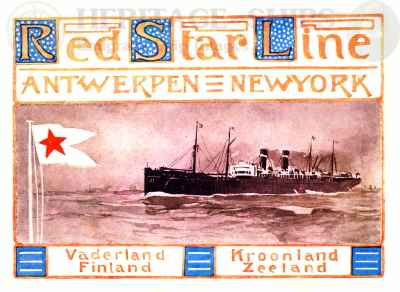
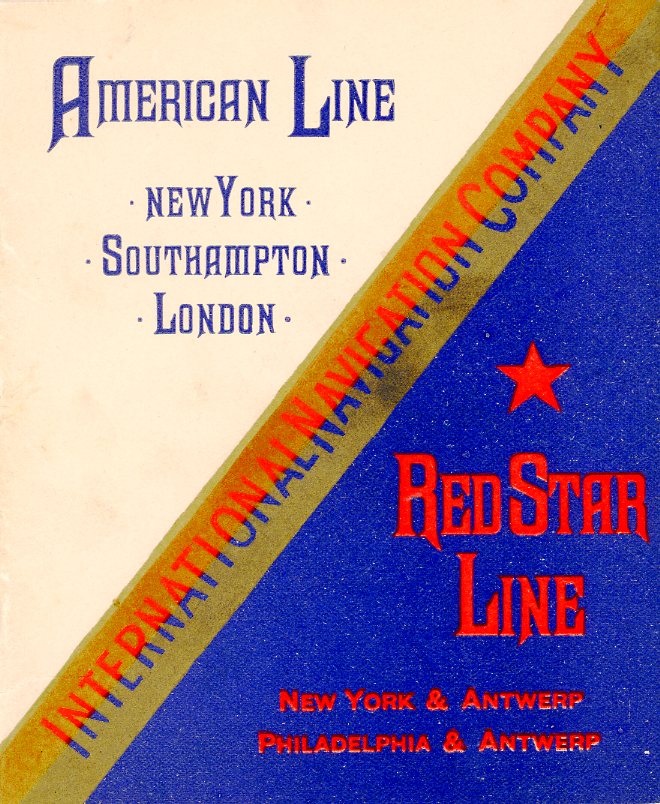
Front cover of a Red Star Line advertising folder. The company flag with its distinctive red star is shown, while the ship's funnel carries the American Line colors: black with a white band. — Buy a copy
The Red Star Line became increasingly closely connected with the American Line through the International Navigation Company of Philadelphia. Although the individual line names continued to be used, their operations were gradually brought together within a common transatlantic organization.
An important step in this development came in February 1893, when the Liverpool–New York service of the Inman Line ceased operating under the Inman name. Its ships and services were transferred to the American Line, strengthening the latter as one of the principal services within the International Navigation organization.
The consolidation became still more apparent later that year. A contemporary newspaper report concerning the newly organized International Navigation Company, incorporated under the laws of New Jersey with a capital of $15 million, stated that the company's intention was to bring a substantial part of the transatlantic passenger and freight trade under its control. One of its first objectives was the consolidation of the American Line and Red Star Line, with the aim of providing improved express steamship connections with northern European ports. Following this consolidation, the company was expected to control a fleet of about 25 transatlantic steamships.
The Red Star Line name nevertheless survived and continued to be associated principally with services from Antwerp to New York and Philadelphia, while the American Line operated particularly from British ports. In practice, however, the distinction between their fleets became increasingly blurred. Ships could be transferred between the different services as requirements changed, and contemporary advertising frequently presented the American Line and Red Star Line together.
This close relationship is important when following the history of individual ships. A vessel associated with the Red Star Line might at another period be employed on an American Line service and could later return to Red Star operations. The name of the line therefore did not necessarily identify a permanently separate fleet.
The organization became still larger after the formation of the International Mercantile Marine Company in 1902. Red Star Line, American Line, White Star Line, Atlantic Transport Line, Dominion Line and other associated companies became parts of the same shipping group. The established line names continued to be used, while ships and services could be reorganized within the wider system.
The Red Star Line in Norway
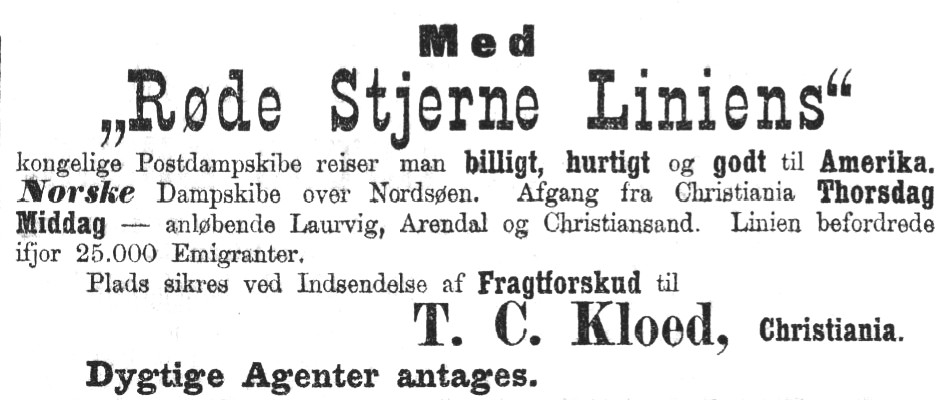
Announcement in the Norwegian newspaper VG, April 21st, 1888
Compared with several of the British transatlantic companies, the Red Star Line entered the organized Norwegian emigrant market relatively late. The first Norwegian representation so far identified dates from 1888, when T. C. Kloed in Christiania was authorized to arrange transportation by Norwegian steamships to Antwerp and from there by Red Star Line steamships to New York and onward to the passengers' final destinations in America. In Norway, the company was advertised as the "Røde Stjerne Linie."
The company offered Norwegian emigrants an alternative to the familiar routes through Britain. Instead of crossing the North Sea to Hull and continuing by railway to Liverpool or another British Atlantic port, Red Star passengers could travel by Norwegian steamship to Antwerp and join the transatlantic steamer there.
A Norwegian advertisement from 1888 announced departures from Christiania every Thursday at noon, calling at Laurvig, Arendal and Christiansand before continuing across the North Sea. The same advertisement claimed that the line had carried 25,000 emigrants during the previous year and shows that the company was actively expanding its Norwegian organization, as new local agents were being sought. Passage could be secured by paying an advance on the fare to the general agent in Christiania.
Although the Red Star Line never played as prominent a role in Norwegian emigration as several of the lines operating through British ports, its Norwegian service illustrates the increasing choice available to emigrants and the growing international competition for Scandinavian emigrant traffic during the late nineteenth century.
By 1888, a Norwegian emigrant could arrange a journey beginning aboard a Norwegian steamship at Christiania or another port along the southern Norwegian coast, continuing to Antwerp, crossing the Atlantic aboard a Red Star liner, and then proceeding by American railroad toward the final destination.
Seen from the emigrant's perspective, the Red Star Line was therefore not simply an Antwerp-New York steamship service. It formed one part of an increasingly integrated transportation system linking local agents, Norwegian coastal and North Sea steamships, the emigrant port of Antwerp, transatlantic liners and the American railroad network. For the passenger, these different companies and modes of transportation formed a connected journey from the old home in Europe to the new one in America.
The Journey Through Antwerp
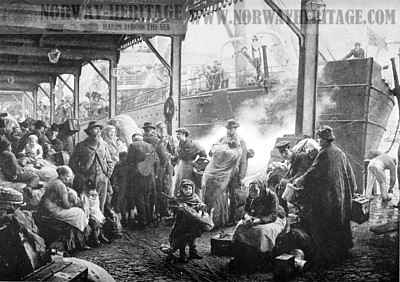
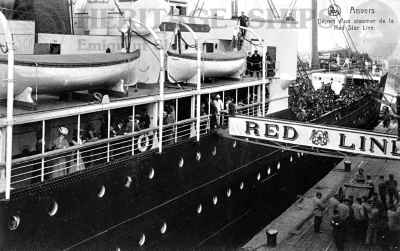
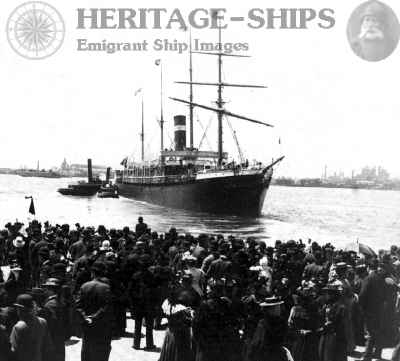
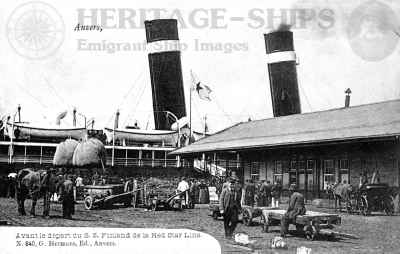
The Pennland embarking passengers at Antwerp — Buy a copyThe Vaderland at Antwerp — Buy a copy
For the emigrant, the Red Star Line was only one part of a much longer journey. A passenger leaving Norway first travelled by Norwegian steamer to Antwerp. There the passenger transferred to the ocean liner for the voyage to New York or Philadelphia. After arrival in America, many passengers continued by railroad for hundreds or even thousands of miles to their final destination.
Through tickets were therefore particularly important. The Norwegian authorization of 1888 specifically permitted the sale of transportation not merely to New York but onward to the passenger's final destination in America. The emigrant could consequently arrange much of the journey before leaving Norway.
Antwerp itself developed into one of the major European emigrant ports. Passengers arriving from different parts of Europe were brought together there before boarding the Atlantic steamers. For Norwegian passengers, it represented the point at which the first, relatively short stage of the journey from Scandinavia ended and the transatlantic passage began.
Red Star advertising later emphasized the practical advantages of its terminal arrangements with the phrase "Pier to Pier, No Tenders." Passengers could embark and disembark directly at the company's piers instead of being transferred between ship and shore by tender.
On the American side, the transportation system extended beyond the steamship. Red Star's facilities in the New York area provided convenient access to the American railroad network, and company representatives were available to assist arriving passengers. For an emigrant bound for the Midwest or farther west, arrival at New York was therefore another transfer point rather than the end of the journey.
The development of the Red Star fleet reflected the increasing scale of transatlantic migration. The Waesland, which entered Red Star service in 1881, could accommodate approximately 1,000 steerage passengers in addition to her cabin passengers. The Friesland, introduced on the Antwerp-New York route in 1889, had accommodation for 226 first-class, 102 second-class and 600 third-class passengers.
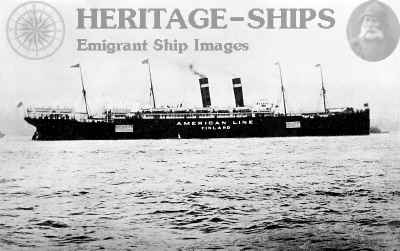
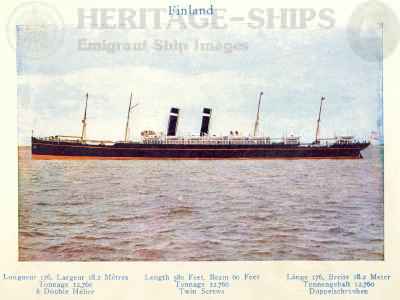
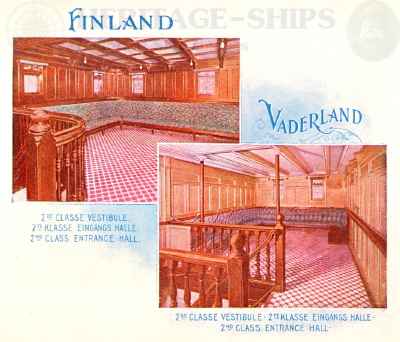
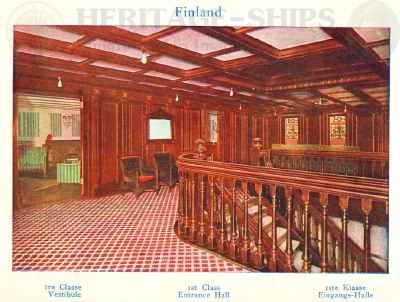
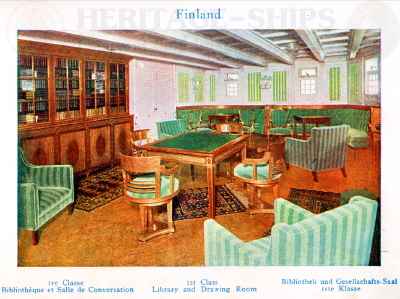
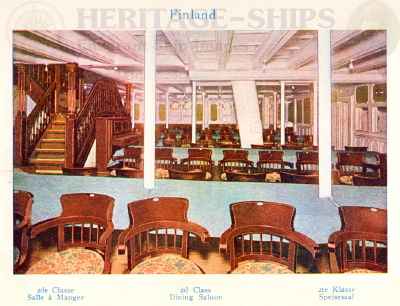
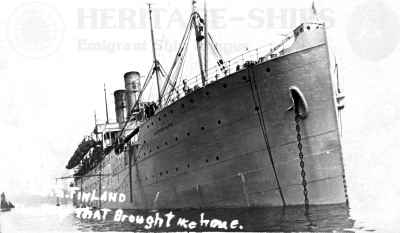
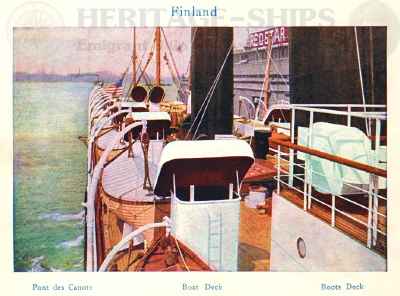
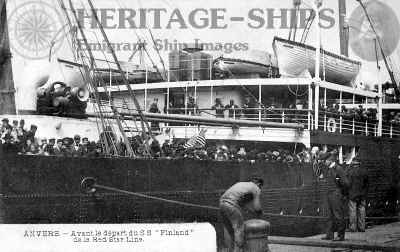
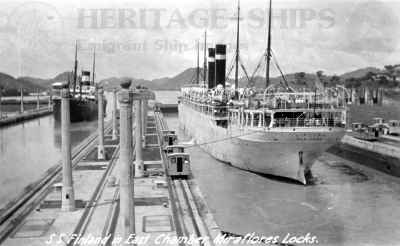
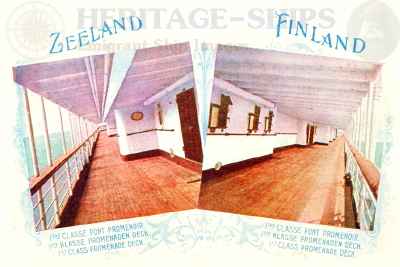
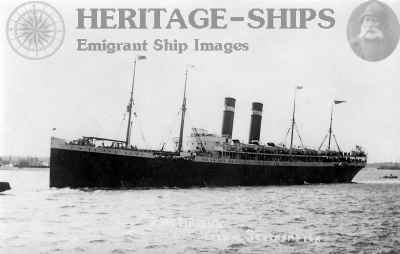
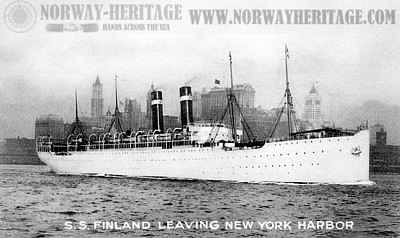
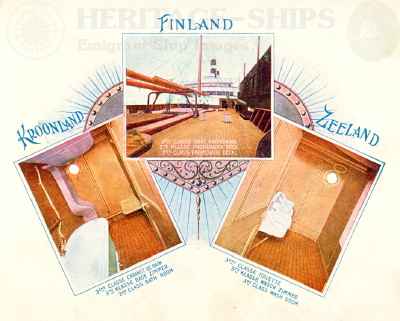
Larger ships followed around the turn of the century. The Vaderland entered service in 1900 and the Zeeland in 1901, followed by the American-built Kroonland and Finland in 1902. These ships represented a substantial increase in size and passenger capacity compared with the vessels with which the service had begun three decades earlier.
One of the largest Red Star liners before the First World War was the Lapland, which entered the Antwerp-New York service in 1909. At 17,540 tons, she could accommodate 450 first-class, 400 second-class and as many as 1,500 third-class passengers.
These figures illustrate an important feature of the transatlantic passenger business. The large liners were not simply luxury vessels for wealthy travelers. Behind the increasingly elaborate first- and second-class accommodation was a mass transportation system in which hundreds, and sometimes more than a thousand, third-class passengers could make the same Atlantic crossing.
Passenger Accommodation
Red Star advertising naturally emphasized comfort, safety and service. As with other transatlantic companies, such claims should be understood partly as advertising aimed at a highly competitive passenger market.
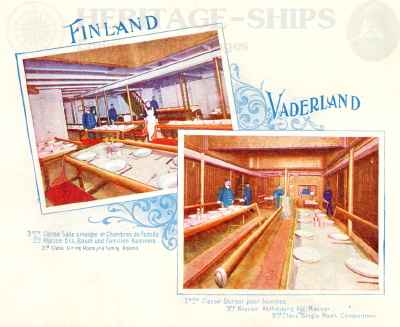
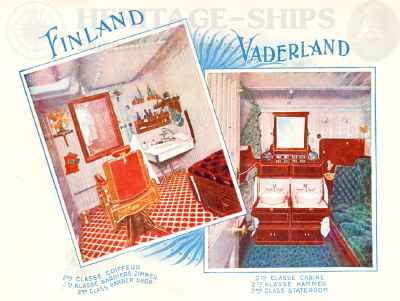
For emigrants, however, improvements in passenger accommodation were significant. The older concept of large open steerage compartments gradually gave way to more organized third-class accommodation, while meals, sanitary arrangements, ventilation and the separation of different groups of passengers became increasingly regulated.
The experience nevertheless differed considerably according to class. First- and second-class passengers occupied cabins and had access to dedicated dining and public rooms, while emigrants travelling in steerage or third class lived much more simply and in considerably more crowded conditions.
For most emigrants, the important considerations were not luxury but the practical conditions of a journey lasting several weeks from their home in Europe to their destination in America: a secure berth, regular meals, adequate sanitary facilities, assistance in an unfamiliar language, the handling of baggage, and help when transferring between steamships and railroads.
Changes in the Transatlantic Service
Red Star Line and American Line flags
The principal Red Star routes were Antwerp-Philadelphia and Antwerp-New York. Philadelphia was particularly important during the early years, while New York gradually became the dominant passenger route. At the beginning of the twentieth century Southampton and later Dover were included in the New York service.
The close association with the American Line and subsequently the International Mercantile Marine organization made the deployment of ships increasingly flexible. Vessels could appear on different services during their careers, and the composition of what might be described as the "Red Star fleet" consequently changed according to the requirements of the larger shipping organization.
This is important when interpreting passenger records, advertisements and contemporary descriptions. The line advertised to the passenger did not necessarily indicate that a vessel spent its entire career with that particular service.
The First World War
The First World War fundamentally disrupted Red Star's operations. The German occupation of Antwerp in 1914 deprived the company of its European home port, and its ships were consequently employed on other routes within the wider International Mercantile Marine organization.
Several vessels were also used for wartime purposes. The Vaderland was renamed Southland in 1915, while the Zeeland became Northland. The Southland survived a torpedo attack in the Aegean in 1915 but was finally sunk by a German submarine off Ireland in June 1917.
After the war the company returned to Antwerp. In 1920 the Zeeland and Kroonland helped reopen the Antwerp-Southampton-New York service.
The Red Star Line returned after the war to a transatlantic passenger market that was changing rapidly. The great period of unrestricted European mass migration was coming to an end, particularly after the introduction of stricter United States immigration quotas during the 1920s.
The company nevertheless continued to operate substantial passenger liners. The second Belgenland, originally ordered before the war, entered Red Star service during the 1920s and became one of the best-known ships associated with the line. Together with ships such as the Lapland and Pennland, she represented Red Star during its final major period of passenger operation.
The decline in passenger traffic was eventually dramatic. In 1913 the line had carried more than 117,000 passengers. By 1934 the annual total had fallen below 4,000.
The remaining Pennland and Westernland were sold to Arnold Bernstein of Hamburg in 1935. They continued to operate between Antwerp, Southampton and New York under the Red Star Line name, allowing the familiar name to survive after the original organization had effectively ceased operating in its former form.