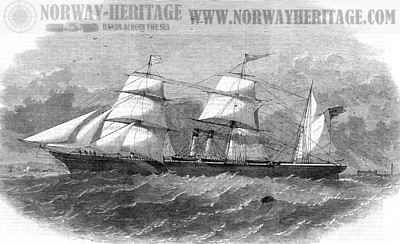
The Allan Line was one of the major North Atlantic passenger companies of the nineteenth century and played an important role in carrying emigrants from Britain and northern Europe to Canada and the United States.
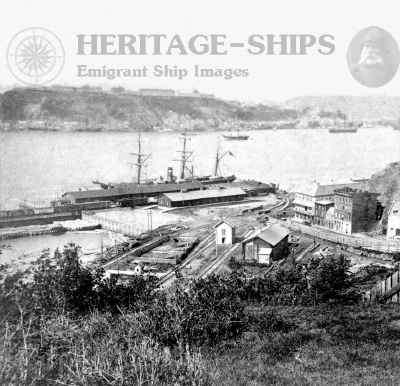
The company was established in Montreal in the 1850s as the Montreal Ocean Steam Ship Company, but was commonly known as the Allan Line. Its first steamship, S.S. Canadian (1), entered the Liverpool–Quebec–Montreal service in 1854. During winter, when navigation on the St. Lawrence was closed by ice, the service was diverted to Portland, Maine. The opening of the St. Lawrence & Atlantic Railway between Portland and Montreal in 1853 made it possible for passengers and mail to continue overland to Canada.
In 1856 the company secured a Canadian mail contract for regular sailings between Liverpool and Canada, and by 1859 it was operating a weekly service during the navigation season.
Emigrants and the Atlantic Service
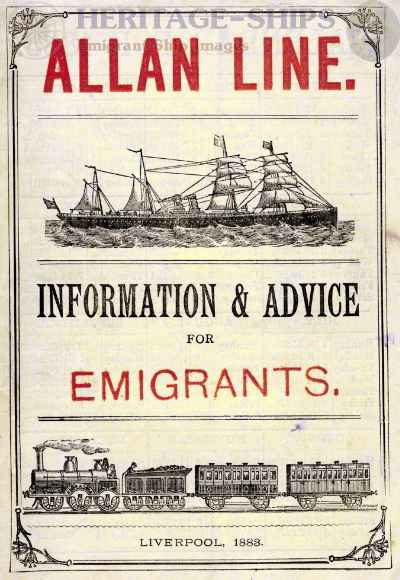
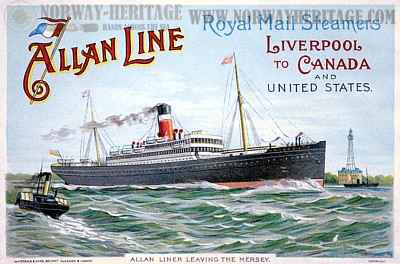
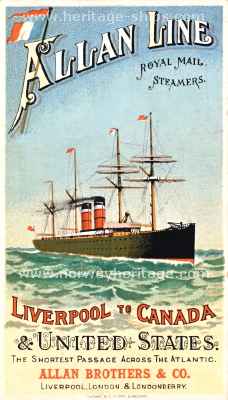
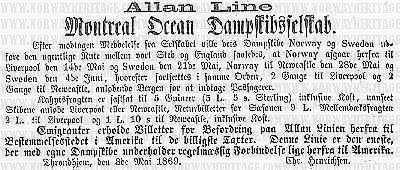
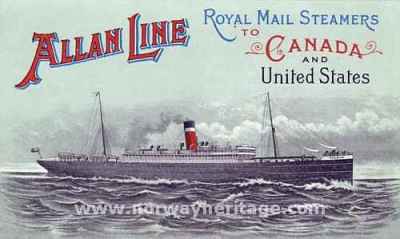
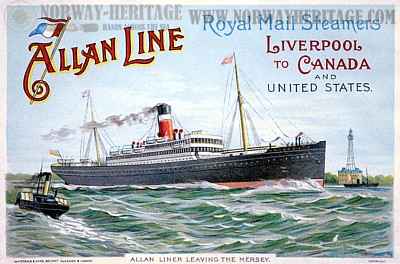
Advert for the Allan Line on the cover of an old promotional booklet
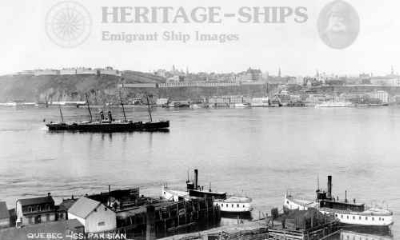
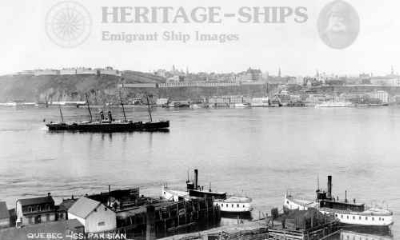
Emigrant traffic formed an important part of the business from an early stage. The Canadian (1) had accommodation for 80 first-class passengers and 350 in third or emigrant class (steerage). As the ships grew larger, so did the capacity for emigrants. S.S. Sarmatian, introduced in 1871, could carry 850 third-class (steerage) passengers, while S.S. Parisian, completed in 1881, had accommodation for 150 first-class, 100 second-class and 1,000 third-class (steerage) passengers.
The growth of emigration influenced the development of the route network. Allan Line steamers began calling at Moville in 1860 to serve the growing Irish traffic, and in 1861 the company established a new emigrant service from Glasgow to Quebec and Montreal. The S.S. Saint Andrew inaugurated the service in September 1861, followed by the S.S. Saint George.
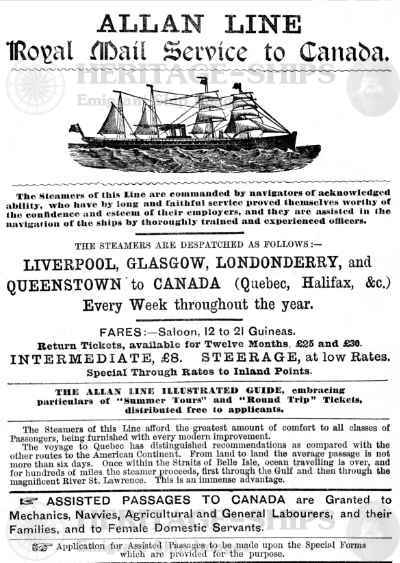
An Allan Line emigrant guide issued in 1883 shows how the company promoted both Canada and the journey itself. At the time, the Allan Line was under contract with the Canadian Government for the conveyance of assisted passengers. The guide promoted Canada as a destination for settlers and workers and recommended that emigrants bound for Canada, Manitoba and the Canadian Northwest travel directly to Quebec or Halifax.
Particular emphasis was placed on the St. Lawrence route. The company argued that once a vessel had entered the Strait of Belle Isle, the open Atlantic portion of the voyage was largely over, and the remainder of the journey continued through the Gulf and River St. Lawrence toward Quebec. Speed and safety were also important selling points. The company highlighted the performance of their steamer Sardinian and emphasized the experience of its captains and officers.
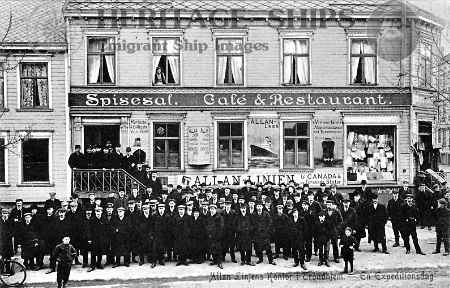
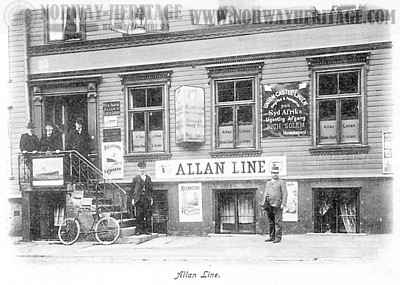
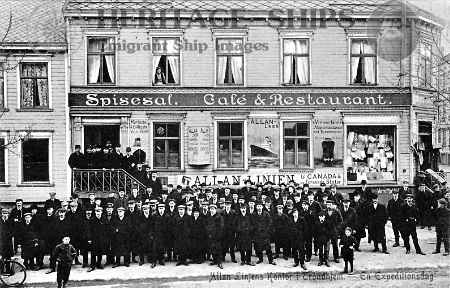
Emigrants gathered outside the office of the Allan & State Line on the day of departure from Trondhjem, Norway. The emigrants on this picture were to board a ship from Trondhjem (Trondheim) to Hull in England, and to go by train from Hull to Liverpool where they boarded the transatlantic steamship — Buy a copy
For many emigrants, however, the Atlantic crossing was only one stage of a much longer journey. Local agents, feeder steamers and railway connections linked inland districts and regional ports with Liverpool and Glasgow.
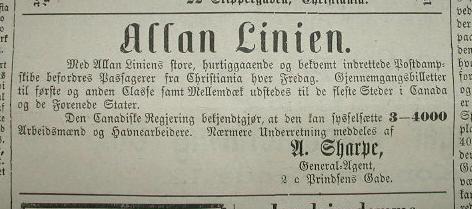
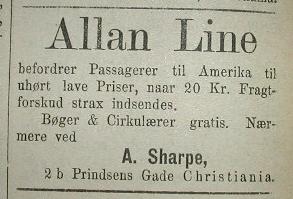
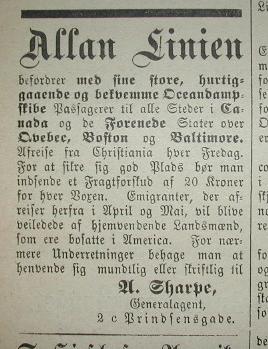
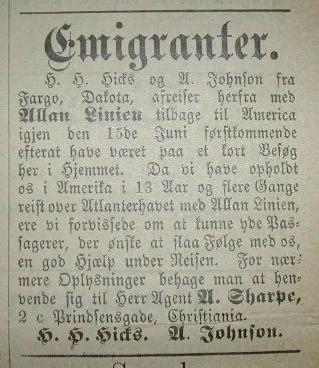
The Allan Line's Norwegian and Scandinavian operations provide a good example. In 1869 the company introduced the steamships Norway and Sweden for feeder traffic between Scandinavia and Britain, with passengers continuing by railway to Liverpool or Glasgow. Occasionally, the steamship Damascus was also used in the feeder service, as well as on the Atlantic route. Norwegian sources show Allan Line services from Trondheim continuing into 1871 and 1872. The ships called at ports including Trondheim, Kristiansund, Ålesund, Bergen, Kristiania (Oslo) and Kristiansand at different times, and carried freight as well as passengers. The company also carried passengers booked with other lines from Norway to the United Kingdom, although this cooperation was not always trouble-free. In 1870, there was a considerable newspaper dispute between the local agent of the Anchor Line and the Allan Line. The company discontinued its feeder service in 1872 because of the declining number of emigrants.
After the Allan Line ceased operating its own feeder steamers, Norwegian emigrants continued to travel through Britain. Wilson Line became particularly important in this traffic. Many emigrants crossed the North Sea to Hull aboard Wilson Line steamers and then travelled by train across England to Liverpool, where they boarded the transatlantic steamer.
A surviving account from 1902 illustrates how this worked in practice:
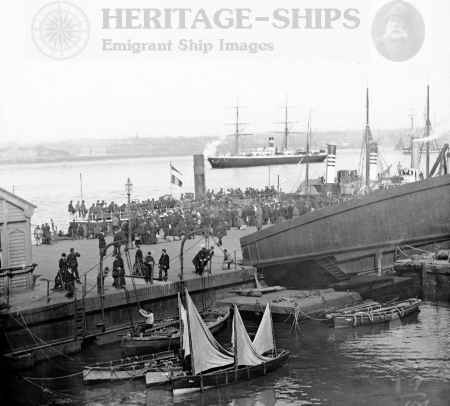
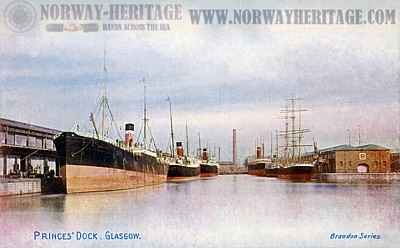
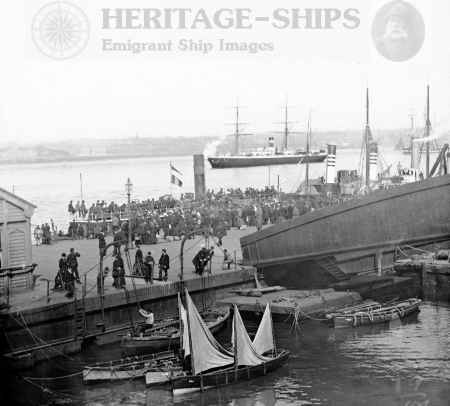
Allan Liner embarking emigrants at Liverpool, with a tender carrying them out to the ship — Buy a copy
March 12: - Wednesday, the emigrants left Trondheim, Norway aboard the Wilson Line steamship Salmo, commanded by Captain Soulsby. The ship sailed via Kristiansund, Ålesund, Bergen and Stavanger
March 16: - Reached Hull, England on the afternoon of
March 17: - The emigrants travelled by train from Hull to Liverpool and was accommodated at the Allan Line emigrant lodging house.
March 20: - Departed Liverpool aboard S.S. Tunisian.
March 29: - The ship arrived at Halifax, the journey continued by rail to Cass Lake, Minnesota.
The journey from Trondheim to Halifax had therefore taken 17 days and involved a Norwegian coastal voyage, the North Sea crossing, railway travel across England, several days in Liverpool, and the Atlantic crossing. Halifax was not the final destination, but merely the point of entry into North America.
Many emigrants who landed at Quebec or Halifax were travelling onward to the United States. Canadian ports therefore appear frequently in the records of emigrants whose final destinations were in states such as Wisconsin, Minnesota, Illinois, Iowa or farther west. From the Canadian port they continued by rail through Canada and across the border into the United States.
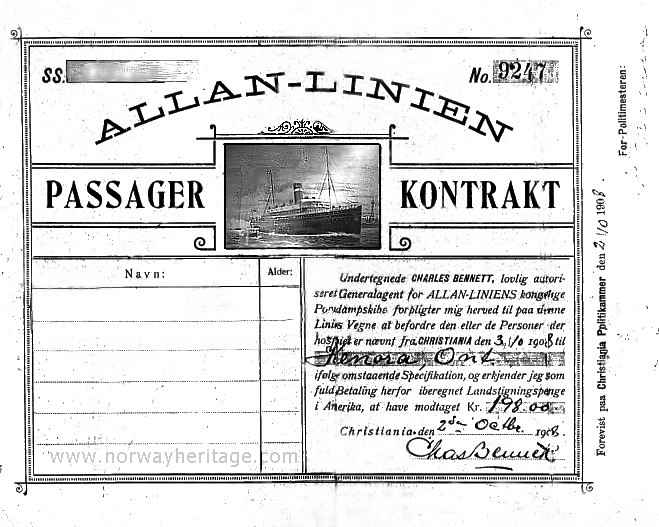
Passenger lists are an important source for tracing this part of the journey. When emigrants arrived at Canadian ports, passenger lists were submitted by the shipping companies to the Canadian authorities. Library and Archives Canada preserves passenger lists from 1865 to 1935. More information is available on the Norway Heritage page Canadian Passenger Records.
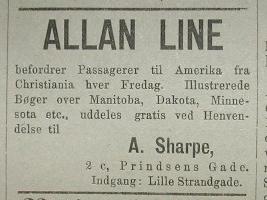
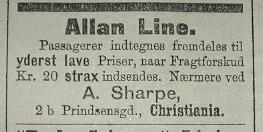
Local agents were another essential part of the system. They advertised departures, sold tickets, arranged connections and often served as the emigrant's main point of contact with the transatlantic company. A photograph from 1903 shows emigrants gathered outside the Allan & State Line office in Trondheim before departure. The office was located in Søndre gate 25, close to both the railway station and the harbor.
At that time Richard Solem was the Allan Line's head agent for the regions north of Dovre and for Jämtland in Sweden. The passengers shown outside the office were to travel from Trondheim to Hull and then by railway to Liverpool before boarding their Atlantic steamer.
The name Allan & State Line reflected an important change in the company's history. In 1891 the Allan Line acquired the fleet of the State Line. The State Line had operated between Glasgow and New York, and several of its ships continued for a time under the designation Allan-State Line in order to preserve the goodwill of the former company.
The Allan Line continued to expand during the later nineteenth century. At its peak in 1891 it operated 37 transatlantic ships and maintained eight distinct passenger services. The company also participated in the technological development of Atlantic shipping. The S.S. Buenos Ayrean of 1880 was the first steel passenger liner on the North Atlantic, while the S.S. Parisian was the largest steel vessel yet built when she entered service in 1881. In 1905 the Victorian and Virginian became the first turbine-powered and triple-screw liners on the North Atlantic.
The Allan Line also expanded beyond North America. In 1876 the company opened a service from Glasgow to Montevideo and Buenos Aires. Initially this was largely a winter operation, making use of ships displaced from the Canadian trade when the St. Lawrence was closed by ice. From 1887 the Glasgow–River Plate service operated monthly throughout the year.
By the early twentieth century competition had intensified. Canadian Pacific increasingly combined Atlantic steamship services with its own transcontinental railway network, giving it an advantage in through transportation across Canada and onward to the Pacific. The two companies gradually came closer together. Canadian Pacific Ocean Services began managing the fleets in 1916, and the remaining Allan Line vessels came under full Canadian Pacific management in 1917.
Principal passenger and emigrant routes
Period
Route
Notes
1854–1917
Liverpool–Quebec–Montreal
Principal summer Canadian service
1854–1901
Liverpool–Halifax–Portland, Maine
Principal winter connection
From 1860
Liverpool–Moville–Canada
Moville added for Irish passenger traffic
1861–1917
Glasgow–Quebec–Montreal
Established as an important emigrant route
1861–1914
Glasgow–Portland–New York
Winter and U.S. traffic
1864–1914
Glasgow–Philadelphia
Important U.S. service
1869–1872
Norway/Scandinavia – British ports
Feeder service connecting with rail to Liverpool or Glasgow
1871–1892
Liverpool–Queenstown–Halifax–Baltimore
North American service with intermediate calls
1876–1913
Glasgow–Montevideo–Buenos Aires
Initially seasonal and later a regular River Plate service
1880s onward
Glasgow–Boston
Important alternative North Atlantic route
1891 onward
Glasgow–New York
The old State Line route under the Allan & State Line connection
1880s–1917
London–Canada
Later extension of the company's Canadian network
The importance of the Allan Line to emigration lay not simply in the number of people it carried, but in the transport network it helped create. Feeder steamers, railway connections, local agents and transatlantic liners formed parts of the same system. An emigrant could begin the journey at a local agency office far from the Atlantic, cross the North Sea with one company, travel across Britain by train, cross the Atlantic with another, and continue by railway from Canada into the United States.