Norway Heritage was founded in 1997 by Norwegian historian and genealogist Børge (Borge) Solem, while studying history at the Norwegian University of Science and Technology (NTNU) in Trondheim. What began as a small collaborative project has grown into an extensive collection of historical databases, passenger lists, ship histories, articles, and other resources documenting Norwegian emigration and maritime history. For nearly three decades, the project's central purpose has remained unchanged: to preserve historical information, make it freely accessible, and help people around the world discover and understand the stories of Norwegian emigrants.
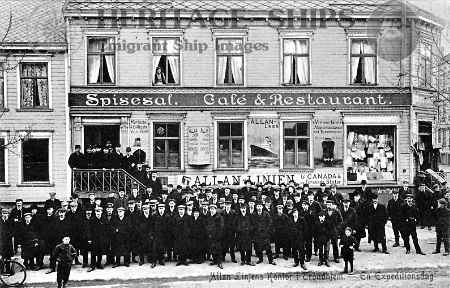

Børge's interest in Norwegian emigration has deep family roots. His great-great-grandfather Rich. Solem, great-grandfather Olaf H. Solem, and grandfather Richard W. Solem served as general agents for several major transatlantic shipping companies, including the Allan Line, Cunard Line, and White Star Line. Through their work, they helped thousands of Norwegian emigrants begin their journeys across the Atlantic. Growing up with this family history inspired an early fascination with the people, ships, and stories behind the great waves of emigration, an interest that would eventually lead to the creation of Norway Heritage.
His own family history also includes relatives who emigrated to the United States. Contact with these American branches of the family has been maintained across several generations, preserving family connections between Norway and the United States long after the original emigration.
When Norway Heritage was founded in 1997, the World Wide Web was still relatively new. Many of today's major genealogy websites did not yet exist, and historical information was frequently exchanged through international e-mail discussion groups and mailing lists. RootsWeb was one of the most important meeting places for genealogists and family historians around the world.
RootsWeb was acquired by Ancestry in 2000, and its popular mailing lists were discontinued in 2020. Its subsequent decline illustrates how much the online genealogy community has changed since the early days of Norway Heritage.

During his research into Norwegian emigration and maritime history, Børge came into contact with Canadian researchers Gery and Sue Swiggum, who operated a mailing list on RootsWeb known as TheShipsList. They discovered that they shared many interests and were frequently answering the same questions about emigrant ships, passenger lists, shipping companies, and migration routes.
Rather than repeatedly providing the same detailed information in individual correspondence, they decided to create a website where their research could be made freely available to everyone. The project was originally launched as The Solem and Swiggum Ship Index.
A few years later, Norwegian researcher Trond Austheim joined the project, making important contributions to its continued development. By 1999, the website was known as 100 Years of Emigrant Ships from Norway: The Solem, Swiggum & Austheim Ship Index (SS&A).
In the early years, the website consisted entirely of hand-coded HTML pages, with every page created and updated manually. As the amount of historical information grew, this approach became increasingly difficult to maintain. Trond Austheim's technical expertise made it possible to introduce Microsoft Access databases and dynamic pages built with Classic ASP, a major improvement that transformed how information was stored, organized, and presented on the website. This transition laid the technical foundation for the continued expansion of its historical databases and research resources.
What began as a practical way of sharing information gradually developed into something much larger. As more researchers discovered the website, new databases, passenger lists, ship histories, articles, photographs, and historical documents were added. The project eventually became known as Norway Heritage, reflecting its expanding scope and its ambition to document and preserve the history of Norwegian emigration. Over the years, Norway Heritage has also benefited from the dedication of volunteers and contributors from around the world. They have helped transcribe passenger lists, share historical documents and photographs, correct information, contribute articles, and preserve material that might otherwise have remained difficult to access. Their generosity, enthusiasm, and commitment have played an essential role in the project's development.
Since around 2014, Børge Solem has maintained and developed Norway Heritage independently. Balancing the demands of the project with a full-time career and family responsibilities became increasingly challenging, particularly as large commercial genealogy platforms expanded and transformed the online research landscape.
At the same time, the website's underlying technology was showing its age. Built on Classic ASP and Microsoft Access databases, Norway Heritage had accumulated considerable technical debt over the years. Maintaining and expanding the aging platform became increasingly difficult, and a comprehensive modernization was needed to secure the project's long-term future.
Faced with these challenges, Børge had to reassess the future of Norway Heritage and consider how the project could be sustained in the years ahead. The response from many users who valued the website and wanted to see it continue played an important role in his decision to renew and further develop Norway Heritage. Their encouragement reinforced his commitment to preserving the project's accumulated research and historical resources for future generations.
In 2026, work began on a comprehensive rebuilding of Norway Heritage using modern web technologies. Børge took on much of the development work himself, drawing on earlier programming experience while adapting to newer technologies. The aim is to establish a more sustainable and manageable technical platform, reducing the time required for maintenance and allowing greater attention to be devoted to historical research, documentation, and the development of new content.
Today, Norway Heritage represents nearly three decades of continuous research, documentation, and preservation. Thousands of hours have been devoted to locating, transcribing, verifying, and documenting historical records from archives, libraries, museums, newspapers, and private collections. Whenever possible, information is checked against original sources, with an emphasis on historical accuracy and reliable documentation. Over the years, millions of visitors from around the world have used Norway Heritage to explore their family histories, investigate Norwegian emigration, and learn about the ships that carried generations of emigrants across the Atlantic. The website continues to serve family historians, genealogists, historians, students, authors, educators, museums, and maritime researchers seeking reliable and freely accessible historical information.
Maintaining and developing Norway Heritage has become increasingly demanding, both technically and financially. Modern web technologies offer new opportunities for preserving and presenting historical information, but they also involve higher costs for hosting, maintenance, security, and continued development.
To ensure the long-term sustainability of Norway Heritage, it became necessary to establish a formal organizational and financial framework through which revenue could be generated and managed in accordance with applicable legal and regulatory requirements. Heritage Web AS was therefore established by Børge Solem, primarily to support the continued operation, maintenance, and development of the Norway Heritage Project.
Researchers, authors, publishers, museums, and media producers have increasingly sought access to historical photographs and documents for publications, exhibitions, and other projects. Through Heritage-Ships and professional historical research services, Heritage Web AS can generate revenue that helps cover the costs of maintaining and developing Norway Heritage. The principal purpose is not to commercialize Norway Heritage's historical databases and research resources, but to help ensure that they remain freely accessible to the public. Although the technologies and financial requirements have changed considerably since 1997, Norway Heritage remains an independent project dedicated to careful research, original sources, international collaboration, and the preservation of historical knowledge for future generations.
From the beginning, Norway Heritage has been guided by the belief that historical knowledge should be shared whenever possible. Unlike many commercial genealogy services, Norway Heritage has never been based on subscriptions or exclusive access to historical information. Its databases, articles, and research resources have been developed with the aim of making historical knowledge freely available to anyone interested in Norwegian emigration. The project continues to emphasize careful documentation, responsible use of historical sources, and the importance of preserving information for future generations. Although Norway Heritage has grown far beyond what its founders imagined in 1997, its original philosophy remains unchanged.
History is more than names and dates. It is the story of ordinary people whose journeys shaped families, communities, and nations. Norway Heritage exists to preserve those stories, connect people with their past, and ensure that the history of Norwegian emigration remains accessible to future generations.
