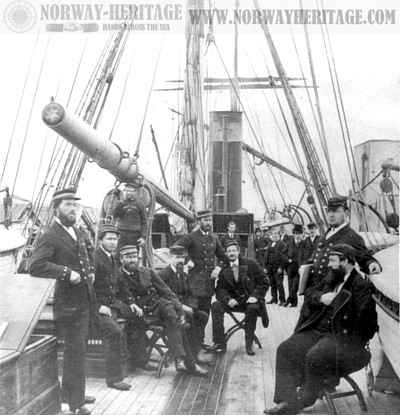
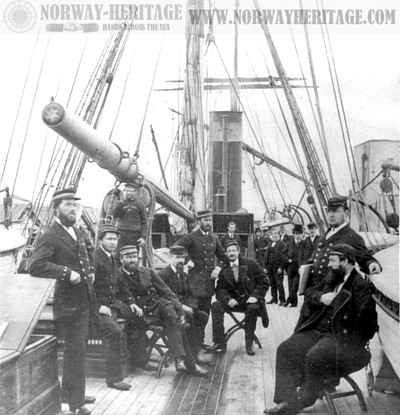
Officers gathered on the after deck of the steamship Idaho of the Guion Line — Buy a copy
The Idaho (official No. 58,901) was an iron-hulled, brig-rigged screw steamer built at Jarrow, County Durham, England, in 1869. She was owned by the Liverpool and Great Western Steamship Company (Guion Line), with Stephen B. Guion of Liverpool as managing owner. The Idaho was a sister ship to the Nevada.
The vessel measured 3,357 gross tons and 2,178 registered tons. She was powered by two simple surface-condensing steam engines with a combined nominal rating of 440 horsepower. The Idaho was fitted out to accommodate 72 first-class passengers and 800 steerage passengers, reflecting the considerable demand for transatlantic passenger transport during this period.
The Final Voyage
On 21 May 1878, the Idaho, under the command of Captain William Holmes, departed New York for Liverpool via Queenstown (now Cobh), Ireland. According to the subsequent court proceedings, she carried 63 passengers, a crew of 82, 54 horses, and approximately 3,200 tons of general cargo. The Atlantic crossing was marked by periods of fog, rain, headwinds, and strong westerly gales. Nevertheless, the vessel reached Queenstown on 1 June, where she landed the mails and several passengers before continuing towards Liverpool.
After leaving Queenstown, the Idaho proceeded eastward along the southern coast of Ireland. The weather was initially fine, with a light southerly breeze, and the steamer was making approximately 11 to 12 knots. During the afternoon, the vessel passed Ballycotton and Mine Head. At about 6:15 p.m., Hook Tower was observed, and Captain Holmes and his officers estimated their distance from the lighthouse at seven to eight miles. This estimate later proved to be incorrect.
At approximately 6:40 p.m., dense fog suddenly enveloped the ship, reducing visibility to little more than the length of the vessel. Additional lookouts were posted and the steam whistle was sounded, but the Idaho continued at full speed. No soundings were taken to establish the depth of water beneath her keel. Shortly after 7 p.m., rocks were suddenly sighted ahead, slightly to starboard. Captain Holmes ordered the engines reversed at full speed and the helm put hard to starboard, but there was insufficient time to avoid a collision.
The Idaho struck Coningbeg Rock, near the Saltee Islands off the coast of County Wexford, Ireland. The impact severely damaged her bottom, and water began pouring into the holds. The vessel was sinking rapidly.
A Dramatic Rescue
Captain Holmes immediately ordered the lifeboats lowered and the passengers assembled on deck. Although the sudden collision caused considerable alarm, the officers and crew managed to maintain sufficient discipline to evacuate everyone aboard. Several passengers later described the frightening moments following the impact. John Watson, associated with Wallack's Theatre in New York, recalled that many cabin passengers had been relaxing in the saloon when the ship struck. The violent shock threw some people off their feet, and cries of fear and confusion followed as passengers hurried towards the deck. Women were given priority in the lifeboats, while officers worked to prevent panic among those waiting to escape. At one point, according to passenger accounts, an officer threatened several men who attempted to approach a boat before the evacuation of the women had been completed.
Another passenger, D. G. Chittenden, described how rapidly the boats were lowered and praised the determination of the officers. He identified the second officer, John Worrall, as having prevented frightened men from interfering with the evacuation. As the Idaho settled deeper into the water, the remaining passengers and crew continued to abandon ship. Captain Holmes stayed aboard until the evacuation was complete and was among the last to leave. The steamer foundered shortly afterwards, leaving only her mastheads visible above the water.
Despite the speed with which the vessel sank, every passenger and crew member was saved. The animals aboard were less fortunate. Passengers recalled the distressing cries of the horses and other livestock trapped aboard the sinking vessel. There was no opportunity to rescue them.
A Night on Great Saltee Island
The survivors faced another difficult ordeal after escaping the wreck. Their lifeboats were surrounded by dense fog, and the small islands off the Irish coast were difficult to locate. Guided by compasses, the boats eventually approached Great Saltee Island. The survivors called for assistance, and inhabitants of the island helped direct them towards a suitable landing place.
The island offered little shelter or food for such a large number of unexpected visitors. A local farming family provided what assistance they could, offering black bread and milk to the exhausted survivors. Passengers were accommodated in the farmhouse, while others spent the night in an adjoining building or barn, sleeping on straw or whatever bedding could be improvised. The following morning, arrangements were made to transport the survivors to the mainland at Kilmore. From there, they continued to Wexford, where transportation was organized for their journey through Dublin and eventually back to Liverpool.
Their arrival in Liverpool attracted considerable public attention. Friends and relatives gathered at Lime Street Station, where the passengers and crew were met by representatives of the Guion Line. Most of the passengers had lost nearly all their personal belongings. Among them were several theatrical performers travelling with valuable costumes and equipment. John Watson lost an extensive theatrical wardrobe, while Miss Grace Courtland, the wife of D. G. Chittenden, reportedly lost costumes valued at $2,000, together with jewellery and other possessions.
Passengers Praise the Captain and Crew
Despite the loss of the ship and their belongings, the passengers expressed considerable gratitude towards Captain Holmes, his officers, and the crew. After reaching Kilmore, they held a meeting and unanimously adopted a testimonial praising the conduct of those responsible for their rescue. The passengers attributed their survival to the discipline maintained aboard and the prompt action taken during the evacuation. They emphasized that the boats had been launched and filled in an orderly manner while the ship was sinking beneath them. The testimonial reflected the strong impression made upon the survivors by the successful evacuation of a large steamship under extremely dangerous circumstances.
The Official Inquiry
The loss of the Idaho was subsequently investigated by a court in Liverpool. Its findings, reported in the Liverpool Weekly Courier on 22 June 1878, presented a less favourable assessment of Captain Holmes's navigation before the accident. The court concluded that the captain had seriously misjudged the ship's position after passing Ballycotton, particularly its distance from Hook Tower. When the dense fog descended, the Idaho was still proceeding at full speed. Captain Holmes had neither reduced speed nor taken soundings to determine the depth of water. The court considered these omissions particularly serious because the vessel was navigating near dangerous rocks with a large number of passengers and crew aboard.
The court rejected the explanation that the fog was expected to be temporary. It concluded that Captain Holmes should have reduced speed immediately and used the lead to establish the vessel's position more accurately. Had these precautions been taken, the court believed there would have been sufficient warning to alter course and avoid the rocks. Captain Holmes was therefore found responsible for the loss of the Idaho, and his master's certificate was suspended for six calendar months. However, the court also acknowledged Captain Holmes's excellent conduct after the collision. His determination, presence of mind, and the discipline maintained among the officers and crew had enabled everyone aboard to escape safely. In recognition of these mitigating circumstances and his previous record, the court recommended that he be permitted to serve as first officer during the period of suspension.
The circumstances surrounding the loss of the Idaho present a striking contrast. Captain Holmes was held responsible for navigational errors that led to the destruction of his ship, yet his conduct after the grounding was widely praised. The passengers regarded him as the man whose leadership had saved their lives, while the court considered him responsible for placing those lives in danger. Even the court acknowledged his effective leadership during the evacuation, illustrating how a shipmaster could be held accountable for a maritime disaster while simultaneously earning recognition for his actions in its aftermath.
Chronological History
Year
Event
1869
Feb. 13, launched
1869
Apr. 13, maiden voyage Liverpool - Queenstown - New York
1870
Liverpool → New York Aug. 7. Liverpool & Great Wester Steam Ship Company.
1870
Liverpool → New York Sept. 18. Liverpool & Great Wester Steam Ship Company.
1871
Liverpool → New York June 4. Liverpool & Great Western Steam Ship Company<BR>Agent DHrr. Blichfeldt & Co., Christiania.
1871
Liverpool → New York July 15
1871
Liverpool → New York Aug. 28. Agent DHrr. Blichfeldt & Co., Christiania.
1871
Liverpool → New York Oct. 8. Agent DHrr. Blichfeldt & Co., Christiania.
1871
Liverpool → New York Nov. 19
1872
Liverpool → New York June 16. Agent DHrr. Blichfeldt & Co., Christiania.
1872
Liverpool → New York July 28. Also reported arrive 1872-07-29.
1872
Liverpool → New York Sept. 8. Agent DHrr. Blichfeldt & Co., Christiania.
1873
Liverpool → New York May 17
1873
Liverpool → New York June 29. Agent DHrr. Blichfeldt & Co., Christiania.
1874
Liverpool → New York May 25. Agent O. Jacobsen, Christiania.
1874
Liverpool June 24 → New York July 5. Agent O. Jacobsen, Christiania.
1874
Liverpool Aug. 5 → New York Aug. 16. Agent O. Jacobsen, Christiania.
Do you have more information about this subject, or a question about the text above? Leave a comment here.
Questions about passenger lists, relatives or other research are best asked in the forum,
where many more readers will see them. Comments that fit better in the forum may be moved there by the moderator.
Comments are reviewed before they appear publicly. Fields marked with * are required.
Members: log in to post with your member name.