Cunard Line

By Børge Solem · Last updated: 2026-09-20
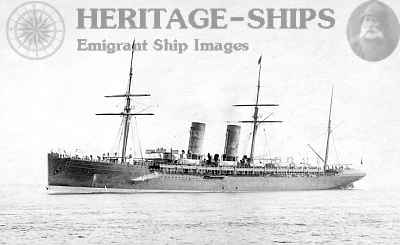
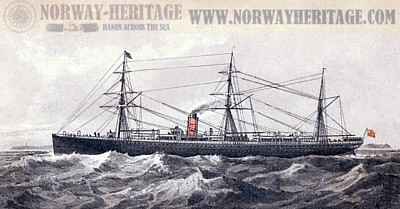
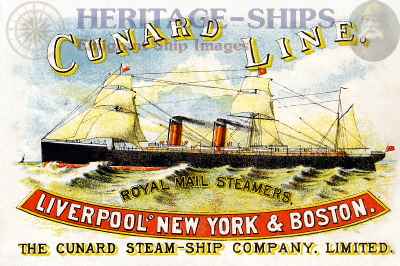
Cunard Line advertisement showing the S.S. Servia.
Cunard Line advertisement showing the S.S. Servia. — Buy a copy

The Cunard Line had its origins in the efforts of Samuel Cunard, a merchant and shipowner of Halifax, Nova Scotia, to establish a regular steamship service across the North Atlantic. Cunard had been involved in shipping and the carriage of mail for many years and became convinced that steamships could provide a more regular and reliable transatlantic mail service than the sailing vessels then employed.

An opportunity arose in 1838, when the British government invited tenders for the regular conveyance of mail by steamship across the Atlantic. Cunard traveled to Britain, where he joined forces with George Burns of Glasgow and David MacIver of Liverpool. Their proposal for a regular mail service between Liverpool, Halifax, and Boston was accepted by the British Admiralty.

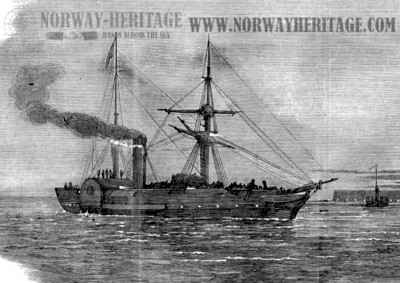
The service began in 1840 under the name The British and North American Royal Mail Steam Packet Company, although it soon became commonly known as the Cunard Line after its principal founder. Four paddle steamers, the Britannia, Acadia, Caledonia, and Columbia, were placed on the new route, providing regular fortnightly sailings between Liverpool, Halifax, and Boston.

During the following decades, the company steadily expanded its North Atlantic operations. New York became an increasingly important destination, while the fleet developed from the relatively small wooden paddle steamers of the 1840s to much larger iron steamships.

The Development of the Cunard Line

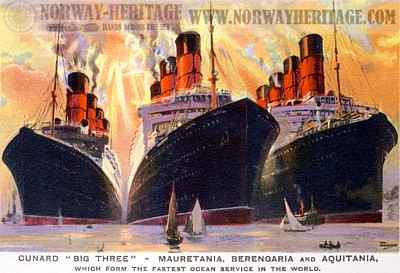
Cunard Line's “Big Three”: Mauretania, Berengaria, and Aquitania.
Cunard Line's “Big Three”: Mauretania, Berengaria, and Aquitania. — Buy a copy

The rapid development of steam navigation brought increasing competition on the North Atlantic. One of Cunard's most important early competitors was the American Collins Line, which entered the trade in 1850 with large and fast steamships.

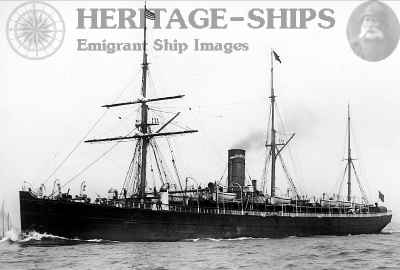
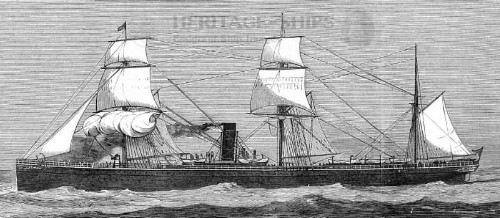
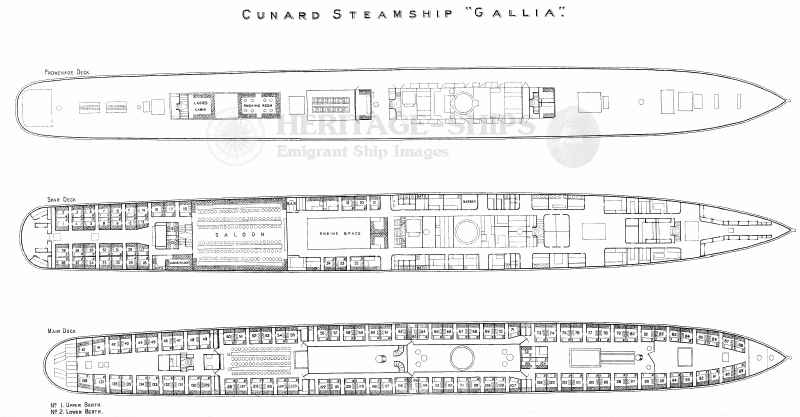
Cunard continued to expand and modernize its fleet. The Scotia, introduced in 1862, belonged to the last generation of large Cunard paddle steamers. She was followed by increasingly larger screw steamships such as the Bothnia, Scythia, and Gallia.

In 1878, the business was registered as a limited company, and in 1880 it entered a new period of expansion as the Cunard Steam Ship Company Limited.

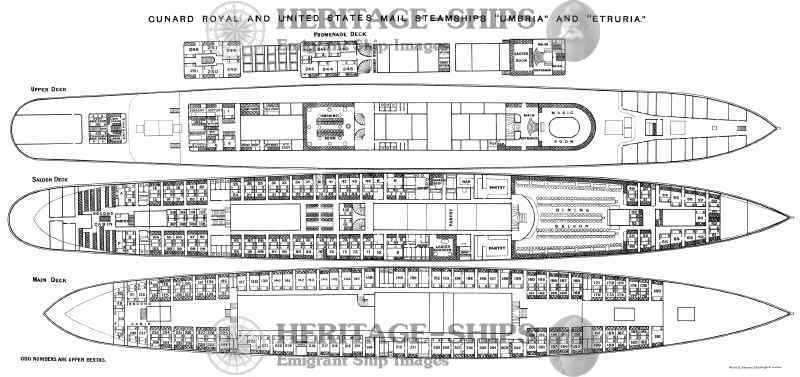
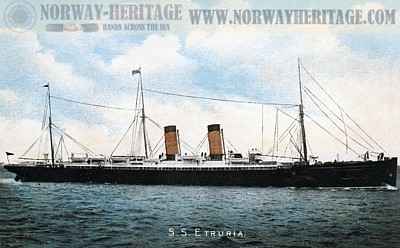
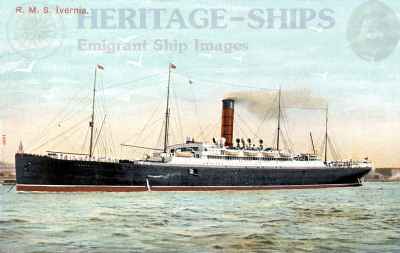
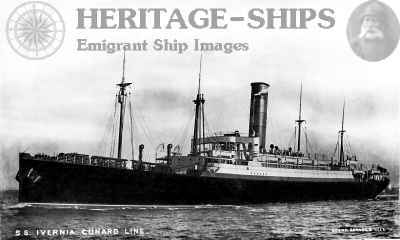
During the 1880s and 1890s, ships such as the Servia, Aurania, Umbria, and Etruria were added to the fleet. They were followed by the Campania and Lucania and, in the early twentieth century, by ships such as the Ivernia, Saxonia, and Carpathia.

A further development came with the Lusitania and Mauretania, which entered service in 1907. Among the largest and fastest passenger ships in the world when introduced, they represented the enormous development that had taken place since the first Cunard steamships crossed the Atlantic in 1840. They were followed by the still larger Aquitania, which entered service in 1914.

The Cunard Line and Norwegian Emigration

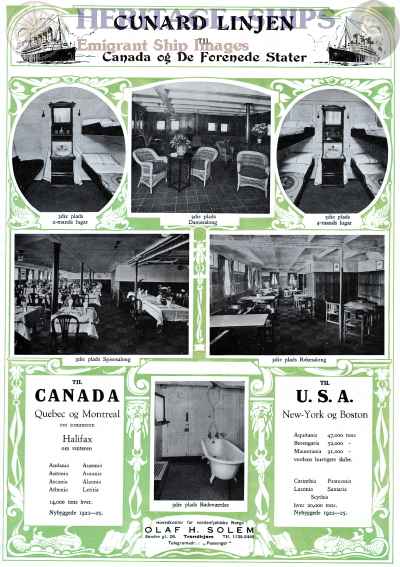
Cunard Line advertisement poster for third-class service to Canada and the United States. Canadian routes served Quebec and Montreal in summer and Halifax in winter. U.S. routes served New York and Boston aboard ships including Aquitania, Berengaria and Mauretania. The poster shows third-class cabins, dining and smoking saloons, ladies' saloon and bathroom. Text in Norwegian, issued by general agent Olaf H. Solem, Trondhjem.
Cunard Line advertisement poster for third-class service to Canada and the United States. Canadian routes served Quebec and Montreal in summer and Halifax in winter. U.S. routes served New York and Boston aboard ships including Aquitania, Berengaria and Mauretania. The poster shows third-class cabins, dining and smoking saloons, ladies' saloon and bathroom. Text in Norwegian, issued by general agent Olaf H. Solem, Trondhjem. — Buy a copy

The Cunard Line was one of the first British transatlantic steamship companies to establish an organized passenger agency in Norway for the growing emigrant trade.

By 1869, Norwegian agents were arranging emigrant journeys by steamship to Hull, across England to Liverpool, and from there aboard Cunard steamships to New York, with onward transportation to the passengers' final destinations in North America. By 1870, Cunard had an established agency in Christiania, and the company's representation was subsequently extended through agents and subagents in other parts of Norway.

The early agency organization was not necessarily as permanent or as clearly structured as it later became. Agents could change companies, represent more than one transportation interest, or have their authority transferred or withdrawn. The surviving Norwegian records show several changes in Cunard's representation during the early 1870s. By 1871, Cunard was also represented in Trondhjem.

As the emigrant trade developed, the company established a more extensive organization of agents and subagents. The general agency in Norway was located in Christiania, while agents in important emigrant centers such as Stavanger, Bergen, and Trondhjem served the surrounding districts.

Traveling with the Cunard Line from Norway

The Cunard Line did not operate its own regular feeder service between Norway and Britain. Norwegian emigrants traveling with Cunard therefore depended on other shipping companies for the first stage of their journey.

For many years, one of the principal routes was by steamship from Norway to Hull and then by railway across England to Liverpool. From Liverpool, the emigrants boarded a Cunard steamship for the Atlantic crossing. The Norwegian agent records show this route already in the late 1860s, with tickets covering not only the journey to New York but also onward transportation to the emigrant's destination in America.

For emigrants, the Cunard Line was therefore part of a much larger transportation system. A journey sold by a Cunard agent in Norway could involve a Scandinavian feeder steamer, a railway journey across Britain, a Cunard transatlantic steamship, and finally rail transportation in North America.

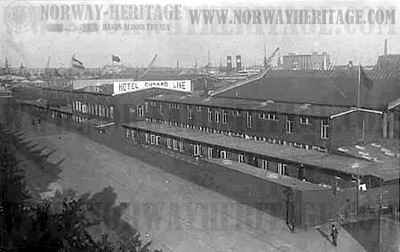
Connections did not always correspond perfectly, and emigrants could have to wait in Liverpool before the departure of their Atlantic steamer. Hotels and boarding houses associated with the emigrant traffic provided accommodation for passengers during their stay.

The local agents played an important role in coordinating these different stages. They sold tickets, provided information about departure dates and routes, arranged the necessary connections, and linked emigrants in towns and rural districts with the international transportation network that carried them to North America.

From Steam Packets to Ocean Liners

When the Britannia began the Cunard service in 1840, transatlantic steam navigation was still in its early stages. During the following seventy years, the company developed alongside the enormous growth of steamship travel and mass emigration across the North Atlantic.

For Norwegian emigrants, however, the Cunard Line was more than a fleet of famous ocean liners. Behind the transatlantic steamships stood a network of agents, feeder services, railways, hotels, and connecting transportation that made it possible to purchase and undertake a journey from Norway to a final destination in North America. 

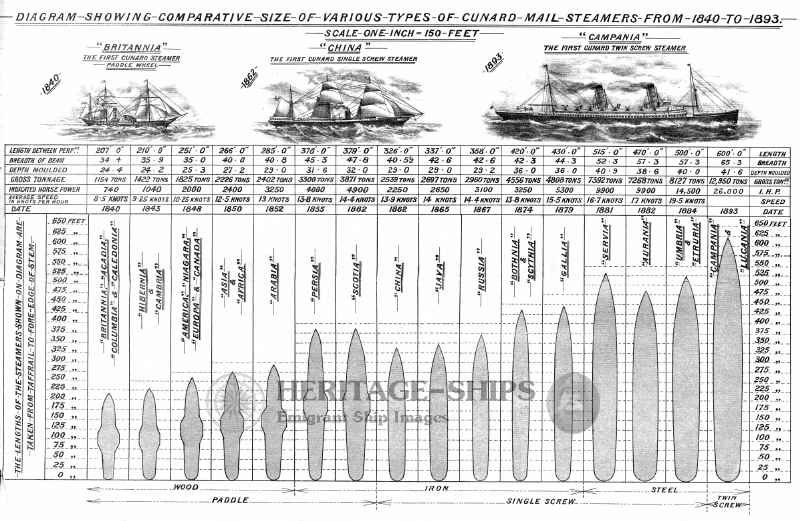
Diagram showing comparative size of various types of Cunard mail steamers from 1840 to 1893. Ships: Britannia, Acadia, Columbia and Caledonia 1840, Hibernia and Cambria 1843, America, Niagara, Europa and Canada 1848, Asia and Africa 1850, Arabia 1852, Persia 1855, Scotia 1862, China 1862, Java 1865, Russia 1867, Bothnia and Scythia 1874, Gallia 1879, Servia 1881, Aurania 1882, Umbria and Etruria 1884, Campania and Lucania 1893.
Diagram showing comparative size of various types of Cunard mail steamers from 1840 to 1893. Ships: Britannia, Acadia, Columbia and Caledonia 1840, Hibernia and Cambria 1843, America, Niagara, Europa and Canada 1848, Asia and Africa 1850, Arabia 1852, Persia 1855, Scotia 1862, China 1862, Java 1865, Russia 1867, Bothnia and Scythia 1874, Gallia 1879, Servia 1881, Aurania 1882, Umbria and Etruria 1884, Campania and Lucania 1893. — Buy a copy

A voyage from Norway to America in 1911 - An account of a voyage from Bergen to Newcastle on the S/S Hera, then from Liverpool to New York on the S/S Mauretania.
The Great Liners - How great were the liners really? - We are displaying some pictures from a Cunard Line "Comparisons" booklet issued by the company some time around 1925
THE TALE OF THE UMBRIA, shaft breaking in mid-Atlantic, 1892
The collision between the S/S Umbria and the S/S Iberia in 1888

Recorded Ships

Type Ship Built Shipyard Tonnage
S.S. Abyssinia 1870 J. & G. Thomson & Co. 3376 gross
S.S. Acadia 1840 John Wood & Co. 1154 gross
S.S. Africa 1850 Robert Steele & Co. 2226 gross
S.S. Alaunia (1) 1913 Scott’s Shipbuilding & Eng. Co. Ltd 13405 gross
S.S. Alaunia (2) 1925 John Brown & Co. Ltd. 14040 gross
S.S. Albania (1) 1900 C. S. Swan & Hunter 7640 gross
S.S. Albania (2) 1920 Scott’s Shipbuilding & Eng. Co. Ltd 12767 gross
S.S. Aleppo 1864 J. & G. Thomson & Co. 2057 gross
S.S. Algeria 1870 J. & G. Thomson & Co. 3428 gross
S.S. Alps 1852 William Denny & Co. 1440 gross
S.S. America 1848 Robert Steele & Co. 1826 gross
S.S. Andania (1) 1913 Scott’s Shipbuilding & Eng. Co. Ltd 13405 gross
S.S. Andania (2) 1921 Hawthorn, Leslie & Co. Ltd. 13950 gross
S.S. Andes 1852 William Denny & Co. 1440 gross
S.S. Antonia 1921 Vickers Ltd. 13867 gross
Aquitania 1913 John Brown & Co. Ltd. 45647 gross
S.S. Arabia (2) 1852 Robert Steele & Co. 2402 gross
S.S. Ascania (1) 1911 Swan, Hunter & Wigham Richardson 9111 gross
S.S. Ascania (2) 1925 Armstrong Whitworth & Co. 14013 gross
S.S. Asia (1) 1850 Robert Steele & Co. 2226 gross
S.S. Athenia 1922 Fairfield Shipbuilding & Eng. Co. Ltd. 13465 gross
S.S. Atlas 1860 J. & G. Thomson & Co. 1794 gross
S.S. Aurania (1) 1882 J. & G. Thomson & Co. 7269 gross
S.S. Aurania (2) 1916 Swan, Hunter & Wigham Richardson 13936 gross
S.S. Aurania (3) 1924 Swan, Hunter & Wigham Richardson 13984 gross
S.S. Ausonia (1) 1909 Swan, Hunter & Wigham Richardson 7907 gross
S.S. Ausonia (2) 1921 Armstrong Whitworth & Co. 13912 gross
S.S. Australasian 1857 J. & G. Thomson & Co. 2902 gross
S.S. Balbec 1852 William Denny & Co. 774 gross
S.S. Batavia 1870 William Denny & Co. 2553 gross
S.S. Berengaria 1913 AG Vulcan 52226 gross
S.S. Bothnia (1) 1874 J. & G. Thomson & Co. 4535 gross
S.S. Brest 1874 Blackwood & Gordon 1463 gross
S.S. Britannia 1840 Robert Duncan & Co. 1156 gross
S.S. British Queen 1849 William Denny & Co. 773 gross
S.S. Calabria 1857 J. & G. Thomson & Co. 2902 gross
S.S. Caledonia 1840 Wood 1154 gross
S.S. Cambria 1844 Robert Steele & Co. 1422 gross
S.S. Cameronia (1) 1911 D. & W. Henderson Ltd. 10963 gross
S.S. Cameronia (2) 1919 William Beardmore & Co. 16365 gross
S.S. Campania 1892 Fairfield Shipbuilding & Eng. Co. Ltd. 12950 gross
S.S. Canada 1848 Robert Steele & Co. 1831 gross
S.S. Carinthia (1) 1895 London & Glasgow Co. Ltd. 5598 gross
S.S. Carinthia (2) 1925 Vickers Ltd. 20277 gross
S.S. Carmania 1905 John Brown & Co. Ltd. 19524 gross
S.S. Caronia 1904 John Brown & Co. Ltd. 19687 gross
S.S. Carpathia 1902 C. S. Swan & Hunter 13555 gross
S.S. Cassandra 1906 Scott’s Shipbuilding & Eng. Co. Ltd 8135 gross
S.S. Catalonia 1881 J. & G. Thomson & Co. 4841 gross
S.S. Cephalonia 1882 Laird Bros 5517 gross
S.S. China 1861 Robert Napier & Sons 2638 gross
S.S. Columbia 1841 Robert Steele & Co. 1154 gross
S.S. Corsica 1863 J. & G. Thomson & Co. 1134 gross
S.S. Cuba 1864 Tod & McGregor 2668 gross
S.S. Damascus 1856 William Denny & Co. 1214 gross
S.S. Demarara 1872 J. & G. Thomson & Co. 1904 gross
S.S. Emeu 1853 Robert Napier & Sons 1538 gross
S.S. Emperor of India 1914 Caird & Co. 11430 gross
S.S. Etna 1855 Caird & Co. 2215 gross
S.S. Etruria 1884 John Elder & Co. 7718 gross
S.S. Europa 1847 John Wood & Co. 1834 gross
S.S. Franconia (1) 1910 Swan, Hunter & Wigham Richardson 18150 gross
S.S. Franconia (2) 1922 John Brown & Co. Ltd. 20175 gross
S.S. Gallia 1878 J. & G. Thomson & Co. 4809 gross
S.S. Hecla 1860 Robert Napier & Sons 1785 gross
S.S. Hibernia 1843 Robert Steele & Co. 1422 gross
S.S. Imperator 1912 AG Vulcan 52226 gross
S.S. Ivernia 1899 C. S. Swan & Hunter 14058 gross
S.S. Java 1865 J. & G. Thomson & Co. 2696 gross
S.S. Jura 1854 J. & G. Thomson & Co. 2241 gross
S.S. Kaiserin Auguste Victoria 1905 AG Vulcan 24581 gross
S.S. Kedar 1860 William Denny & Co. 1783 gross
S.S. Laconia (1) 1911 Swan, Hunter & Wigham Richardson 18099 gross
S.S. Laconia (2) 1921 Swan, Hunter & Wigham Richardson 19680 gross
S.S. Lancastria 1920 William Beardmore & Co. 16243 gross
S.S. Lebanon 1854 J. & G. Thomson & Co. 1373 gross
S.S. Lettia 1924 Fairfield Shipbuilding & Eng. Co. Ltd. 13475 gross
S.S. Lucania 1893 Fairfield Shipbuilding & Eng. Co. Ltd. 12952 gross
S.S. Lusitania 1906 John Brown & Co. Ltd. 31550 gross
S.S. Malta 1865 J. & G. Thomson & Co. 2132 gross
S.S. Marathon 1860 Robert Napier & Sons 1784 gross
S.S. Margaret 1839 Caird & Co. 700 gross
S.S. Marocco 1861 William Denny & Co. 1855 gross
S.S. Mauretania (1) 1906 Swan, Hunter & Wigham Richardson 31938 gross
S.S. Melita 1853 Alexander Denny 1254 gross
S.S. Nantes 1874 Blackwood & Gordon 1473 gross
S.S. Nemisis 1857 Tod & McGregor 2717 gross
S.S. Niagara 1847 Robert Steele & Co. 1824 gross
S.S. Olympus 1860 J. & G. Thomson & Co. 1794 gross
S.S. Orduna 1913 Harland & Wolff 15499 gross
S.S. Oregon 1883 John Elder & Co. 7347 gross
S.S. Palestine 1858 Robert Steele & Co. 1800 gross
S.S. Palmyra 1865 Caird & Co. 2044 gross
S.S. Pannonia 1903 John Brown & Co. Ltd. 9851 gross
S.S. Parthia 1870 William Denny & Co. 3167 gross
S.S. Pavonia 1882 J. & G. Thomson & Co. 5588 gross
S.S. Persia 1855 Robert Napier & Sons 3300 gross
S.S. Royal George 1907 Fairfield Shipbuilding & Eng. Co. Ltd. 11146 gross
S.S. Russia 1867 J. & G. Thomson & Co. 2960 gross
S.S. Samaria 1868 J. & G. Thomson & Co. 2574 gross
S.S. Samaria (2) 1921 Vickers Ltd. 19602 gross
S.S. Saragossa 1874 J. & G. Thomson & Co. 2263 gross
S.S. Saturnia 1910 Charles Connell & Co. 8611 gross
S.S. Saxonia 1899 John Brown & Co. Ltd. 14281 gross
S.S. Scotia (1) 1861 Robert Napier & Sons 3871 gross
S.S. Scythia (1) 1874 J. & G. Thomson & Co. 4557 gross
S.S. Scythia (2) 1920 Vickers Ltd. 19730 gross
S.S. Servia 1881 J. & G. Thomson & Co. 7392 gross
S.S. Siberia 1867 J. & G. Thomson & Co. 2498 gross
S.S. Sidon 1861 William Denny & Co. 1872 gross
S.S. Slavonia 1902 James Laing & Co. 10606 gross
S.S. Sylvania (1) 1895 London & Glasgow Co. Ltd. 5598 gross
S.S. Tarifa 1865 J. & G. Thomson & Co. 2058 gross
S.S. Taurus 1853 William Denny & Co. 1126 gross
S.S. Transylvania 1914 Scott’s Shipbuilding & Eng. Co. Ltd 14315 gross
S.S. Trinidad 1872 J. & G. Thomson & Co. 1900 gross
S.S. Tripoli 1863 J. & G. Thomson & Co. 2057 gross
S.S. Tuscania (1) 1914 Alexander Stephen & Sons 14348 gross
S.S. Tuscania (2) 1921 Fairfield Shipbuilding & Eng. Co. Ltd. 16991 gross
S.S. Tyrrhenia 1920 William Beardmore & Co. 16243 gross
S.S. Ultonia 1898 C. S. Swan & Hunter 8845 gross
S.S. Umbria 1884 John Elder & Co. 7718 gross
S.S. Vandyck 1921 Workman, Clark & Co. Ltd. 13233 gross
S.S. Vasari 1908 Raylton Dixon & Co. 10117 gross
S.S. Vauban 1912 Workman, Clark & Co. Ltd. 10660 gross
S.S. Vestris 1912 Workman, Clark & Co. Ltd. 10494 gross

This list might not be a complete list of all the ships in this line's fleet.

Pictures

Click to enlarge

« Previous Page 7 of 13 Next »