|
|
| Year | Remarks |
|---|
| 1874 | Launched | | 1874 | Christiania - Christiansand - Hull | | 1874 | Aug. 18, former Capt Nicholson of S/S Hero arrived from Hull on S/S Angelo maiden journey to Christiania, landed on pier Palæbryggen. Returned to Hull on Friday Aug. 21 with passengers and cargo of wood pulp and oats. | | 1875 | Christiania - Christiansand - Hull | | 1876 | Christiania - Christiansand - Hull | | 1877 | April 27. Capt. Nicholson from Christiania to Hull with passengers and wood pulp. | | 1877 | Christiania - Christiansand - Hull | | 1878 | Christiania - Christiansand - Hull | | 1879 | Christiania - Christiansand - Hull | | 1879 | July. 4. Capt. Nicholson from Christiania to Hull with 134 emigrants. Cargo loaded; timber and general goods. Capt. G. Nicholson died of stroke in August 1879. | | 1880 | Christiania - Christiansand - Hull | | 1881 | Christiania - Christiansand - Hull | | 1881 | Christiania - Christiansand - Hull - London | | 1882 | Christiania - Christiansand - Hull | | 1882 | May 12, The Wilson Line steamships Angelo and Argo left Christiania with 889 emigrants for over Hull, England to immigrate to the United States | | 1883 | Christiania - Christiansand - Hull | | 1884 | Christiania - Christiansand - Hull | | 1885 | April. Fitted with electrical light all over include lantern and even in the machine and firing room. Total 120 lamps of whom 8 in the dining room. Phonix dynamo machines from Paterson & Coopers and Edison Swan lamps were used | | 1885 | Christiania - Christiansand - Hull | | 1886 | Christiania - Christiansand - Hull | | 1887 | Christiania - Christiansand - Hull | | 1887 | June 3, Capt. Johnson from Christiania with 325 emigrants. Cargo: 29.000-kilo paper, 20.000-kilo wood pulp, 42.200-kilo canned milk, 28.000-kilo matches, fresh salmon, zinc ashes and clothes. | | 1888 | Christiania - Christiansand - Hull | | 1889 | March 22, Capt. Johnson from Christiania to Hull with 214 emigrants. Cargo: timber, wood pulp, paper, 33.800kg nails, sewing, butter, shoddy, smoked and fresh herring and 1.000 kg of old ropes | | 1889 | Christiania - Christiansand - Hull | | 1890 | Christiania - Christiansand - Hull | | 1891 | Christiania - Christiansand - Hull | | 1891 | Oct. 10. Capt Johnson from Christiania with 93 emigrants. Cargo loaded 2800litre red whortleberry, 250kilo butter, 8352kilo margarine, nails, paper, wood pulp, matches and timber. | | 1892 | Christiania - Christiansand - Hull | | 1893 | April 7, Capt. Johnsen from Kristiania with passengers. Cargo; 2.132kg pork, 70800 kg herring, smoked herring, butter, margarine, clothes, nails, paper, wood pulp, and 72.000kg matches. | | 1893 | Christiania - Christiansand - Hull | | 1894 | Christiania - Christiansand - Hull | | 1895 | Christiania - Christiansand - Hull | | 1896 | Christiania - Christiansand - Hull | | 1896 | June 28. Capt. Johnson, route Kristiania - Hull with 285-m³ timbers, 48.000-kilo matches, 138.000-kilo wood pulp | | 1896 | Oct. 10. Capt. Johnson for Hull with a cargo of 1.260 liters of beer, 464 m³ timbers, 84.000-kilo matches and 63.000-kilo wood pulp | | 1897 | Jan. 8 Capt. Johnson, Kristiania - Hull, cargo 2000kg margarine, 35.000kg matches, 345-m³ timber, 210.000 wood pulp, 14.000 kg sewing and 68.000 fresh herring | | 1897 | Kristiania - Kristiansand - Hull | | 1897 | June 11, Capt. Johnson from Kristiania to Hull with emigrants. Cargo: 125 m³ timbers, 19.000kg matches and 43.000kg wood pulp | | 1897 | Sept. 17; Capt. Johnson left Kristiania for Hull. Arrived in Hull Sept. 19 | | 1897 | Sept. 19; collided in Hull with the Dutch ship “Rijnstrom” while on anchor. Angelo sprang leak so Capt. Johnson immediately weights anchor and sailed her on ground close to Earl’s Shipyard. There was some damage to the cargo but no personal injuries | | 1898 | Kristiania - Kristiansand - Hull | | 1899 | Kristiania - Kristiansand - Hull | | 1900 | Kristiania - Kristiansand - Hull | | 1900 | Nov. 13 Arrived in Hull and had to go in dock. The route Kristiania – Hull replaced by S/S Eldorado | | 1901 | Kristiania - Kristiansand - Hull | | 1902 | Kristiania - Kristiansand - Hull | | 1903 | Kristiania - Kristiansand - Hull | | 1904 | Kristiania - Kristiansand - Hull | | 1905 | Kristiania - Kristiansand - Hull | | 1906 | Sold for scrapping | | The information listed above is not the complete record of the ship. The information was collected from a multitude of sources, and new information will be added as it emerges |
|
The Angelo (1) was built in 1874 by Humphry & Pearson Shipbuilding in Hull for the Wilson Line. Tonnage was 1,536 tons gross, 1,057 under deck and 993 net. Poop 385 tons, forecastle 32 tons and house on
deck 73 tons. Rigging: iron construction, single screw, 3 masts steam Schooner, 2 deck, 1 of iron,
4 bulkheads and 1 partial bulkhead. Propulsion: compound engine with 2 inverted cylinders of 37
and 72 inches diameter respectively, stroke 42 inches, delivering 300 horsepower. The engine was
built by the same company as the hull.
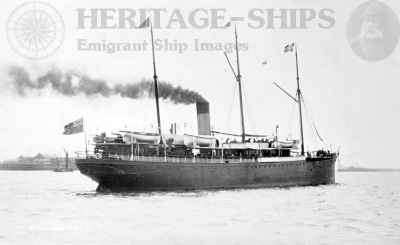
 Picture of the S/S Angelo [From The Illustrated London News, 1874] Support Norway Heritage: Purchase a copy |
|
Along with the picture there was also an article with a description of the ship. The article is also printed in the book "The Wilson Line of Hull, 1831-1981" by Arthur G.Credland & M. Thompson. (The text has been shortened)
" - She has been built under special survey, and is classed 20 years in the London register. Her lines are very fine. The accommodation for passengers is superior to that of most vessels a float. The dining room is
entirely separate from the dormitories and there is a magnificent drawing room apart from the
staterooms or the dining saloon. The vessel is pooped for fully three parts of her entire length,
and there is a top gallant forecastle 35ft long. The bulwarks between the forecastle and the
poop are about 7ft high. At the aft and is a teak-built deckhouse which is a smoking room,
reading room or lounge, for the use of passengers. The house is fitted up in mahogany and
upholstered in green leather.
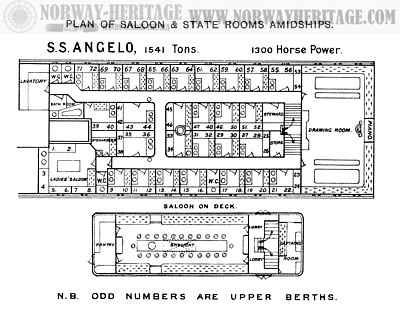 Angelo, Wilson Line steamship cabin plan
Support Norway Heritage: Purchase a copy
Next comes a huge iron galley with ventilation roof. The galley is divided by a partition. One
side is for cooking for first class passengers, the other for emigrants who are brought to Hull
on their way to America.
Amidships is a substantial teak-built house, which rests upon iron coamings. This is the dining
saloon 43ft long and 15ft wide. The roof of the dining-room is a promenade for the first class
passengers; all round it are seats for their accommodation. The saloon within is a luxuriously
fitted apartment. The cabinet work is of polished mahogany, and the sofas and settees are
upholstered in crimson velvet. The floor is covered with a rich oilcloth, on which hansom
Brussels carpet-runners are laid. The sides of the saloon are paneled in maple, with wainscot
frames and rosewood mouldings. In the center of each frame an ebony pilaster springs from the
top of the sofa.
The pilasters terminate in richly carved and gilded capitals, and support a cornice in white and
gold. At the after and of the saloon is a pantry. The drawing room may be entered from either
side of the vessel. This room is 18ft wide and occupies the forepart of the poop. It is not less
magnificently fitted. The style of the woodwork is in keeping with that of the dining saloon but
the upholstery is green velvet, which offers a fine contrast of color with the gilded carved
work. The sofas are fixed across each end and the front side of the place reserved for a
Broadwood piano. The floor is covered with a velvet pile carpet, of rich pink and blue pattern.
Altogether the drawing room is most elegant and affords a degree of comfort and convenience
rarely attained on board ship. The staterooms most of which are double berth afford accommodation
to 74 passengers. There is a saloon for the exclusive use of lady passengers, and connecting with
the stewardesses berth.
Outwardly as well as inwardly the Angelo presents a handsome appearance. She is rigged with three
pole masts, and with fore and aft canvas. The fore and main masts are iron and mizzenmast of
wood. The whole of the standing rigging is of wire rope. The sails consist of fore, main and
mizzen topsails, stay foresail and jib and mizzen stay sails. Fore the shipping and discharging
of cargo, three stern winches have been provided. The anchor is weighed by Harfield patent steam
windlass which works with its own engine by steam supplied from the main boilers. The Angelo is
propelled by a pair of compound surface condensing engines of 300 horse power, nominal, each are
expected to develop 1400 indicated horse power. The high pressure cylinder is 41in in diameter,
and the low pressure 72in with a 42in stroke. The engines are driven with two double-ended
boilers, carrying a working pressure of 800lb to the square inch. The vessel can attain a speed
of 12 knots"
The Angelo was placed on the Scandinavian feeder service the same year she was launched. Her first call at Christiania was in August 1874. She left Christiania for Hull via Christiansand on August 21st. Then for the rest of 1874 she was maintaining the Christiania Hull service together with the S/S Hero. The Wilson Line had weekly service from Christiania, departing every Friday, and arriving at Hull Sunday evening or Monday morning.
In 1875 the S/S Angelo departed Christiania on Friday, July 2nd. at 5 p.m. and arrived Hull Sunday at 6½ p.m. This was a record-breaking journey over the North Sea. On the way to Hull the Angelo called at Christiansand and stayed there for four hours. In the spring of 1884 the Angelo ran aground on the small island of Bastø in the Christianiafjord (Oslofjord) while on her return voyage from Hull to Christiania. She was successfully towed off on March 19. The S/S Orlando and the S/S Marsdin replaced her on the route while she was in dock for repairs.
The Angelo was steady on in the Christiania service until 1905, when she was released by the S/S Salmo. On November 10th 1905 the Angelo departed from Christiania with emigrants for the last time. She had them done more than 700 voyages between Christiania and Hull, conveying the emigrants on their first stage on their way to America. In February 1906 she was sold to White & White
for scrapping.

S/S Angelo at Christiania
Support Norway Heritage: Purchase a copy |
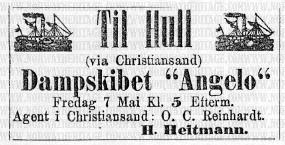
The picture is from an old stereo view card. It shows emigrants boarding the S/S Angelo at the pier in Christiania. The picture is probably taken some time between 1900 and 1906, probably by photographer Anders B. Wilse. The announcement below is from Morgenbladet in 1875
|
Wilson Line image gallery
|
Topics related to this ship in the NorwayHeritage community forums:
- Angelo 1903
ANGEL
|
|
|
|